
Denver vs Dallas — Tenant Improvement Glazing & Commercial Glass Markets
Denver vs Dallas — Tenant Improvement Glazing, Commercial Glass Contractors & Office Build Out Markets
Denver and Dallas are both major commercial glazing and tenant improvement markets, but they create demand for glass in noticeably different ways.
Denver’s opportunity is increasingly tied to repositioning existing buildings, flight-to-quality office renovations, selective Class A development, adaptive reuse, and modernization of older commercial spaces. Dallas operates at a substantially larger development and corporate scale, with office relocations, headquarters projects, massive industrial growth, mixed-use development, retail expansion, and high-volume tenant finish-out activity.
For commercial glass contractors, tenant improvement contractors, general contractors, developers, property managers, and building owners, this makes Denver vs. Dallas an especially useful comparison.
The same basic glazing products appear in both markets:
Storefront → Entrances → Office Glass → Conference Rooms → Interior Partitions → Specialty Glazing
But the economic reasons behind those projects can be very different.
Denver vs Dallas Commercial TI Glazing at a Glance
| Tenant Improvement Factor | Denver | Dallas |
|---|---|---|
| Office repositioning | Very strong opportunity | Strong opportunity |
| Corporate office build outs | Strong | Extremely strong |
| Interior office glass | High-value market | High-volume + high-value |
| Industrial TI glazing | Strong | Exceptional |
| Storefront renovations | Strong | Very strong |
| New commercial development | Selective | Much larger scale |
| Adaptive reuse | Important | Important |
| Flight to quality | Major driver | Major driver |
| Warehouse office build outs | Growing | Massive addressable market |
| High-end architectural glazing | Concentrated submarkets | Numerous major submarkets |
The difference isn’t that one city “needs glass” and the other doesn’t.
It’s where the glass opportunity originates.
Denver Tenant Improvement Glazing: Modernizing the Existing Building
Denver’s current office conditions make renovation particularly interesting.
CBRE reported positive metro Denver office absorption of 179,000 square feet in Q2 2026, while leasing reached 1.7 million square feet—the strongest quarterly leasing total since Q1 2022. At the same time, vacancy remained high at 28.7%.
That combination can create an attractive environment for TI contractors.
There is a lot of existing space competing for tenants.
And tenants increasingly have the ability to ask:
“Why should we choose this building?”
Commercial glass can become part of the answer.
Denver’s Flight-to-Quality Glass Opportunity
Denver tenants continue to favor newer, more modern, better-amenitized buildings. Cushman & Wakefield specifically identifies the continuing flight-to-quality trend, with tenants prioritizing flexibility, efficiency and higher-quality occupancy.
That creates pressure on older buildings.
A landlord may not be able to move the property.
But ownership can change:
- The entrance
- Lobby glazing
- Vacant suites
- Conference rooms
- Interior office fronts
- Storefront systems
- Failed insulated glass
- Amenity spaces
This turns commercial glass into part of the building repositioning strategy.
Dallas Tenant Improvement Glazing: Scale Changes the Equation
Dallas has the same modernization opportunities—but layered onto a much larger growth engine.
CBRE’s 2026 outlook expects strong DFW tenant demand, suburban office spillover and limited availability in prime and Class A buildings. It also expects lower interest rates to encourage new construction and capital improvements.
Dallas also started 2026 with major tenants moving into and expanding within the market. JLL reported 332,300 square feet of positive Q1 office absorption, with 1.57 million square feet under development and 83.3% of that pipeline preleased.
For glazing contractors, that can translate into a different type of opportunity:
More Buildings + More Tenants + More Relocations + More Expansion + More Finish-Outs
Denver Office Glass vs Dallas Office Glass
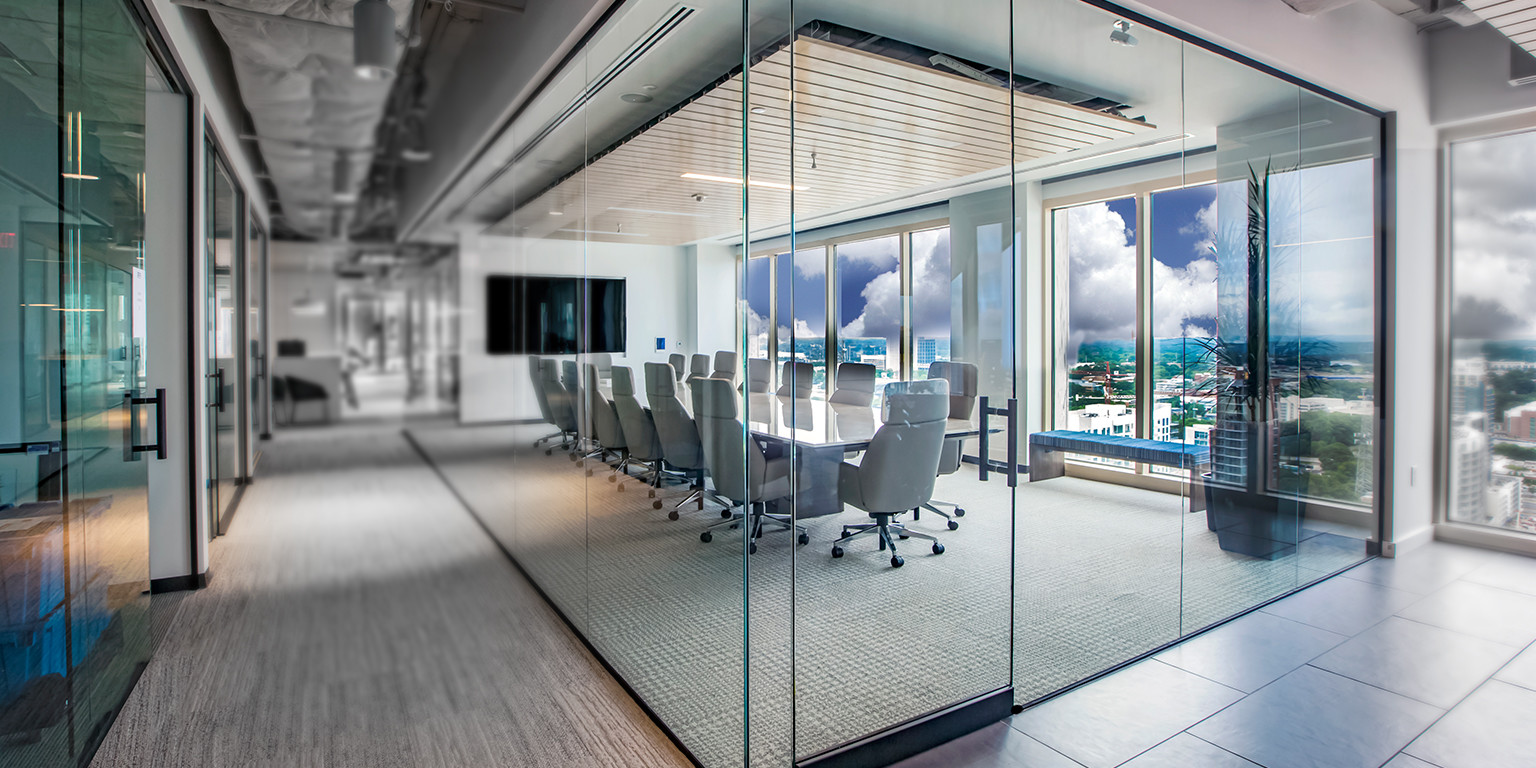
Both markets support interior architectural glazing.
Typical applications include:
- Glass office fronts
- Conference rooms
- Executive offices
- Huddle rooms
- Training rooms
- Reception glazing
- Glass doors
- Sidelites
- Interior entrances
But the strategic emphasis can differ.
Denver
Glass can help an existing building compete with newer buildings.
Dallas
Glass can help a new or existing building capture rapidly moving corporate demand.
That distinction is subtle but important.
The Denver TI Question
A Denver property owner may be asking:
“How do we make this 25-year-old office property competitive again?”
Commercial glazing might support:
Existing Building → New Lobby → New Entrance → Spec Suites → Glass Offices → Amenity Improvements → Leasing
The glass is helping reposition the asset.
The Dallas TI Question
A Dallas owner or tenant may instead be asking:
“How quickly can we build this space and get 150 employees into it?”
That creates:
Lease → Design → TI Construction → Interior Glass → Doors & Hardware → Punch → Occupancy
The emphasis moves toward scale, coordination, fabrication, scheduling and repeatability.
Denver vs Dallas Conference Room Glass
Conference rooms are important in both cities.
A complete glazing package can involve:
Fixed Glass + Door + Framing + Hardware + Privacy + Acoustics
But higher-end office environments increasingly expect the glass to do more than look contemporary.
Tenants may want:
- ✓ Transparency
- ✓ Daylight
- ✓ Acoustic separation
- ✓ Privacy
- ✓ Integrated access control
- ✓ Architectural consistency
That creates opportunities for glazing contractors capable of discussing complete interior systems rather than simply quoting square footage of tempered glass.

Denver vs Dallas Storefront Tenant Improvements
Storefront TI work is another strong category in both markets.
The existing commercial storefront should be evaluated for:
- Aluminum framing
- Insulated glass
- Entrance doors
- Hardware
- Weather seals
- Perimeter sealants
- Accessibility
- Security
- Architectural appearance
A major tenant improvement does not automatically require a completely new storefront.
The better sequence is:
Inspect → Repair → Reuse → Reconfigure → Replace When Necessary
Dallas Has the Industrial TI Advantage
This is where the comparison becomes much less balanced.
DFW is an enormous industrial market.
Cushman & Wakefield reported DFW industrial vacancy at 8.1% in Q2 2026, with 29.8 million square feet under construction. Warehouse/distribution vacancy had fallen 140 basis points year-over-year.
That creates a tremendous secondary commercial-glass market.
Warehouses aren’t just boxes.
They contain:
- Corporate offices
- Reception areas
- Employee entrances
- Conference rooms
- Training centers
- Operations offices
- Interior observation glass
- Exterior storefront systems
Every large industrial lease can potentially create another tenant improvement project.
Warehouse Office Build Outs
This deserves its own commercial-glass category.
A distribution center might contain 500,000 square feet of warehouse space but only 20,000 square feet of offices.
For the glazing contractor, those 20,000 square feet may be where much of the architectural work occurs.
The TI package could include:
Exterior Entrance → Reception → Office Storefront → Conference Rooms → Glass Offices → Operations Viewing Areas
Dallas provides extraordinary scale for this type of work.
Denver Industrial Tenant Improvements
Denver’s industrial opportunity is smaller but still meaningful.
Cushman & Wakefield reported more than 2.9 million square feet of industrial leases during Q1 2026, up 27.9% year-over-year, with especially strong activity in small- and mid-sized spaces.
That creates a somewhat different glazing opportunity.
Rather than concentrating only on enormous distribution facilities, Denver glazing contractors can target:
- Flex buildings
- Shallow-bay industrial
- Manufacturing
- Service businesses
- Warehouse offices
- Showroom conversions
- Industrial-to-office combinations
These projects can produce smaller but potentially more frequent TI scopes.
Denver’s Repositioning Advantage
Denver’s elevated office vacancy creates a challenge for owners—but an opportunity for contractors.
Downtown vacancy remained 38.6% in Q2 2026, despite recording its first quarterly vacancy decline since Q3 2024. CBRE also reports that proposed conversions are moving forward while Class A demand improves.
That creates a strong narrative around:
Obsolete Building → Capital Improvements → Repositioning → Tenant Improvements → New Occupancy
Commercial glass can participate at almost every step.
Dallas’ Expansion Advantage
Dallas is more naturally positioned around expansion.
CBRE expects strong tenant demand, continued industrial investment, manufacturing-driven logistics demand, data-center growth and additional mixed-use development.
That broadens the glazing opportunity beyond conventional offices.
Dallas TI glass contractors can potentially pursue:
Office + Industrial + Data Infrastructure + Retail + Restaurant + Mixed Use + Medical + Corporate Campus
Few U.S. markets provide that combination at DFW’s scale.
Cherry Creek vs Uptown Dallas
The comparison becomes even more interesting at the premium end.
In Denver, new office construction is heavily concentrated around Cherry Creek. CBRE reported Denver’s office construction pipeline at 708,000 square feet in Q2, after two additional Cherry Creek projects broke ground.
Dallas spreads premium commercial demand across several significant submarkets.
Cushman & Wakefield specifically identifies Uptown/Turtle Creek, Preston Center and Legacy/Frisco among the high-cost Class A locations where tightening top-tier availability was becoming important in early 2026.
That creates two very different premium glazing landscapes.
Denver: concentrated pockets of extremely high-value construction.
Dallas: numerous high-value nodes distributed across a huge metroplex.
Existing Glass Reuse: Denver vs Dallas
Both markets have enormous amounts of second-generation tenant space.
That creates one of the most overlooked TI opportunities:
Reuse the previous tenant’s glass.
Before demolition, the glazing contractor can inventory:
- Glass office fronts
- Conference rooms
- Glass doors
- Sidelites
- Interior storefront
- Mirrors
- Exterior glazing
Tempered glass generally cannot simply be field-cut into completely different dimensions.
But new openings can sometimes be designed around existing panel dimensions.
For large office projects, that can turn demolition waste into a value-engineering opportunity.
Glass Contractors Should Be Involved Before Demolition
This changes the conventional sequence.
Instead of:
Demolition → Framing → Call Glass Contractor
consider:
Glass Survey → Demolition Plan → TI Design → Reuse Decisions → New Glass Package
That can be valuable in both Denver and Dallas.
It becomes particularly useful when tenants inherit high-end conference rooms and office-front systems from previous occupants.
Commercial Glass and TI Allowances
Both markets also have conditions where landlords may use tenant-improvement economics to compete for occupancy.
In Dallas, Cushman & Wakefield reported that concessions—including free rent and tenant-improvement allowances—continued to favor tenants in portions of the office market, even while top-tier availability was tightening.
Denver similarly remains a market where high vacancy and competition between existing buildings can create significant pressure to improve spaces.
That means commercial glazing isn’t competing only against other glass.
It’s competing for a portion of the TI budget.
Where Should the TI Budget Go?
Consider a $750,000 office renovation.
The owner and tenant may be deciding between:
- Flooring
- Lighting
- Ceilings
- Millwork
- Furniture
- Technology
- Amenities
- Glass
The glazing contractor needs to communicate why certain glass improvements matter.
For example:
Perimeter Office Glass
Helps daylight reach interior work areas.
Conference Room Glass
Creates visual openness while defining meeting spaces.
Entrance Glass
Changes the arrival experience.
Storefront Modernization
Improves exterior perception.
This makes glazing part of the business case for the TI.
Denver vs Dallas Commercial Glass Value Engineering
The approach should also differ slightly by market.
Denver Value Engineering
Prioritize:
Reuse + Retrofit + Reposition
Look carefully at what the existing building already has.
Dallas Value Engineering
Prioritize:
Standardize + Repeat + Scale
For larger portfolios and corporate build outs, repeatable glazing details can improve procurement and scheduling.
Both approaches can reduce unnecessary cost.
Multi-Location Tenant Improvement Programs
Dallas has a particular advantage for companies expanding across Texas and the South.
A corporate client may be developing offices or commercial locations in:
Dallas → Fort Worth → Austin → Houston → San Antonio
Standardized glass specifications can travel with them.
Denver can play a similar role across the Mountain West:
Denver → Colorado Springs → Fort Collins → Salt Lake City → Albuquerque
That creates an entirely different opportunity for commercial glazing contractors.
Instead of winning one project, the contractor relationship can become part of a regional TI program.
Denver vs Dallas Commercial Glazing Contractor Opportunity
From a pure market perspective, Dallas wins on scale.
DFW’s combination of corporate growth, industrial construction, suburban expansion, manufacturing, logistics and mixed-use development creates an enormous addressable market. Its industrial sector alone has tens of millions of square feet under construction.
But Denver has a particularly compelling repositioning and modernization opportunity.
High office vacancy, improving leasing, limited new prime supply and persistent flight-to-quality pressure mean existing buildings have strong incentives to become more competitive.
For glazing contractors, those produce different positioning strategies:
Dallas: “We can execute and scale your commercial TI glazing program.”
Denver: “We can help modernize and reposition the glass systems you already own.”
Denver vs Dallas: Two Different Commercial Glass Machines
Dallas is the larger machine.
Denver may be the more interesting retrofit laboratory.
Dallas generates opportunities through:
Growth → Leasing → Construction → Expansion → Tenant Improvements
Denver increasingly generates opportunities through:
Competition → Repositioning → Modernization → Tenant Improvements → Leasing
Both eventually reach the commercial glazing contractor.
But understanding the difference can change what services are emphasized.
Dallas Commercial Glass Focus
Office tenant finish-outs, industrial office build outs, corporate expansions, storefront programs, entrances, interior glass, portfolio work and large-scale repeatable glazing.
Denver Commercial Glass Focus
Office modernization, existing-glass reuse, storefront retrofit, building repositioning, spec-suite glazing, amenity renovations, entrance upgrades and high-end interior office glass.
The Bigger Opportunity: Connecting Denver and Dallas
For a commercial glazing contractor or TI network, Denver and Dallas should not necessarily be viewed as competing markets.
They can represent two sides of a broader commercial construction strategy.
Denver teaches the retrofit and repositioning model.
Dallas provides the scale and expansion model.
Together they create a powerful commercial glass footprint:
Existing Building Modernization + New Tenant Construction + Office Build Outs + Industrial TI + Storefront Renovations + Commercial Entrances + Interior Architectural Glass
For property owners, developers, general contractors, facility managers and tenant improvement contractors operating across multiple states, that combination can be particularly valuable.
Because whether the project involves repositioning a Denver office building or completing a massive Dallas corporate or industrial build out, the glazing contractor ultimately faces the same challenge:
Understand what already exists → Determine what should remain → Design the new glazing around the tenant → Coordinate fabrication early → Install without becoming the final obstacle to occupancy.
That is where commercial glass becomes part of the tenant improvement strategy rather than simply another subcontractor package.