
Denver vs Salt Lake City — Commercial Glass & Tenant Improvement Glazing
Denver vs Salt Lake City — Commercial Glass, Tenant Improvement Glazing & Office Build Out Markets
Denver and Salt Lake City are two of the most important commercial construction markets in the Mountain West, but they create tenant improvement glazing opportunities for different reasons.
Denver has the larger inventory of mature commercial buildings and a much more pronounced repositioning problem. High office vacancy, aging buildings, conversions, flight-to-quality leasing, and competition between existing properties create demand for modernization.
Salt Lake City is a tighter, more geographically connected market where existing-space absorption, corporate growth, industrial development, office modernization, and the broader Wasatch Front economy create a different type of TI opportunity.
For commercial glazing contractors, general contractors, property owners, developers, facility managers, and tenant improvement contractors, the comparison can be simplified:
Denver = Reposition + Renovate + Compete
Salt Lake City = Absorb + Improve + Expand
Denver vs Salt Lake City Commercial TI Glazing
| Commercial Glass Opportunity | Denver | Salt Lake City |
|---|---|---|
| Office repositioning | Exceptional | Strong |
| Existing office renovation | Exceptional | Very strong |
| Interior office glass | Very strong | Very strong |
| Spec-suite glazing | Major opportunity | Growing opportunity |
| Storefront modernization | Very strong | Strong |
| Industrial TI glazing | Very strong | Very strong |
| Warehouse office build outs | Strong | Exceptional regional opportunity |
| Adaptive reuse | Major driver | Growing |
| Existing glass reuse | High potential | High potential |
| New office construction | Selective | Currently extremely limited |
| Regional reach | Front Range | Wasatch Front |
| Commercial entrance upgrades | Strong | Strong |
The same glass systems appear in both cities.
The economic reason for installing them is often different.
Denver Commercial Glass: The Repositioning Market
Denver’s existing office inventory creates an enormous modernization opportunity.
Metro office vacancy was still 28.7% in Q2 2026 despite improving leasing and positive absorption. Downtown vacancy remained 38.6%. At the same time, leasing strengthened, obsolete buildings continued moving toward conversions, and demand remained concentrated in higher-quality properties.
That creates a direct challenge for older buildings:
How do we compete for the tenants who are actually signing leases?
Commercial glass can become part of that answer.

The Denver Glass Repositioning Package
An older office property may not require an entirely new façade.
Ownership might instead modernize the tenant experience through:
- Main entrance glass
- Lobby glazing
- Storefront systems
- Failed insulated glass replacement
- Spec-suite glass
- Conference rooms
- Interior office fronts
- Amenity-space glazing
- Glass doors
- Access-controlled entrances
The strategy becomes:
Exterior → Entrance → Lobby → Available Suite → Tenant Experience
Commercial glass appears repeatedly throughout that sequence.
Salt Lake City’s TI Story Is Different
Salt Lake City has substantially healthier office fundamentals.
The Salt Lake City–Provo market recorded 295,000 square feet of positive office absorption in Q2 2026, extending occupancy growth to seven consecutive quarters. Vacancy fell to 22.6%, its lowest level in more than three years.
Even more interesting for tenant improvement contractors: there were no office projects under construction for the second consecutive quarter.
That changes the opportunity.
If tenants need space and very little new office inventory is being built, more activity has to occur within the buildings that already exist.
And that means:
Existing Space → New Tenant → New TI → New Glass
Salt Lake City May Be an Underestimated Renovation Market
This is where Salt Lake City’s commercial glass opportunity gets interesting.
The absence of new office construction does not necessarily mean an absence of construction opportunities.
It can mean the opposite for TI contractors.
Existing buildings need to absorb demand.
CBRE reported 603,000 square feet of office inventory removals over the prior 12 months compared with just one 120,000-square-foot delivery.
Tenants therefore have fewer brand-new options.
Existing buildings need to be made competitive.
Denver Has More Distressed Inventory
Denver’s opportunity is more aggressive.
Downtown alone still had 38.6% vacancy in Q2. However, Class A conditions were improving, obsolete space was moving toward conversion, and the market continued showing a flight-to-quality pattern.
That creates an environment where owners may have to make a decision:
Invest → Reposition → Convert → Sell
For the buildings remaining office properties, doing nothing becomes increasingly difficult.
That’s a powerful environment for commercial renovation.
Salt Lake City Has a Scarcity Argument
Salt Lake City’s argument is almost the reverse.
With no office projects under construction in Q2, improving occupancy, and shrinking vacancy, existing buildings can become increasingly important to companies looking for space.
That supports:
- ✓ Second-generation office renovations
- ✓ Tenant build outs
- ✓ Suite combinations
- ✓ Office reconfigurations
- ✓ Interior glass
- ✓ Entrance modernization
- ✓ Spec suites
- ✓ Building amenity improvements
The landlord isn’t necessarily trying to rescue a distressed building.
Ownership may simply be trying to capture increasing demand.
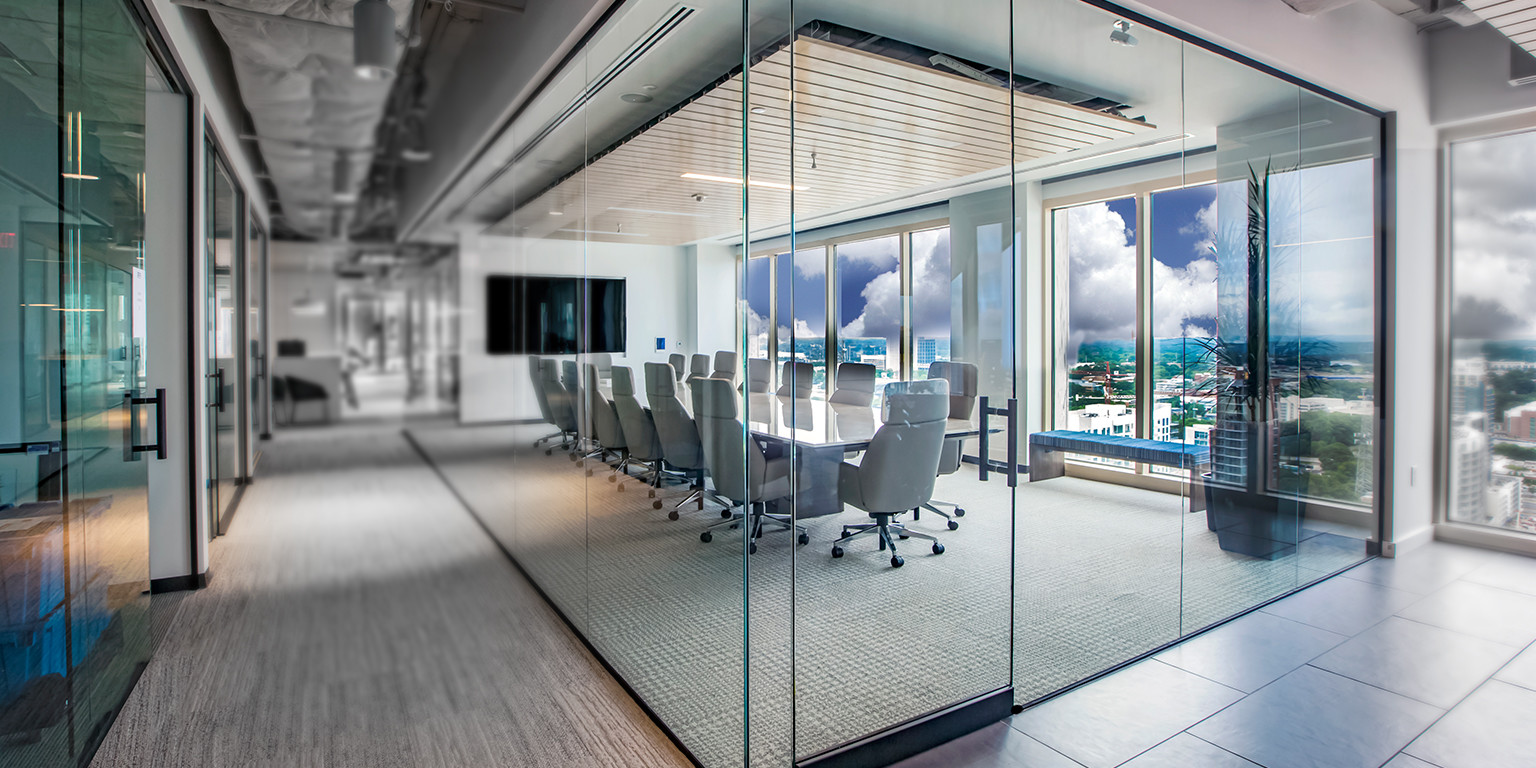
Denver vs Salt Lake City Office Glass
Interior glass is particularly relevant in both markets.
Applications include:
- Conference rooms
- Executive offices
- Private offices
- Huddle rooms
- Reception areas
- Training rooms
- Collaboration spaces
- Glass doors
- Sidelites
The architectural objective is often similar:
Exterior Daylight → Glass Perimeter Offices → Interior Workspace
But the business objective can differ.
Denver
Modernize an existing office so it can compete with higher-quality properties.
Salt Lake City
Modernize existing space because tenants have limited access to brand-new office inventory.
Same glass.
Different investment thesis.
Point of the Mountain Changes the Salt Lake City Story
Salt Lake City also shouldn’t be treated as only the downtown core.
The broader Wasatch Front creates a much more interesting commercial corridor.
Point of the Mountain recorded positive absorption of roughly 193,000 square feet in Q1 2026, direct vacancy of 11.8%, and no office projects under construction.
That creates an attractive environment for tenant improvements in existing buildings.
The commercial glass opportunity can follow:
Salt Lake City → Sandy → Draper → Lehi
rather than being concentrated entirely inside one downtown district.
Denver Has Its Own Corridor Strategy
Denver works similarly but across a broader geography.
The opportunity can extend through:
Downtown → Cherry Creek → Denver Tech Center → Centennial → Boulder Corridor
That gives a commercial glazing contractor multiple distinct TI environments.
Cherry Creek, for example, is currently one of the few areas adding meaningful new office supply. Denver’s Q2 construction pipeline increased to 708,000 square feet after two additional Cherry Creek projects started construction.
Denver therefore contains both sides of the market:
Older Building Repositioning + Premium New Construction
That’s valuable for a glazing contractor capable of serving both.
Denver vs Salt Lake City Storefront TI Glazing
Ground-floor tenant improvements create another parallel opportunity.
Both markets contain:
- Restaurants
- Retail
- Medical offices
- Fitness centers
- Banks
- Mixed-use buildings
- Ground-floor offices
These projects frequently inherit existing aluminum storefront.
The glazing contractor should evaluate:
Framing → Glass → Entrance → Hardware → Weather Seals → Accessibility → Security
before complete replacement is specified.
Storefront Repair vs Replacement
The decision should not automatically be tied to the size of the interior renovation.
A $750,000 tenant improvement may still have a perfectly usable storefront.
Selective modernization might involve:
- IGU replacement
- Broken glass replacement
- Entrance repairs
- New closers
- Hardware
- Weather seals
- Perimeter sealants
- Privacy or branding film
Complete replacement becomes more appropriate when the system itself no longer supports the new tenant.
Denver’s Climate vs Salt Lake City’s Climate
Both markets expose exterior glazing to demanding Mountain West conditions.
Commercial storefronts and entrances may encounter:
Sun + Temperature Swings + Wind + Snow + Freeze Conditions
That makes exterior glazing fundamentally different from interior TI glass.
A GC value-engineering an interior conference-room partition is making a different decision from one reducing the performance of the exterior storefront.
Exterior systems remain part of the building envelope.
The Industrial Comparison Is Particularly Interesting
Neither market should be viewed only through office construction.
Denver’s industrial market recorded 1.07 million square feet of Q1 2026 net absorption, 4.46 million square feet of leasing activity and 3.1 million square feet under construction.
Salt Lake City also has an enormous industrial base. CBRE reported 2.8 million square feet of net absorption during the first half of 2026, while vacancy declined to 7.2%.
For commercial glass contractors, those numbers matter because warehouses contain offices.
Industrial Tenant Improvement Glass
A modern warehouse may include:
Employee Entrance → Reception → Administrative Offices → Conference Rooms → Training Areas → Operations Offices → Warehouse
Glass can appear throughout those areas.
Typical applications include:
- Exterior storefront
- Employee entrances
- Interior office storefront
- Conference rooms
- Glass offices
- Observation windows
- Safety glazing
That makes industrial construction an indirect driver of commercial glazing demand.
Salt Lake City’s Distribution Advantage
Salt Lake City’s geography gives its industrial market particular strategic importance.
The Wasatch Front functions as a major western distribution and logistics corridor, and industrial activity remains heavily concentrated around the northwest portion of the market. CBRE reported that development has moderated from previous peaks while tenant demand and absorption have strengthened.
That creates TI opportunities inside:
- Distribution centers
- Logistics facilities
- Manufacturing properties
- Flex buildings
- Corporate industrial campuses
- Warehouse offices
For glazing contractors, the warehouse office can sometimes be more interesting than the warehouse itself.
Denver’s Industrial Advantage
Denver has greater geographic breadth across the Front Range.
Industrial demand can generate projects involving:
- Denver
- Aurora
- Commerce City
- Thornton
- Centennial
- Broomfield
- Boulder-area corridors
Colliers reported Denver’s Q1 industrial leasing volume at its highest quarterly level since Q3 2021.
That creates a large addressable market for industrial tenant improvements alongside traditional office work.
Denver vs Salt Lake City Existing Glass Reuse
Both markets contain enormous quantities of second-generation commercial space.
That creates an overlooked opportunity:
Existing glass reuse.
Before demolition, a glazing contractor can document:
- Conference rooms
- Glass office fronts
- Doors
- Sidelites
- Interior storefront
- Mirrors
- Exterior glazing
Tempered glass generally cannot simply be cut into a completely different dimension after fabrication.
But that doesn’t make it worthless.
Design the New TI Around Selective Glass Reuse
Consider a tenant inheriting 20 glass offices and five conference rooms.
The conventional process might be:
Demolish Everything → Build New → Buy New Glass
A more strategic process is:
Inventory → Measure → Design → Identify Reusable Openings → Demolish Selectively → Fabricate What’s Missing
Perhaps only 25% of the glass is reusable.
That can still represent meaningful value.
This strategy makes particular sense for landlords repeatedly turning second-generation office suites.
Denver vs Salt Lake City Spec-Suite Glazing
Spec suites could become especially important in both markets.
Denver owners need spaces capable of standing out in a high-vacancy environment.
Salt Lake City owners may want spaces capable of capturing tenants quickly as vacancy tightens and new construction remains extremely limited.
Glass can make a speculative suite feel finished through:
- ✓ Conference rooms
- ✓ Office fronts
- ✓ Reception glass
- ✓ Glass doors
- ✓ Privacy film
- ✓ Collaboration rooms
A tenant can tour the space and immediately understand how it works.
Commercial Glass and Building Repositioning
Denver arguably wins this category.
Its high vacancy and large amount of obsolete inventory create a much stronger pressure to fundamentally rethink older properties.
The sequence can become:
Old Office → Repositioning → Lobby → Amenities → Spec Suites → New Entrances → New Tenant Improvements
Commercial glass can participate throughout.
Salt Lake City’s repositioning market exists too, but improving occupancy means the argument can be more about capturing demand than rescuing obsolete space.
Commercial Entrance Modernization
Entrances deserve attention in both markets.
A TI project may involve:
- Aluminum doors
- All-glass doors
- Automatic operators
- Sidelites
- Transoms
- Closers
- Panic hardware
- Electric strikes
- Card readers
This requires coordination between:
Glazing Contractor → GC → Hardware → Electrical → Security
Those decisions should occur before fabrication.
Denver vs Salt Lake City Commercial Glass Value Engineering
This is another place where market conditions suggest slightly different strategies.
Denver
Think:
Reuse → Retrofit → Reposition
Preserve usable systems and concentrate capital where improvements change leasing perception.
Salt Lake City
Think:
Reuse → Standardize → Expand
Create repeatable systems that can support multiple suites and properties as tenants absorb existing inventory.
Neither approach means “use cheaper glass.”
It means allocate the glazing budget more intelligently.
A Mountain West Multi-Market Glazing Strategy
The more interesting opportunity is connecting the two markets.
Denver can anchor the eastern side of a Mountain West commercial construction network:
Fort Collins → Denver → Colorado Springs
Salt Lake City can anchor another corridor:
Salt Lake City → Sandy → Draper → Lehi → Provo
Then the broader network begins connecting:
Colorado → Utah → New Mexico → Idaho → Nevada
For tenant improvement contractors and commercial glazing companies, this creates something much larger than two city pages.
It creates a regional commercial construction story.
Which Market Is Better for Commercial TI Glass?
There isn’t one winner across every category.
Denver wins for commercial building repositioning.
Its high vacancy and large existing office inventory create stronger pressure for landlords to modernize buildings.
Salt Lake City may win for existing-space TI momentum.
Office occupancy has now grown for seven consecutive quarters while new office construction has effectively stopped.
Both are strong industrial markets.
Denver entered 2026 with more than 3 million square feet under construction, while Salt Lake City has recently produced strong absorption as its earlier development wave is absorbed.
And both markets create substantial opportunities for interior office glass, storefront modernization, commercial entrances, warehouse office build outs, and existing-glass reuse.
Denver vs Salt Lake City: Two Different TI Glass Engines
The strongest distinction is ultimately this:
Denver
Vacancy → Competition → Repositioning → Renovation → Tenant Improvement → Commercial Glass
Salt Lake City
Tenant Demand → Existing Inventory → Leasing → Tenant Improvement → Expansion → Commercial Glass
Denver’s commercial glass opportunity is heavily influenced by the need to make older buildings competitive again.
Salt Lake City’s opportunity increasingly comes from putting existing buildings to work as the market absorbs space without a meaningful new office pipeline.
For commercial glazing contractors, property owners, developers, general contractors, and TI contractors operating across the Mountain West, those markets complement one another extremely well.
Denver provides the repositioning laboratory.
Salt Lake City provides the tightening existing-space market.
Together, they support a broader commercial glazing strategy built around office build outs, storefront renovations, commercial entrances, interior architectural glass, industrial tenant improvements, spec suites, adaptive reuse, and building modernization—exactly the types of projects where bringing the glazing contractor into the process before demolition can create the most value.