
Colorado Springs vs Fort Collins — Tenant Improvement Glazing & Office Buildout Contractors
Colorado Springs vs Fort Collins — Tenant Improvement Glazing, Office Buildout Contractors & Commercial Glass
Colorado Springs and Fort Collins represent two of Colorado’s strongest secondary commercial markets outside Denver, but their tenant improvement and commercial glazing opportunities come from different economic environments.
Colorado Springs combines defense, aerospace, healthcare, technology, professional offices, hospitality, retail, and a growing industrial base. Fort Collins and Northern Colorado lean heavily into technology, advanced manufacturing, research, healthcare, education, bioscience, industrial development, and expanding professional services.
For commercial glazing contractors, office buildout contractors, developers, property managers, facility managers, architects, and general contractors, that creates two different TI environments:
Colorado Springs = Institutional + Corporate + Defense + Healthcare
Fort Collins = Innovation + Manufacturing + Research + Industrial + Professional Office
Yet both markets create demand for the same critical commercial glass systems:
Storefront → Entrances → Office Glass → Conference Rooms → Interior Partitions → Specialty Glazing
Colorado Springs vs Fort Collins Commercial TI Glazing
| Tenant Improvement Opportunity | Colorado Springs | Fort Collins |
|---|---|---|
| Office buildouts | Very strong | Strong |
| Interior office glass | Very strong | Very strong |
| Medical TI | Exceptional | Very strong |
| Defense/aerospace facilities | Exceptional | Limited |
| Research/technology space | Strong | Exceptional |
| Industrial TI | Very strong | Exceptional |
| Warehouse office glass | Strong | Very strong |
| Retail storefront renovation | Very strong | Strong |
| Restaurant buildouts | Very strong | Strong |
| Existing-building modernization | Very strong | Very strong |
| Commercial entrances | Strong | Strong |
| Regional reach | Southern Colorado | Northern Colorado |
The comparison isn’t simply about which city is larger.
It’s about what types of tenants are driving improvements inside the buildings.
Colorado Springs Tenant Improvement Glazing
Colorado Springs supports an unusually diverse commercial construction environment.
Office users coexist with major healthcare systems, military and defense-related organizations, aerospace companies, technology firms, hotels, restaurants, retail centers, medical offices, and industrial facilities.
That diversity creates opportunities for commercial glass contractors across several types of TI construction.
A single glazing company might encounter:
- Corporate office glass
- Medical office partitions
- Commercial storefront
- Entrance systems
- Conference rooms
- Security glazing
- Interior doors
- Mirrors
- Industrial office glass
The project requirements can vary dramatically from one building to another.
Fort Collins Tenant Improvement Glazing
Fort Collins creates a different environment.
Northern Colorado combines commercial office demand with Colorado State University, technology, research, healthcare, advanced manufacturing, breweries, industrial development, and professional services.
That makes the market particularly interesting for projects where office and operational environments overlap.
A facility may contain:
Reception → Corporate Offices → Conference Rooms → Research → Manufacturing → Warehouse
Commercial glass can help connect these environments without making them function as one unrestricted space.
Colorado Springs Office Buildout Contractors
Office tenant improvements in Colorado Springs can range from relatively conventional professional offices to highly specialized corporate environments.
Typical glazing applications include:
- Executive offices
- Private offices
- Conference rooms
- Huddle rooms
- Reception areas
- Training rooms
- Interior entrances
- Collaboration spaces
The commercial glass package may appear late in construction, but many decisions need to occur much earlier.
The GC needs to coordinate framing dimensions, flooring, ceilings, hardware, access control, privacy, and acoustics before glass fabrication begins.
Fort Collins Office Buildout Contractors
Fort Collins office renovations can involve many of the same systems.
But the surrounding tenant mix creates interesting hybrid environments.
A technology, engineering, manufacturing, or research company might require traditional offices alongside laboratory, production, testing, or warehouse areas.
Glass can provide a transition:
Administrative Office → Glass Partition → Technical Environment
That allows visual connection while maintaining separation between different functions.
Interior Office Glass: Colorado Springs vs Fort Collins
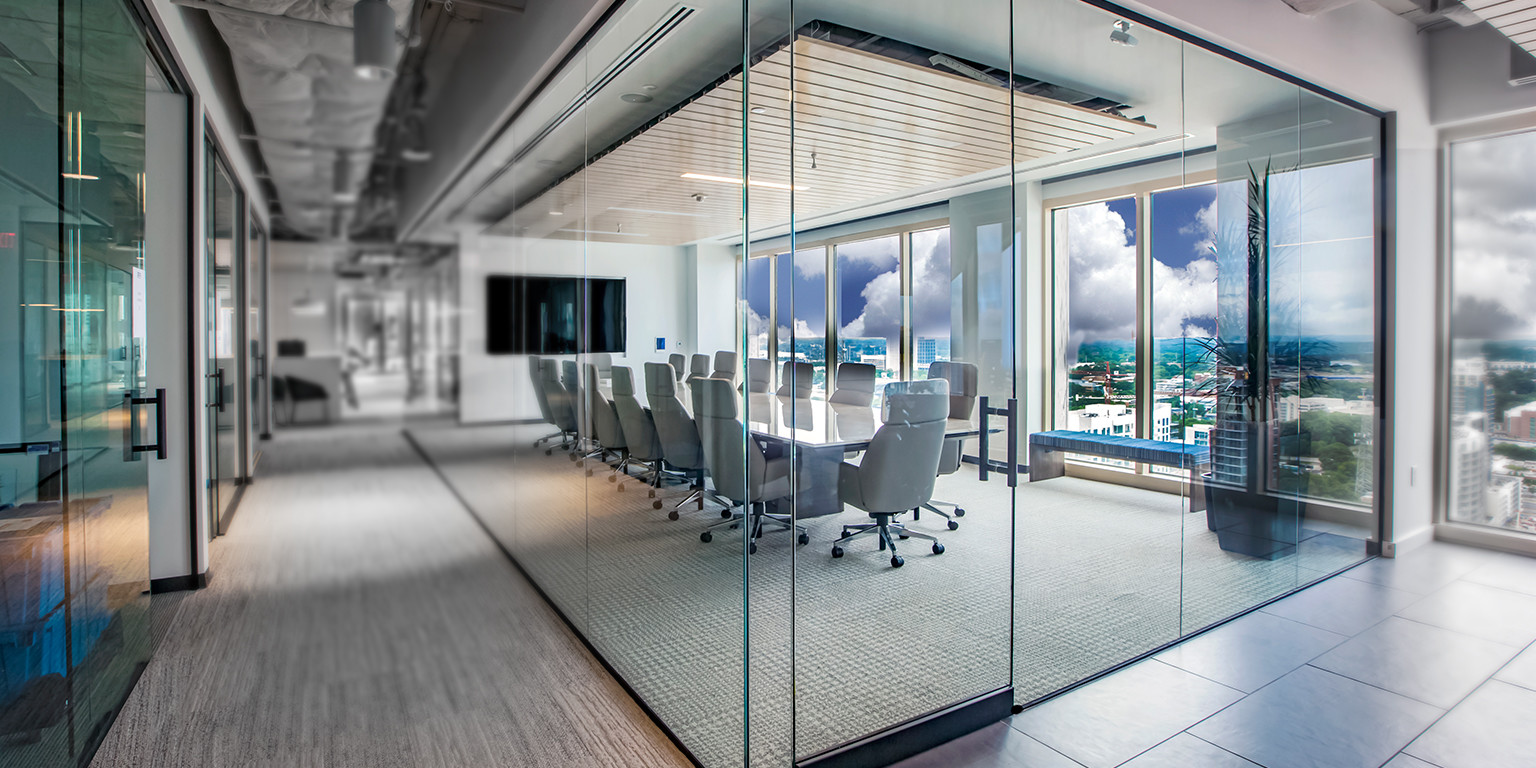
Both markets are strong candidates for interior architectural glazing.
Glass can help move daylight deeper into commercial floor plates.
Instead of:
Exterior Window → Private Office → Opaque Wall → Interior Workspace
the TI can create:
Exterior Window → Private Office → Glass Front → Interior Workspace
That matters in older commercial buildings where perimeter offices may otherwise capture much of the available daylight.
The result can make a second-generation office feel substantially more contemporary without reconstructing the building envelope.
Conference Room Glass
Conference rooms are among the most visible interior glass applications in both cities.
A complete system may include:
Glass + Framing + Door + Hardware + Privacy + Acoustic Strategy
The last element is easy to overlook.
Transparency and acoustic privacy are different requirements.
A conference room can look beautiful while performing poorly if conversations travel through doors, perimeter gaps, ceilings, or surrounding construction.
The glass contractor and TI contractor should understand the tenant’s acoustic expectations before selecting the system.
Existing Glass Before Demolition
Both Colorado Springs and Fort Collins have substantial inventories of second-generation commercial space.
That creates an overlooked TI opportunity:
Evaluate the existing glass before demolishing it.
The previous tenant may have left:
- ✓ Conference rooms
- ✓ Glass offices
- ✓ Glass doors
- ✓ Sidelites
- ✓ Reception glazing
- ✓ Mirrors
- ✓ Interior storefront systems
- ✓ Exterior storefront
Those components represent previous capital investment.
Some may still have value.
Reusing Glass During Office Renovations
Tempered architectural glass generally cannot simply be field-cut into entirely different dimensions after fabrication.
That makes reuse more complicated—but not impossible.
A better process is:
Inventory → Measure → Compare → Redesign Selectively → Reuse → Fabricate What’s Missing
Imagine an incoming tenant inherits 12 glass offices and four conference rooms.
Perhaps only five office fronts and one conference room can realistically be incorporated into the new design.
That can still represent meaningful savings.
The critical point is that the decision has to occur before demolition.
Colorado Springs Medical Tenant Improvement Glass
Colorado Springs has a particularly strong healthcare and medical-office construction environment.
Medical TI glazing may be used around:
- Reception areas
- Administrative offices
- Conference rooms
- Staff spaces
- Interior entrances
- Consultation areas
- Specialty departments
Healthcare projects create an important balance between:
Daylight + Visibility + Privacy + Cleaning + Safety
Clear glass may work perfectly in administrative areas while privacy film or more specialized systems are appropriate elsewhere.
Fort Collins Healthcare & Research Glazing
Fort Collins also has a significant healthcare market, but Northern Colorado adds another interesting dimension through university, research, bioscience, and technology-related activity.
Glass may be used to separate:
- Offices
- Research environments
- Observation areas
- Conference spaces
- Administrative areas
- Technical rooms
The glazing system should be selected according to the actual performance requirements of each space rather than assuming conventional office glass works everywhere.

Colorado Springs Defense & Aerospace TI
This is one of the clearest differences between the markets.
Colorado Springs has substantial defense and aerospace activity.
That can create commercial construction projects where security requirements are considerably more important than in a conventional office.
Potential glazing considerations can include:
- Controlled entrances
- Laminated glass
- Security glazing
- Access-controlled doors
- Interior separation
- Reception security
- Specialized protective systems
The key principle is:
Security Glass ≠ Secure Opening
A complete security assembly may depend on:
Glass + Framing + Anchoring + Doors + Hardware + Adjacent Construction
The performance objective needs to be established before products are selected.
Fort Collins Technology & Advanced Manufacturing TI
Fort Collins has a different specialty opportunity.
Technology, engineering, advanced manufacturing, and research-oriented facilities can combine administrative and operational environments.
A project might require:
Exterior Storefront → Reception → Glass Offices → Conference Rooms → Engineering → Production
That makes interior glass valuable for more than aesthetics.
It can allow supervisors, engineers, clients, and employees to maintain visual connection with operational environments while preserving defined circulation and separation.
Colorado Springs Industrial Tenant Improvements
Industrial and warehouse properties can require significant glazing even though glass represents a relatively small percentage of the overall building.
Typical applications include:
- Employee entrances
- Reception storefront
- Warehouse offices
- Conference rooms
- Interior office fronts
- Observation glazing
- Safety glass
The most valuable glazing package may exist inside a relatively small office portion of a much larger facility.
Fort Collins & Northern Colorado Industrial Buildouts
Northern Colorado creates an especially interesting industrial TI corridor.
The opportunity extends beyond Fort Collins itself into surrounding commercial and industrial markets.
A regional strategy can connect:
Fort Collins → Loveland → Windsor → Greeley
That opens opportunities involving:
- Manufacturing
- Distribution
- Flex space
- Research
- Technology
- Food production
- Warehouse offices
- Corporate industrial facilities
For a commercial glazing contractor, that broader Northern Colorado footprint can be more important than Fort Collins city limits alone.
Colorado Springs Regional Commercial Construction
Colorado Springs creates a similar regional effect in Southern Colorado.
The market can extend through commercial nodes around:
Downtown → North Colorado Springs → InterQuest → Monument → Fountain
Different portions of that corridor generate different TI requirements.
A downtown office renovation may require interior glass and entrance modernization.
A northern corporate development may involve more extensive storefront and architectural glazing.
An industrial property may require warehouse office buildouts and employee entrances.
Storefront Tenant Improvements
Both markets contain substantial inventories of retail, restaurant, medical, fitness, and mixed-use properties with existing aluminum storefront.
Before replacing the system, evaluate:
- Aluminum framing
- Glass
- Insulated glass units
- Entrance doors
- Closers
- Hardware
- Weather seals
- Perimeter sealants
- Accessibility
- Security
A major interior renovation does not automatically mean the storefront needs replacement.
Storefront Repair vs Replacement
This is particularly important for TI budgeting.
An existing storefront may be modernized through:
Keep Framing → Replace Failed Glass → Repair Doors → Upgrade Hardware → Reseal
Complete replacement becomes more appropriate when the system has broader problems such as deteriorated framing, widespread glazing failure, persistent water intrusion, major entrance changes, or architectural incompatibility with the new tenant.
That distinction can preserve TI capital for improvements that create greater value elsewhere.
Restaurant Buildouts: Colorado Springs vs Fort Collins
Both markets support restaurant renovation, but the environments differ somewhat.
Colorado Springs has a larger tourism and hospitality component.
Fort Collins has a distinctive brewery, restaurant, university, and lifestyle economy.
Commercial glazing applications can include:
- Exterior storefronts
- Entrances
- Vestibules
- Private dining rooms
- Wine rooms
- Bar mirrors
- Patio glass
- Interior partitions
- Operable glass systems
For restaurants, storefront transparency has particular value.
The glass isn’t displaying merchandise.
It’s displaying activity.
Customers outside see lighting, people, the bar, food service, and the atmosphere inside.
Commercial Entrance Systems
Entrances are another important TI category in both markets.
A project may involve:
- Aluminum storefront doors
- All-glass doors
- Sidelites
- Transoms
- Closers
- Pivots
- Continuous hinges
- Panic hardware
- Automatic operators
- Electrified hardware
Entrances deserve separate planning because they are moving systems exposed to continuous daily use.
Access Control and Commercial Glass Doors
Modern office, healthcare, research, industrial, and defense environments increasingly use electronic access control.
That creates a coordination chain:
Glazing Contractor → General Contractor → Hardware → Electrician → Security Integrator
The glass entrance may need to accommodate:
- Card readers
- Electric strikes
- Magnetic locks
- Door-position switches
- Automatic operators
- Request-to-exit devices
Those requirements should be established before fabrication.
Colorado Weather and Exterior Commercial Glass
Colorado Springs and Fort Collins share another important consideration: Front Range weather.
Exterior storefronts and entrance systems can experience:
Strong Sun + Temperature Swings + Wind + Snow + Freeze-Thaw Conditions
Interior office glazing is largely protected from those conditions.
Exterior storefront is not.
That distinction becomes important during TI value engineering.
Reducing the cost of an interior glass partition is a fundamentally different decision from compromising a building-envelope component.
Fort Collins vs Colorado Springs Commercial Property Repositioning
Both markets have older commercial properties that can benefit from modernization.
A repositioning project may focus on:
Exterior → Storefront → Entrance → Lobby → Vacant Suite → Interior Glass
Colorado Springs may offer stronger opportunities around larger institutional, corporate, hospitality, and medical properties.
Fort Collins may present particularly interesting opportunities around professional offices, technology buildings, research properties, industrial/flex facilities, and mixed-use commercial spaces.
Spec Suite Glazing
Vacant office suites create another repeatable opportunity.
Instead of waiting for a tenant to sign before improving the space, ownership may create a finished speculative suite.
Commercial glass can help establish that finished appearance through:
- ✓ Conference rooms
- ✓ Office fronts
- ✓ Glass doors
- ✓ Reception glass
- ✓ Privacy film
- ✓ Collaboration spaces
This allows prospective tenants to understand the space immediately during leasing tours.
Commercial Glass Fabrication and the TI Schedule
One challenge is identical in both cities.
Glass is installed late.
But glass needs to be planned early.
A simplified sequence is:
Framing → Drywall → Finished Openings → Field Measure → Fabrication → Installation → Hardware Adjustment
A delay in finished openings delays measurements.
A delay in measurements delays fabrication.
And suddenly glass becomes one of the last obstacles between the contractor and occupancy.
The GC should therefore track the glass release date, not simply the installation date.
Colorado Springs vs Fort Collins Glazing Contractor Strategy
The two markets reward slightly different positioning.
Colorado Springs
Emphasize:
Office TI + Healthcare + Defense/Aerospace + Security + Hospitality + Storefront
Fort Collins
Emphasize:
Office TI + Technology + Research + Manufacturing + Industrial + Interior Glass
Those aren’t exclusive categories.
They simply reflect where each market can create particularly distinctive commercial glazing opportunities.
Commercial Glass Value Engineering
The same value-engineering framework works in both markets.
Existing Glass
Determine what can remain.
Storefront
Compare selective repair with complete replacement.
Entrances
Evaluate framing, doors, hardware, access control, and accessibility separately.
Interior Office Glass
Prioritize conference rooms, reception areas, executive offices, and daylight-critical locations.
Specialty Glass
Evaluate acoustic, privacy, decorative, security, and performance requirements individually.
Future Flexibility
Consider whether the tenant expects the space to change again during the lease.
This provides more options than simply eliminating glass.
Colorado Springs vs Fort Collins — Which TI Glass Market Is Better?
Neither market wins every category.
Colorado Springs has the stronger institutional and specialized-office story.
Healthcare, defense, aerospace, hospitality, professional services, and continued commercial growth create a diverse tenant improvement market.
Fort Collins has the stronger innovation and industrial crossover story.
Technology, research, manufacturing, university-related activity, healthcare, and the broader Northern Colorado industrial corridor create unusual opportunities where commercial glass connects office and operational environments.
For contractors, the bigger opportunity may be recognizing that they aren’t isolated markets.
Connecting Colorado’s Commercial Glass & TI Markets
Colorado Springs and Fort Collins sit on opposite sides of the state’s dominant commercial corridor.
Between them sits Denver.
That creates a powerful commercial construction footprint:
Fort Collins → Loveland → Denver → Centennial → Castle Rock → Colorado Springs
A commercial glazing contractor or tenant improvement network capable of serving that corridor can participate in:
- Office buildouts
- Medical tenant improvements
- Corporate renovations
- Research facilities
- Industrial office buildouts
- Retail renovations
- Restaurant construction
- Storefront replacement
- Commercial entrances
- Interior architectural glass
- Building repositioning
Denver provides the massive central commercial base.
Fort Collins provides Northern Colorado’s research, technology, manufacturing, and industrial ecosystem.
Colorado Springs provides Southern Colorado’s defense, aerospace, healthcare, hospitality, and institutional economy.
Together they create something larger than three local commercial glass markets:
A Front Range tenant improvement and commercial glazing corridor.
For property owners, developers, architects, general contractors, facility managers, and office buildout contractors, the most effective glazing strategy remains remarkably consistent across that corridor:
Evaluate Existing Glass → Preserve What Has Value → Coordinate the New TI → Modernize Storefronts & Entrances → Design Interior Glass Around the Tenant → Release Fabrication Early → Install Without Delaying Occupancy.
That is where commercial glazing becomes part of the tenant improvement strategy—not simply another finish installed at the end of the buildout.