
Dallas vs Oklahoma City — Commercial TI Glazing & Tenant Buildout Markets
Dallas vs Oklahoma City — Commercial TI Glazing, Tenant Buildout Contractors & Commercial Glass Markets
Dallas and Oklahoma City are connected by one of the most important north-south commercial corridors in the central United States, but their tenant improvement glazing markets operate at very different scales.
Dallas-Fort Worth is a massive corporate, industrial, logistics, healthcare, retail, hospitality, and mixed-use construction market. Oklahoma City is smaller, but that creates a different opportunity: commercial construction is more concentrated, regional relationships can carry more weight, and office, medical, industrial, retail, restaurant, and energy-related tenant improvements create a steady need for specialized glazing.
For commercial glass contractors, general contractors, developers, property managers, facility managers, and tenant buildout contractors, the comparison can be simplified:
Dallas = Scale + Corporate Growth + Industrial Expansion
Oklahoma City = Regional Growth + Existing-Building Modernization + Specialized TI
Both ultimately create demand for:
Storefront → Entrances → Office Glass → Conference Rooms → Interior Partitions → Specialty Glazing
Dallas vs Oklahoma City Commercial TI Glazing
| Tenant Improvement Opportunity | Dallas-Fort Worth | Oklahoma City |
|---|---|---|
| Corporate office buildouts | Exceptional | Strong |
| Interior office glass | Exceptional | Very strong |
| Industrial TI glazing | Exceptional | Very strong |
| Warehouse office buildouts | Exceptional | Very strong |
| Storefront renovations | Exceptional | Strong |
| Restaurant buildouts | Exceptional | Strong |
| Medical office TI | Exceptional | Very strong |
| Building repositioning | Very strong | Strong |
| Large portfolio programs | Exceptional | Moderate |
| Existing glass reuse | Major opportunity | Major opportunity |
| Commercial entrances | Exceptional | Strong |
| Regional market reach | North Texas | Central Oklahoma |
The important difference isn’t simply population.
It is the number, size, and type of commercial properties continually being built, leased, expanded, and renovated.
Dallas Tenant Improvement Glass: A Market Built Around Scale
Dallas-Fort Worth can generate glazing work through several construction engines simultaneously.
A commercial glass contractor can pursue:
- Corporate headquarters
- Office relocations
- Medical offices
- Retail centers
- Restaurants
- Hotels
- Industrial facilities
- Distribution centers
- Mixed-use developments
- Building repositioning
That diversity matters because a slowdown in one property type doesn’t necessarily eliminate TI opportunities across the entire metro.
The glazing contractor can move between exterior storefront, interior office glass, entrances, specialty glazing, and industrial office buildouts.
Oklahoma City Tenant Improvement Glass: A Concentrated Regional Market
Oklahoma City’s smaller scale creates a different environment.
Commercial glazing demand can originate from:
- Professional offices
- Healthcare
- Energy companies
- Financial services
- Retail
- Restaurants
- Hospitality
- Industrial properties
- Distribution
- Government-related facilities
The projects may not occur at Dallas volume, but the glazing requirements are often very similar.
A 20,000-square-foot Oklahoma City office buildout can still require conference rooms, glass office fronts, reception glazing, doors, sidelites, privacy film, and access-control coordination.
The difference is the size of the surrounding market—not necessarily the sophistication of the individual project.
Dallas Office Buildout Glazing
Dallas corporate tenant improvements can create extensive interior-glass packages.
Applications include:
- Executive offices
- Private offices
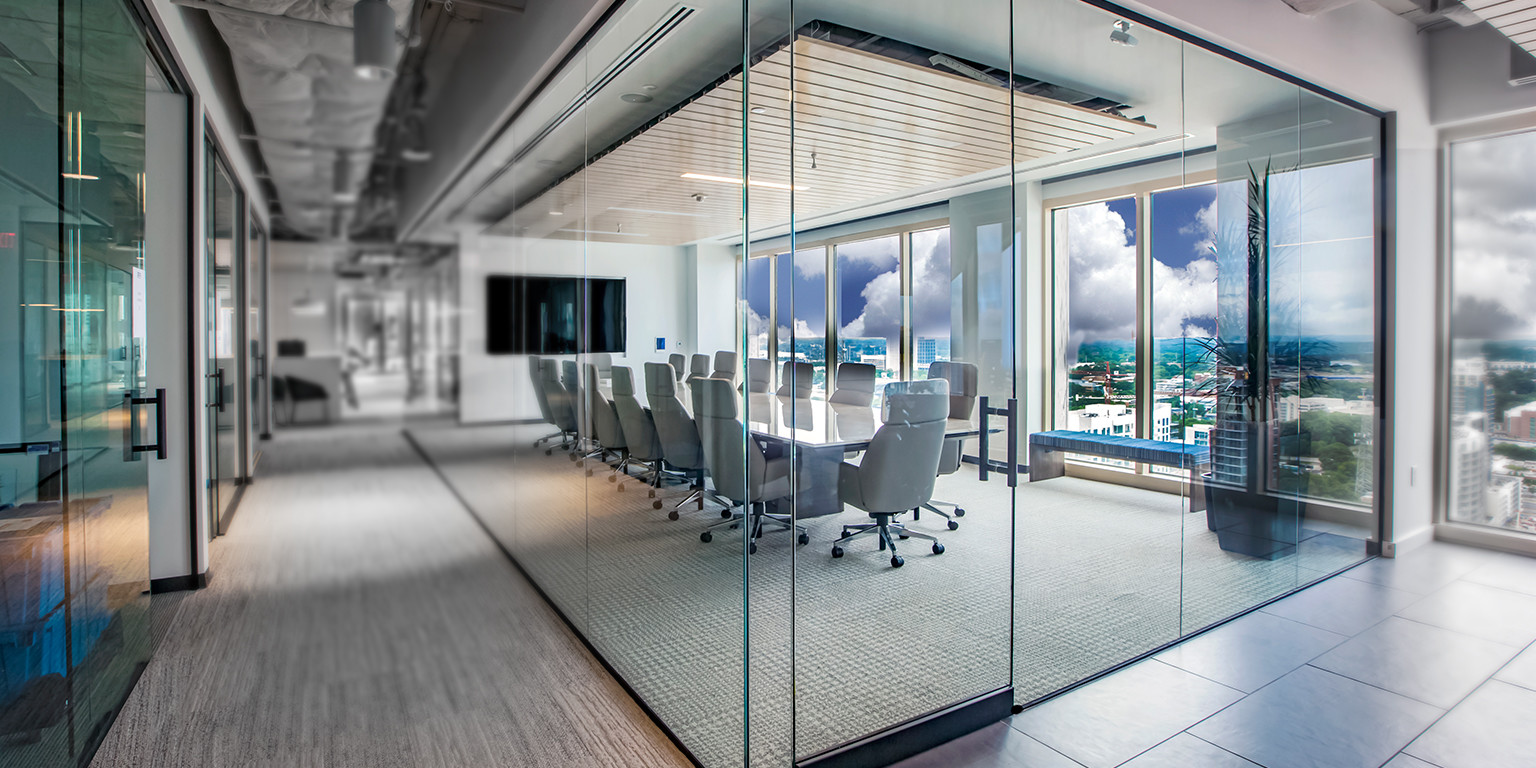
- Conference rooms
- Huddle rooms
- Training centers
- Reception areas
- Collaboration spaces
- Glass corridors
- Interior entrances
Larger tenants may install dozens or even hundreds of individual fabricated panels.
At that point, glazing becomes a meaningful construction package rather than a small architectural finish.
Oklahoma City Office Buildout Glazing
Oklahoma City office TI projects use many of the same systems.
The scope may be smaller, but the architectural objectives remain:
Transparency + Daylight + Privacy + Acoustics + Flexibility
Interior glass can help modernize older office environments without reconstructing the entire property.
A conventional perimeter-office layout might create:
Exterior Windows → Opaque Offices → Interior Workspace
Glass office fronts can change that relationship:
Exterior Windows → Glass Offices → Interior Workspace
Existing daylight becomes a building asset rather than something captured entirely by perimeter offices.
Existing Glass Before Demolition
Both markets have enormous amounts of second-generation commercial space.
That creates one of the most overlooked TI glazing opportunities.
Before demolition, identify:
- ✓ Conference-room glass
- ✓ Glass office fronts
- ✓ Doors
- ✓ Sidelites
- ✓ Interior storefront
- ✓ Mirrors
- ✓ Exterior storefront
- ✓ Commercial entrances
The previous tenant may have spent significant money installing those systems.
A new floor plan does not automatically make every component worthless.
Dallas vs Oklahoma City Existing Glass Reuse
Tempered architectural glass generally cannot simply be field-cut to entirely different dimensions after fabrication.
That makes reuse a design exercise.
Instead of:
Demolish → Design → Buy New Glass
consider:
Inventory → Measure → Design → Reuse Selectively → Fabricate What’s Missing
This can be particularly valuable when landlords repeatedly renovate office suites between tenants.
Dallas has the larger absolute opportunity because of its enormous commercial inventory.
Oklahoma City’s smaller market may make the strategy particularly attractive for owners trying to maximize TI budgets in existing properties.
Conference Room Glass
Conference rooms represent an important glazing category in both cities.
A complete system may include:
Glass + Framing + Door + Hardware + Privacy + Acoustics
Those requirements need to be coordinated.
A beautiful glass conference room isn’t necessarily a successful conference room.
If conversations easily travel through the door, perimeter joints, ceiling, or adjacent construction, the tenant may be disappointed regardless of how expensive the glass looks.
The desired acoustic performance should therefore be discussed before the system is selected.
Dallas Corporate TI Advantage
Dallas has an obvious advantage in corporate scale.
Large companies relocating, consolidating, expanding, or opening regional offices can generate significant interior finish-out projects.
Those projects can require:
- Standardized office fronts
- Multiple conference rooms
- Executive glazing
- Reception systems
- Access-controlled doors
- Privacy treatments
- Specialty glass
For a glazing subcontractor, repeatability becomes important.
The opportunity isn’t simply whether the contractor can install one conference room.
It can become whether the contractor can execute the same glazing standard across three floors, another building, and the tenant’s next location.
Oklahoma City Energy & Corporate Office Opportunity
Oklahoma City has a different corporate identity.
Energy, engineering, professional services, healthcare, government-related activity, and regional businesses create demand for office renovation and specialized commercial environments.
These projects can emphasize:
- Executive offices
- Conference rooms
- Secure entrances
- Reception glass
- Privacy
- Interior doors
- Building modernization
A smaller market can also make contractor reputation and relationships particularly important.
The glazing contractor may work repeatedly with the same general contractors, property managers, and building owners across different projects.
Dallas Industrial Tenant Improvements
Industrial construction is one of Dallas-Fort Worth’s greatest commercial-glass advantages.
Warehouses and distribution facilities may appear glass-light from outside, but the office component tells a different story.
A large facility may contain:
Employee Entrance → Reception → Corporate Offices → Conference Rooms → Training → Operations → Warehouse
Commercial glazing can appear throughout those administrative areas.
Typical scopes include:
- Exterior storefront
- Employee entrances
- Interior office storefront
- Glass offices
- Conference rooms
- Operations windows
- Safety glazing
One massive industrial development can generate numerous future TI projects as individual tenants occupy buildings.
Oklahoma City Industrial TI Glazing
Oklahoma City’s industrial and logistics market creates the same basic opportunity at a smaller scale.
Projects can include:
- Distribution facilities
- Manufacturing
- Energy-related operations
- Flex buildings
- Warehouse offices
- Service facilities
Commercial glass can separate office and operational environments while preserving visibility between them.
For many industrial properties, the office component may represent a relatively small percentage of total square footage while containing a disproportionate amount of the architectural glazing.
Warehouse Office Buildouts
This deserves to be treated as its own commercial glass category.
A warehouse tenant may need:
- New employee entrance
- Reception area
- Administrative offices
- Conference room
- Training room
- Operations office
- Interior observation windows
That creates a glazing sequence:
Exterior Storefront → Entrance → Reception → Interior Office Glass → Operations Glass
Dallas simply provides this opportunity at extraordinary scale.
Oklahoma City provides it as part of a growing central-U.S. industrial and distribution market.
Dallas vs Oklahoma City Storefront Tenant Improvements
Both markets contain large inventories of:
- Retail spaces
- Restaurants
- Medical suites
- Banks
- Fitness centers
- Ground-floor offices
These properties often inherit aluminum storefront from previous occupants.
Before replacement, evaluate:
Framing → Glass → Doors → Hardware → Weather Seals → Perimeter Conditions → Accessibility → Security
A major interior buildout doesn’t automatically mean the storefront needs to disappear.
Storefront Repair vs Replacement
An existing storefront may be modernized through:
- Broken glass replacement
- Failed insulated-glass replacement
- Door repairs
- New closers
- Hardware upgrades
- Weather seals
- Perimeter resealing
- New architectural film
Complete replacement may make more sense when the system has widespread deterioration, persistent leakage, major entrance changes, security deficiencies, or an architectural configuration incompatible with the new tenant.
This is an important TI value-engineering decision in both markets.
Dallas Retail & Restaurant TI Glazing
Dallas’ enormous retail and restaurant footprint creates high-volume storefront opportunities.
Commercial glass can support:
Visibility → Branding → Entrance → Customer Experience
Restaurant projects can expand the scope further with:
- Vestibules
- Private dining glass
- Wine rooms
- Bar mirrors
- Patio glazing
- Operable glass systems
For customer-facing businesses, storefront glass effectively becomes part of the marketing environment.
Oklahoma City Retail & Restaurant Buildouts
Oklahoma City uses the same systems but often within smaller shopping centers, mixed-use properties, neighborhood commercial developments, and regional retail destinations.
A restaurant taking over a former retail suite may inherit an expansive storefront.
That glass can become an asset.
Instead of displaying merchandise, the storefront displays the restaurant itself.
Lighting, customers, dining activity, and the bar become visible from outside.
Medical Tenant Improvement Glass
Healthcare is important in both markets.
Medical TI glazing may appear around:
- Reception
- Administrative offices
- Conference rooms
- Staff spaces
- Interior entrances
- Selected consultation areas
Healthcare introduces a different balance:
Daylight + Privacy + Safety + Cleaning + Accessibility
Clear office glass may work perfectly in one portion of the facility while privacy treatments or specialized systems are needed elsewhere.
Commercial Entrance Systems
Entrances create important glazing work in Dallas and Oklahoma City because multiple trades converge at the opening.
A commercial entrance may involve:
- Aluminum doors
- All-glass doors
- Sidelites
- Transoms
- Closers
- Pivots
- Continuous hinges
- Panic hardware
- Automatic operators
- Electrified hardware
The entrance is not simply glass.
It is a continuously operating building system.
Access Control & Commercial Glass Doors
Modern commercial tenant improvements increasingly incorporate electronic access.
That creates:
Glazing Contractor → GC → Hardware Supplier → Electrician → Security Integrator
The entrance may need:
- Electric strikes
- Magnetic locks
- Card readers
- Door-position switches
- Request-to-exit devices
- Automatic operators
Those requirements should be established before fabrication.
Late access-control changes can create expensive rework around doors and aluminum framing.

Dallas vs Oklahoma City Security Glazing
Both markets contain tenants with elevated security requirements.
Applications may include:
- Financial offices
- Healthcare properties
- Corporate facilities
- High-value retail
- Government environments
- Energy facilities
The important distinction is between a security glass product and a security system.
Glass + Framing + Anchoring + Doors + Hardware + Adjacent Construction
All of those components influence the performance of the opening.
The required protection level should be established before the glazing package is specified.
Commercial Building Repositioning
Dallas and Oklahoma City both contain aging office and commercial properties competing with newer buildings.
Glazing can help reposition those assets through:
Exterior → Entrance → Lobby → Spec Suite → Interior Glass
Potential improvements include:
- Storefront modernization
- Entrance replacement
- Lobby glazing
- Failed IGU replacement
- Conference rooms
- Glass office fronts
- Amenity glazing
This allows ownership to improve the tenant experience without necessarily rebuilding the entire property.
Dallas Repositioning Scale
Dallas has more submarkets and more commercial inventory.
A regional glazing strategy can reach:
Dallas → Uptown → Las Colinas → Plano → Frisco → Richardson → Addison → Fort Worth
Each submarket can generate different types of office and commercial renovation.
That geographic scale creates significant opportunities for glazing contractors working with portfolio owners and repeat general contractors.
Oklahoma City Concentration Advantage
Oklahoma City is geographically extensive, but its major commercial relationships can be more concentrated.
For a glazing contractor, that can create another kind of advantage.
Winning relationships with:
GCs + Developers + Property Managers + Facility Teams
can potentially lead to repeat projects throughout the metro.
The objective becomes less about chasing every individual glass project and more about becoming part of the recurring TI construction ecosystem.
Spec Suite Glazing
Speculative office suites are valuable in both markets.
A landlord can use glass to make an unoccupied suite feel substantially more complete:
- ✓ Conference rooms
- ✓ Office fronts
- ✓ Reception glazing
- ✓ Glass doors
- ✓ Privacy film
- ✓ Collaboration rooms
This gives prospective tenants a finished environment they can understand during a leasing tour.
Commercial Glass Fabrication & Tenant Buildout Scheduling
The scheduling problem is identical in Dallas and Oklahoma City.
Commercial glass is often installed late.
But it cannot be planned late.
A simplified sequence is:
Framing → Drywall → Finished Openings → Field Measurement → Fabrication → Installation → Hardware Adjustment
If finished openings are delayed, measurement is delayed.
Then fabrication is delayed.
Then glass installation lands directly against tenant turnover.
The GC should therefore track the glass release date, not simply the installation date.
Dallas vs Oklahoma City Commercial Glass Value Engineering
The best value-engineering strategy differs somewhat by market.
Dallas
Think:
Standardize + Repeat + Scale
This can be especially valuable for corporate, industrial, retail, and portfolio clients.
Oklahoma City
Think:
Reuse + Modernize + Maximize Existing Assets
Selective renovation can help ownership stretch TI and capital-improvement budgets.
Both markets should still evaluate existing glass before demolition.
The I-35 Tenant Improvement Corridor
The larger opportunity is connecting Dallas and Oklahoma City rather than treating them as isolated markets.
The commercial corridor can extend:
Dallas → Denton → Gainesville → Ardmore → Norman → Oklahoma City
For general contractors, commercial glazing companies, developers, and multi-location property owners, that creates a natural regional construction footprint.
Dallas provides the massive southern anchor.
Oklahoma City provides the central Oklahoma anchor.
And commercial, industrial, retail, healthcare, hospitality, and logistics properties connect the markets in between.
Multi-Market Commercial Glass Programs
This becomes especially valuable for organizations managing multiple properties.
A standardized glazing program might establish:
- Storefront systems
- Commercial doors
- Hardware
- Interior office glass
- Conference-room standards
- Privacy treatments
- Security requirements
- Repair procedures
Instead of procuring every TI glazing package from scratch, ownership can create repeatable standards across multiple locations.
That can be particularly attractive for:
Retailers → Restaurant Groups → Healthcare Operators → Industrial Portfolios → Corporate Offices → Property Management Companies
Dallas vs Oklahoma City — Which Commercial TI Glass Market Wins?
Dallas wins on scale.
Its corporate, office, industrial, logistics, retail, medical, and mixed-use footprint creates far more potential projects and substantially larger portfolio opportunities.
But Oklahoma City can be attractive precisely because it isn’t Dallas.
A smaller contractor ecosystem and more concentrated commercial community can make strong GC, developer, and property-management relationships disproportionately valuable.
For commercial glass contractors, the two markets therefore suggest different strategies:
Dallas
Volume → Scale → Standardization → Portfolio Relationships
Oklahoma City
Relationships → Renovation → Specialized TI → Repeat Local Work
Connecting Dallas & Oklahoma City Commercial Glazing
Together, Dallas and Oklahoma City create a much stronger commercial glass story than either city viewed independently.
Dallas supplies extraordinary project volume.
Oklahoma City extends the network north into another major commercial and industrial market.
The combined opportunity includes:
Office Tenant Improvements + Industrial Buildouts + Warehouse Offices + Storefront Renovations + Restaurants + Medical TI + Commercial Entrances + Interior Office Glass + Building Repositioning
For property owners, developers, facility managers, general contractors, and tenant buildout contractors, the commercial glazing strategy can remain consistent across both markets:
Survey Existing Glass → Preserve What Has Value → Coordinate TI Design → Modernize Storefronts & Entrances → Design Interior Glass Around the Tenant → Release Fabrication Early → Complete Installation Before Turnover
Dallas and Oklahoma City may operate at different scales, but together they form a natural I-35 commercial tenant improvement and glazing corridor—one that connects North Texas growth with Oklahoma’s commercial, industrial, healthcare, energy, and redevelopment markets.