

Oklahoma City vs Albuquerque — Commercial Glass & TI Glazing Contractors
Oklahoma City vs Albuquerque — Commercial Glass, TI Glazing Contractors & Tenant Improvement Markets
Oklahoma City and Albuquerque are two commercial markets that can be easy to underestimate if they are viewed only through population or skyline size.
For commercial glass and tenant improvement contractors, both markets have something more useful: substantial inventories of existing commercial buildings, industrial facilities, medical properties, offices, storefronts, and specialized facilities that continually need to be modified for new occupants.
The economic engines, however, are different.
Oklahoma City = Energy + Healthcare + Regional Corporate + Industrial + Retail
Albuquerque = Aerospace + Defense + Advanced Manufacturing + Research + Healthcare
That distinction changes where commercial glazing opportunities originate and what contractors may be asked to provide.
Oklahoma City vs Albuquerque Commercial TI Glazing
| Commercial Glass Opportunity | Oklahoma City | Albuquerque |
|---|---|---|
| Office tenant improvements | Very strong | Strong |
| Interior office glass | Very strong | Very strong |
| Storefront renovations | Very strong | Very strong |
| Industrial TI glazing | Very strong | Exceptional |
| Advanced manufacturing glass | Growing | Exceptional |
| Aerospace / defense TI | Strong | Exceptional |
| Medical office glazing | Exceptional | Very strong |
| Warehouse office buildouts | Very strong | Very strong |
| Existing-building modernization | Exceptional | Exceptional |
| Security glazing | Strong | Exceptional |
| Retail TI storefronts | Very strong | Strong |
| Specialized technical facilities | Strong | Exceptional |
Neither market needs to depend entirely on new construction.
In fact, existing-space modification may be the more interesting commercial-glass opportunity in both cities.
Oklahoma City Tenant Improvement Glass: Existing Space Has to Compete
Oklahoma City’s office market entered 2026 with roughly 10% vacancy and a record 8.7 million square feet of available space, according to the Greater Oklahoma City outlook. At the same time, the metro has approximately 156 million square feet of industrial inventory.
That combination creates two distinct glazing opportunities.
On the office side:
Existing Building → Leasing Competition → Renovation → Tenant Buildout → Interior Glass
On the industrial side:
Warehouse / Manufacturing → New Occupant → Office Buildout → Entrances + Storefront + Interior Glass
The opportunity isn’t necessarily to build more glass buildings.
It’s to keep changing the buildings Oklahoma City already has.
Albuquerque Commercial Glass: Specialized Growth Changes the Equation
Albuquerque has a more specialized growth story.
Its Q2 2026 office vacancy fell to 12.9%, with demand concentrated in higher-quality Class A and upper-tier Class B space.
More importantly for specialized TI construction, aerospace and defense companies were significant contributors to recent leasing, while the industrial sector has been benefiting from high-tech manufacturing and aerospace/defense investment.
That creates a different commercial-glass chain:
Advanced Industry → Specialized Facility → Technical Buildout → Security / Separation / Office Glass
Albuquerque’s advantage isn’t simply volume.
It’s the complexity of some of the tenants creating that volume.
Oklahoma City Office Glass & Tenant Buildout Contractors
Oklahoma City office renovations can require:
- Glass office fronts
- Conference rooms
- Executive offices
- Reception glazing
- Glass doors
- Sidelites
- Privacy film
- Interior storefront
- Access-controlled entrances
The smaller average office transaction can actually be interesting for TI contractors.
CBRE reported that office leases during the second half of 2025 averaged about 2,400 square feet per transaction.
That points toward a market with plenty of smaller suite turnover rather than one dependent exclusively on giant corporate relocations.
And suite turnover creates repeatable TI work.
Albuquerque Office Glass & Commercial TI Contractors
Albuquerque presents a different pattern.
Quality matters.
Tenants have been concentrating demand in better-positioned Class A and upper-tier Class B properties, while downtown still had significantly higher vacancy at 23.6% in Q2 2026.
That creates opportunities at both ends.
Higher-quality buildings need modern TI packages to capture tenants.
Older properties need modernization to compete.
Commercial glass can participate in both.
Office Glass as a Repositioning Tool
Consider an older office suite with:
Exterior Windows → Private Offices → Drywall Corridor → Dark Interior
A tenant improvement can change that relationship:
Exterior Windows → Glass Office Fronts → Interior Workspace
The building hasn’t moved.
The exterior windows haven’t changed.
But the interior glass allows the existing daylight to work harder.
That can be useful in both Oklahoma City and Albuquerque, where substantial amounts of existing office inventory need to compete for modern tenants.
Conference Room Glass
Conference rooms are one of the most obvious interior TI glazing applications.
A complete system can include:
Glass + Framing + Door + Hardware + Privacy + Acoustic Strategy
Those components shouldn’t be treated independently.
A glass conference room may look excellent while providing poor acoustic privacy.
Performance can depend on:
- Glass thickness
- Laminated configurations
- Framing
- Perimeter seals
- Door seals
- Ceiling conditions
- Adjacent walls
For executive, medical, technical, financial, and defense-related users, acoustics can be as important as transparency.
Existing Glass Before Demolition
Both markets have an overlooked resource in the previous tenant’s glass.
Before demolition, the project team should identify:
- ✓ Conference-room glass
- ✓ Glass office fronts
- ✓ Doors
- ✓ Sidelites
- ✓ Interior storefront
- ✓ Mirrors
- ✓ Exterior storefront
- ✓ Entrance systems
That material represents capital already invested in the property.
The incoming tenant may need a different layout.
That doesn’t automatically make every existing glass component worthless.
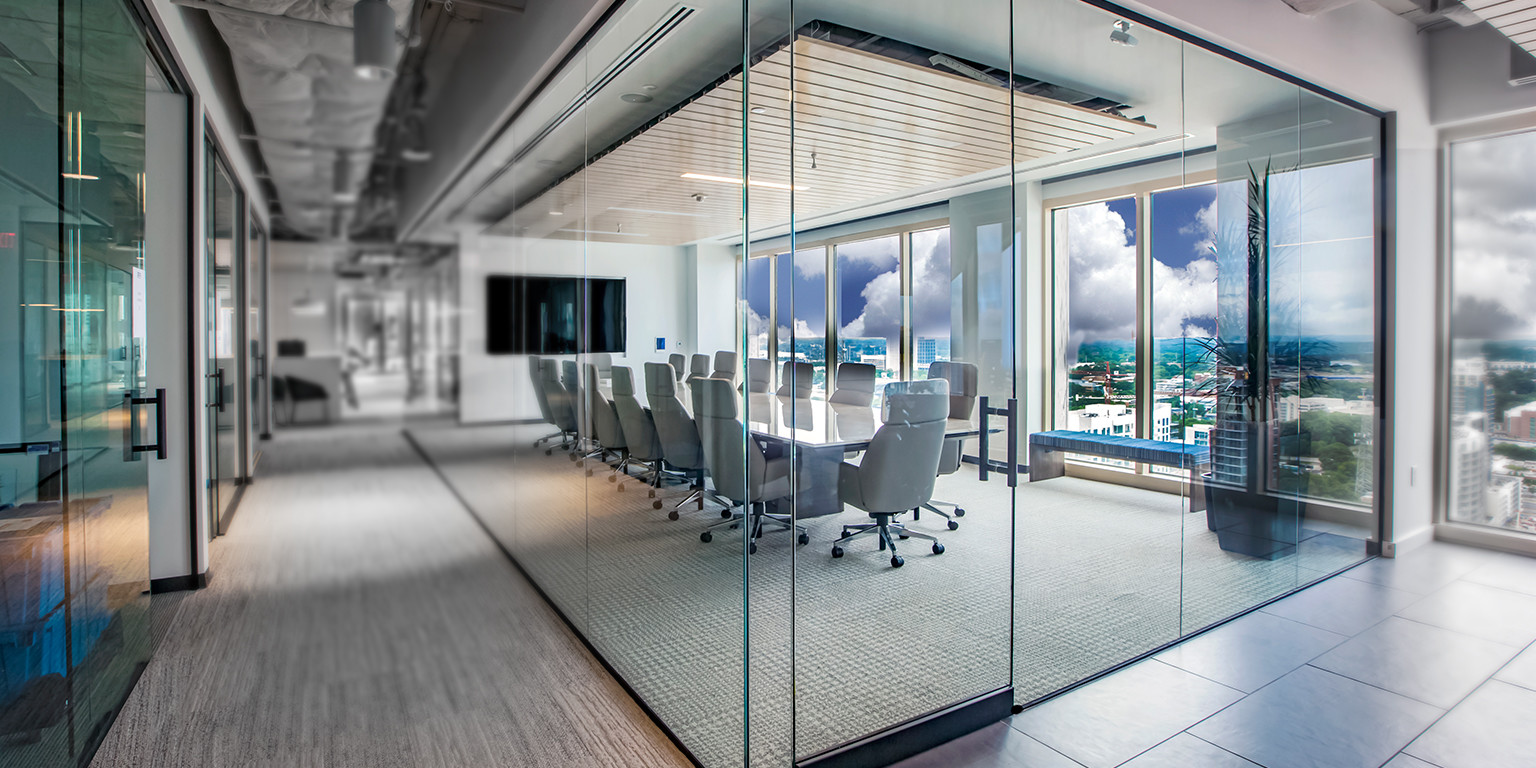
Oklahoma City vs Albuquerque Existing Glass Reuse
Tempered architectural glass generally cannot simply be cut into completely different dimensions after fabrication.
That makes reuse a planning exercise.
Instead of:
Demolish Everything → Design → Purchase New Glass
consider:
Inventory → Measure → Design → Reuse Selectively → Fabricate What’s Missing
Even if only 20–30% of a previous tenant’s glazing works with the new layout, it may still be worth evaluating.
This becomes particularly valuable for landlords completing repeated tenant turnovers.
Oklahoma City Healthcare TI Opportunity
Healthcare is one of the more important specialized TI categories in Oklahoma City.
Medical tenant improvements can involve:
- Reception glazing
- Administrative offices
- Conference rooms
- Staff spaces
- Interior entrances
- Privacy glass
- Automatic entrances
- Specialty doors
Healthcare-related office users also remain one of the stronger demand segments in portions of the metro.
These projects require a different glazing mindset from a conventional speculative office.
The objective may be:
- Visibility + Privacy + Accessibility + Safety + Durability
- Albuquerque Aerospace & Defense TI Opportunity
This is where Albuquerque separates itself.
Recent Albuquerque office activity has included aerospace and defense expansions, while industrial investment has included high-tech manufacturing and aerospace-related facilities.
That can create glazing applications around:
- Controlled entrances
- Technical offices
- Observation areas
- Administrative spaces
- Research environments
- Secure reception areas
- Interior separation
- Specialized glazing
Not every aerospace or manufacturing facility requires high-security glass.
But when security requirements do exist, the glazing needs to be considered as a complete assembly.
Security Glass Is Not the Security System
This distinction becomes particularly important in Albuquerque but applies in Oklahoma City as well.
A protective opening can depend on:
Glass + Framing + Anchoring + Door + Hardware + Adjacent Construction
Installing stronger glass into an inadequate frame does not necessarily create the intended protection.
Security objectives should therefore be established during TI design rather than added as a late glass substitution.
Oklahoma City Industrial Tenant Improvement Glass
Oklahoma City has an enormous industrial base.
The 2026 regional outlook identifies approximately 156 million square feet of industrial inventory, with another 560,000 square feet under construction at the beginning of the year.
For commercial glass contractors, industrial doesn’t simply mean exterior windows.
A warehouse or manufacturing facility can contain:
Employee Entrance → Reception → Administrative Offices → Conference Rooms → Training → Operations → Warehouse
Most of the building may contain little architectural glass.
The office component can contain a lot of it.
Albuquerque Industrial Glazing Is a Different Animal
Albuquerque’s industrial market is smaller, but current fundamentals are unusually tight.
Industrial vacancy was only 3.6% in Q2 2026, while year-to-date absorption remained positive at 347,000 square feet.
Earlier in the year, Colliers highlighted growth in high-tech manufacturing and aerospace/defense activity, including new and expanding manufacturing facilities.
That creates a more specialized industrial TI opportunity.
The work is less about a generic warehouse and more about manufacturing, engineering, research, operations, and office space combined in one facility.
Warehouse Office Buildouts
Warehouse office glass deserves its own category in both markets.
Potential scopes include:
- Exterior storefront
- Employee entrances
- Reception glass
- Interior office storefront
- Conference rooms
- Training-room glass
- Operations windows
- Safety glazing
A 200,000-square-foot industrial facility may have only 10,000 or 20,000 square feet of office.
For the glazing contractor, that relatively small portion can contain much of the project’s architectural glass.
Oklahoma City Storefront Tenant Improvements
Oklahoma City’s retail and commercial footprint creates another substantial TI opportunity.
The regional outlook tracks approximately 50 million square feet of retail inventory, with the metro accounting for more than half of Oklahoma’s taxable retail sales.
That supports ongoing:
- Retail buildouts
- Restaurant conversions
- Medical storefronts
- Fitness renovations
- Financial offices
- Service businesses
Many of those projects inherit an existing aluminum storefront.
Albuquerque Storefront Renovations
Albuquerque creates a similar opportunity through second-generation commercial space.
The storefront may not need to be replaced simply because the tenant changes.
Instead, evaluate:
Framing → Glass → Doors → Hardware → Seals → Accessibility → Security
The new TI may be able to preserve much of the existing system.
Storefront Repair vs Replacement
This is one of the most important commercial-glass value-engineering decisions.
An existing system may only need:
- Failed IGU replacement
- Broken glass replacement
- Door adjustment
- New closers
- Hardware upgrades
- Weather seals
- Perimeter resealing
- Privacy or branding film
Complete replacement becomes more appropriate when the problems are systemic.
That can include deteriorated framing, chronic leakage, widespread glass failure, major entrance changes, security deficiencies, or a new architectural design incompatible with the existing storefront.
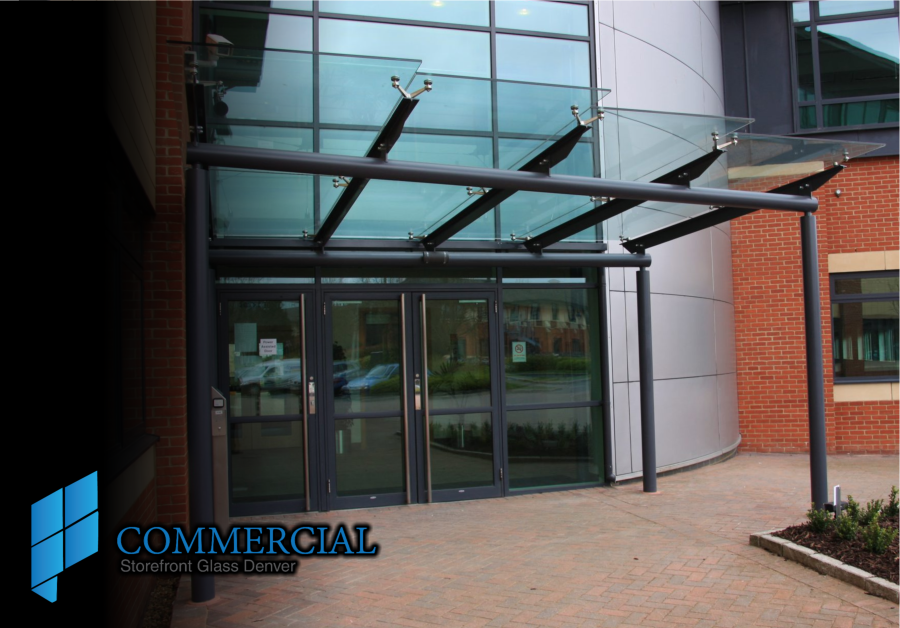
Restaurant & Retail TI Glazing
Retail and restaurant tenants use storefront glass differently from office tenants.
For retail:
Traffic → Storefront → Merchandise → Entrance → Sales Floor
For restaurants:
Traffic → Storefront → Activity → Atmosphere → Entrance
The restaurant storefront effectively displays the business itself.
That makes transparency, entrances, patio glass, private dining glass, mirrors, and operable systems part of the customer experience.
Oklahoma City Commercial Building Modernization
Oklahoma City’s substantial available office inventory makes modernization particularly relevant.
The process can follow:
Older Building → Capital Improvements → Lobby / Entrance → Spec Suite → New Tenant
Glass can participate throughout:
- Lobby systems
- Entrance upgrades
- Storefront modernization
- Failed IGU replacement
- Interior office fronts
- Conference rooms
For property owners, this makes commercial glazing part of leasing strategy rather than simply maintenance.
Albuquerque Adaptive Reuse & Commercial Modernization
Albuquerque has an interesting additional dynamic: obsolete office inventory is already being removed or converted.
Colliers reported that several properties were removed from statistical office inventory for multifamily and mixed-use conversions during Q1 2026.
That creates two construction paths.
A building can be kept as commercial and modernized, or its use can change and the building can be reconfigured.
Both can involve commercial glazing, although the glass scope can be radically different.
Spec Suite Glass
Spec suites can work particularly well in both markets.
Ownership can install:
- ✓ Conference rooms
- ✓ Office fronts
- ✓ Reception glazing
- ✓ Glass doors
- ✓ Privacy film
That work can be completed before a tenant signs.
The prospective tenant tours something that already looks like a functioning office rather than a demolition shell.
That can make glass part of the leasing presentation.
Commercial Entrance Systems
Entrances are another major TI category.
A commercial entrance can involve:
- Aluminum doors
- All-glass doors
- Sidelites
- Transoms
- Closers
- Pivots
- Continuous hinges
- Panic hardware
- Automatic operators
- Electrified hardware
The entrance should be viewed as an operating system rather than simply another piece of glass.
Access Control & Commercial Glass Doors
Modern healthcare, corporate, manufacturing, research, and technical facilities increasingly require electronic access.
That creates a coordination sequence:
Glazing Contractor → TI Contractor → Hardware → Electrical → Security Integrator
The opening may require:
- Electric strikes
- Card readers
- Magnetic locks
- Door-position switches
- Request-to-exit devices
- Automatic operators
Those decisions need to occur before fabrication.
Commercial Glass Fabrication & TI Scheduling
The same problem exists in Oklahoma City and Albuquerque.
Glass is installed late but needs to be planned early.
A typical sequence is:
Framing → Drywall → Finished Openings → Field Measure → Fabrication → Installation → Hardware Adjustment
When the finished opening is late, measurement is late.
Then fabrication is late.
Then glass suddenly becomes one of the final obstacles between the GC and occupancy.
The contractor should track the glass release date, not simply the installation date.
Oklahoma City vs Albuquerque Commercial Glass Value Engineering
The strongest strategies differ slightly.
Oklahoma City
Think:
Reuse + Renovate + Standardize + Repeat
A large existing commercial inventory and recurring suite turnover can reward repeatable TI glazing programs.
Albuquerque
Think:
Reuse + Retrofit + Specialize + Protect
The combination of existing buildings and specialized aerospace, defense, manufacturing, research, and healthcare users can reward more technically focused glazing capabilities.
Neither strategy means simply installing cheaper glass.
It means deciding where the glass creates the greatest value within the tenant improvement.
Regional Commercial Glass Contractor Opportunities
Oklahoma City can anchor a central corridor:
Oklahoma City → Norman → Tulsa → North Texas
Albuquerque can anchor a Southwest / Mountain West corridor:
Albuquerque → Rio Rancho → Santa Fe → Colorado → Arizona
That gives the markets different regional roles.
Oklahoma City can connect naturally into Texas and the central United States.
Albuquerque can connect naturally into Colorado, Utah, Arizona, and the broader Mountain West.
Oklahoma City vs Albuquerque — Which TI Glazing Market Is Better?
Oklahoma City wins on broader conventional commercial scale.
Its office, healthcare, retail, industrial, energy, and regional corporate economy creates a diverse pool of recurring tenant improvements.
Albuquerque wins on specialized technical potential.
Its aerospace, defense, advanced manufacturing, research, and increasingly tight industrial environment can create glazing scopes where security, controlled access, technical separation, and operational integration matter more.
Albuquerque’s industrial vacancy of only 3.6% in Q2 2026 also illustrates just how tight that side of the market has become.
Oklahoma City vs Albuquerque — Two Different Commercial TI Glazing Engines
The strongest distinction is:
Oklahoma City
Commercial Inventory → Tenant Turnover → Renovation → Buildout → Commercial Glass
Albuquerque
Specialized Industry → Expansion → Technical Buildout → Specialized Commercial Glass
Oklahoma City rewards commercial glazing contractors that can build relationships across a broad base of general contractors, healthcare operators, property managers, retailers, office owners, and industrial clients.
Albuquerque rewards contractors that can combine conventional storefront and office-glass capabilities with the needs of increasingly specialized technical, manufacturing, aerospace, and defense environments. Recent leasing and industrial activity support that distinction.
For property owners, developers, architects, facility managers, general contractors, and tenant improvement contractors, the underlying strategy remains consistent across both markets:
Survey Existing Glass → Preserve What Has Value → Coordinate Storefront & Entrances → Design Interior Glass Around the Tenant → Address Privacy, Security & Acoustics Early → Release Fabrication Before It Threatens Occupancy
That makes Oklahoma City and Albuquerque complementary rather than competing markets—one providing a broad central-U.S. commercial TI base and the other providing a specialized Southwest glazing market increasingly influenced by advanced manufacturing, aerospace, defense, research, and technical facilities.