
Fort Collins vs Salt Lake City — Office Glass & Tenant Improvement Glazing Markets
Fort Collins vs Salt Lake City — Office Glass, Tenant Improvement Glazing & Commercial Build Out Markets
Fort Collins and Salt Lake City are both important Mountain West commercial markets, but they produce tenant improvement glazing demand through different economic and development patterns.
Fort Collins and Northern Colorado benefit from a strong mix of technology, advanced manufacturing, research, healthcare, education, professional offices, flex space, and industrial development. Salt Lake City and the Wasatch Front operate at a larger regional scale, with strong corporate growth, logistics, industrial expansion, healthcare, professional services, office absorption, and multi-market commercial development.
For commercial glazing contractors, general contractors, developers, property managers, architects, facility managers, and office build out contractors, the distinction can be simplified:
Fort Collins = Research + Manufacturing + Industrial-Office Integration
Salt Lake City = Regional Scale + Corporate Growth + Multi-Market TI
Both markets still generate demand for the same core commercial glass systems:
Storefront → Commercial Entrances → Office Glass → Conference Rooms → Interior Partitions → Privacy → Specialty Glazing
Fort Collins vs Salt Lake City Commercial TI Glazing
| Commercial Glass Opportunity | Fort Collins / Northern Colorado | Salt Lake City / Wasatch Front |
|---|---|---|
| Office tenant improvements | Strong | Very strong |
| Interior office glass | Very strong | Very strong |
| Corporate office build outs | Strong | Very strong |
| Research / technology glazing | Exceptional | Very strong |
| Industrial TI glazing | Exceptional | Exceptional |
| Warehouse office build outs | Very strong | Exceptional |
| Medical office glass | Very strong | Very strong |
| Storefront renovation | Strong | Very strong |
| Existing glass reuse | Major opportunity | Major opportunity |
| Multi-location TI programs | Moderate | Exceptional |
| Commercial property repositioning | Strong | Very strong |
| Regional contractor reach | Northern Colorado | Wasatch Front |
The same architectural glass can appear in both markets.
The difference is often what type of tenant is creating the project.
Fort Collins Tenant Improvement Glass: Office Meets Operations
Fort Collins is particularly interesting because office space frequently sits beside research, manufacturing, technical, or industrial environments.
A commercial facility may contain:
Reception → Administrative Offices → Conference Rooms → Engineering → Research → Production → Warehouse
That creates opportunities for glazing that go beyond conventional office architecture.
Glass may be used to provide:
- Visual connection
- Controlled separation
- Observation
- Daylight
- Customer presentation
- Employee circulation
The commercial glass contractor may therefore be working at the boundary between administrative and operational space.
Salt Lake City Tenant Improvement Glass: Regional Scale
Salt Lake City’s advantage is scale.
The broader Wasatch Front creates a connected commercial corridor through:
Salt Lake City → Murray → Sandy → Draper → Lehi → Provo
That produces opportunities across:
- Corporate offices
- Technology companies
- Financial services
- Healthcare
- Industrial facilities
- Distribution centers
- Retail
- Restaurants
- Mixed-use developments
For glazing contractors, the opportunity is not simply one downtown market.
It is a chain of commercial submarkets capable of supporting repeated TI work.
Fort Collins Office Glass Contractors
Office build outs in Fort Collins can require:
- Executive office fronts
- Private office glazing
- Conference rooms
- Huddle rooms
- Training spaces
- Reception glass
- Glass doors
- Interior storefront systems
Interior glazing becomes especially valuable in buildings where perimeter offices might otherwise block natural light.
A conventional layout can create:
Exterior Windows → Private Offices → Opaque Walls → Interior Workspace
Glass can change the sequence:
Exterior Windows → Glass Offices → Interior Workspace
That allows existing daylight to work harder.
Salt Lake City Office Glass Contractors
Salt Lake City office tenant improvements use many of the same systems, but the project scale can be larger and more repeatable.
A corporate tenant may require:
- Dozens of office fronts
- Multiple conference rooms
- Executive areas
- Reception systems
- Glass doors
- Privacy treatments
- Access-controlled entrances
At that point, the glazing contractor is managing a complete interior package rather than isolated rooms.
Repeatable details become more important.
Conference Room Glass in Both Markets
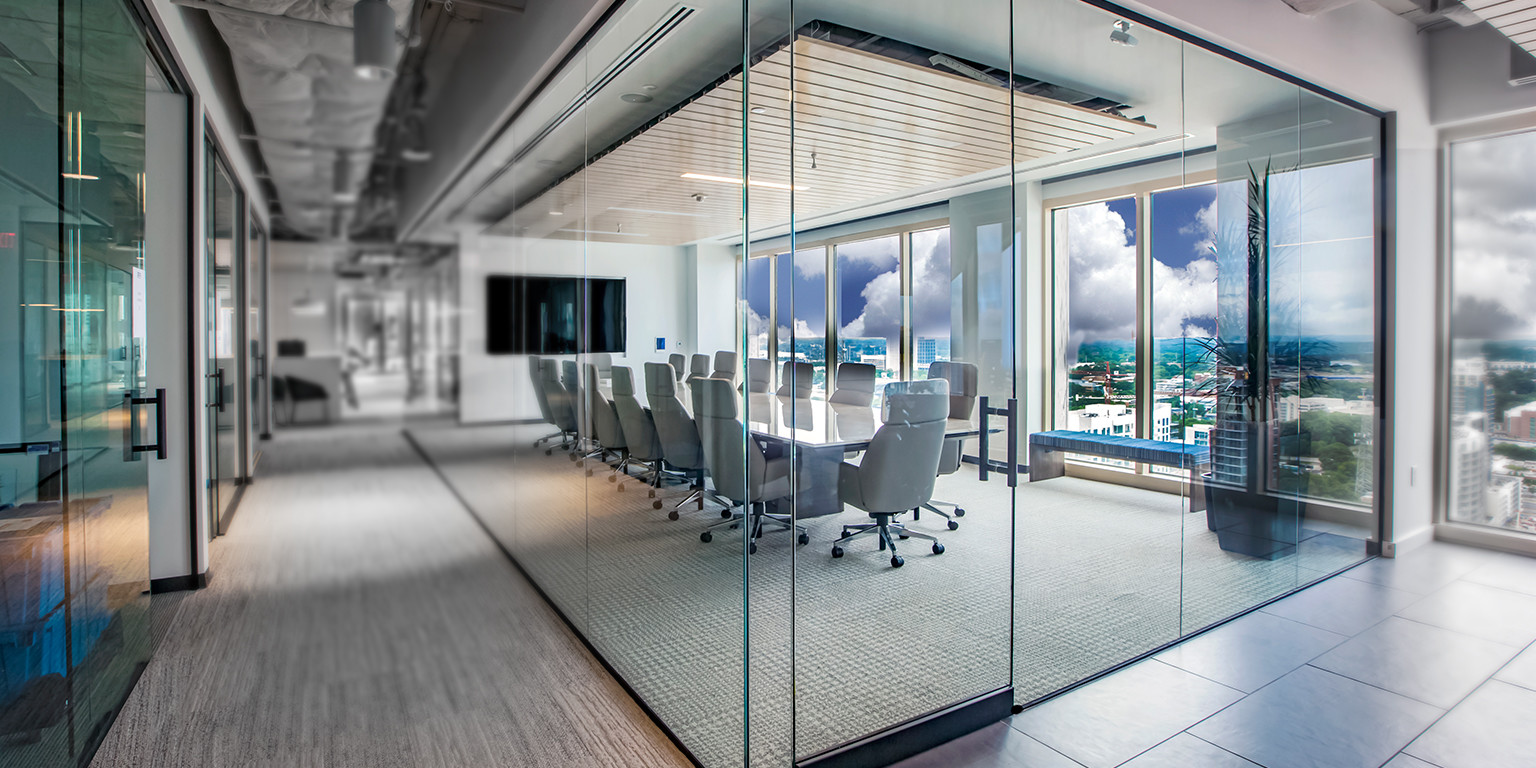
Conference rooms are one of the most common TI glazing applications.
A complete system may include:
Fixed Glass + Framing + Glass Door + Hardware + Privacy + Acoustic Strategy
All six components matter.
A glass conference room can look excellent while still performing poorly if conversations pass easily through perimeter gaps, doors, ceilings, or surrounding construction.
The tenant’s actual privacy expectations should therefore be established before fabrication.
Acoustic Office Glass
Acoustic performance can be particularly important for:
- Executive offices
- HR
- Legal
- Finance
- Medical consultations
- Engineering meetings
- Confidential research
- Client conference rooms
Performance can depend on:
- Glass thickness
- Laminated glass
- Framing
- Door seals
- Perimeter seals
- Ceiling conditions
- Adjacent partitions
The glass itself is only part of the acoustic assembly.
Existing Glass Before Demolition
Both markets contain large amounts of second-generation commercial space.
Before demolition begins, the TI team should inventory:
- ✓ Glass offices
- ✓ Conference rooms
- ✓ Glass doors
- ✓ Sidelites
- ✓ Reception glazing
- ✓ Interior storefront
- ✓ Mirrors
- ✓ Exterior storefront
A previous tenant may have invested heavily in these systems.
Some can remain useful.
Reusing Tempered Glass
Existing tempered glass presents a limitation: panels generally cannot simply be field-cut into completely new dimensions after fabrication.
That means reuse requires planning.
A better TI sequence is:
Survey → Measure → Compare → Reuse Selectively → Fabricate What’s Missing
For example, a new tenant might inherit twelve glass offices and three conference rooms.
Perhaps only four office fronts and one conference room naturally fit the new plan.
That can still preserve meaningful value.
The key is making the decision before demolition.
Fort Collins Research & Technology Glazing
Fort Collins has a particularly strong niche where offices intersect with research and technical environments.
Applications may include:
- Observation glass
- Interior office fronts
- Conference rooms
- Controlled entrances
- Administrative partitions
- Glass between office and technical areas
The design may need to balance transparency with:
- Security
- Controlled access
- Safety
- Acoustics
- Specialized operational requirements
This can make the glazing package more technically important than in a standard speculative office.
Salt Lake City Technology & Corporate Glazing
Salt Lake City and the Lehi-Draper corridor create a strong corporate and technology TI opportunity.
Commercial glass may support:
- Executive offices
- Large conference centers
- Collaboration environments
- Reception glazing
- Training spaces
- Access-controlled entrances
- Amenity areas
The opportunity here is often repeatability.
A corporate user may want the same glazing standard across several suites, floors, or locations.
Fort Collins Industrial TI Glazing
Northern Colorado has a strong industrial and advanced-manufacturing story.
The regional corridor can extend through:
Fort Collins → Loveland → Windsor → Greeley
That creates glazing opportunities in:
- Manufacturing
- Distribution
- Food production
- Flex space
- Research
- Warehouse offices
- Corporate industrial facilities
A relatively small office component inside a large industrial building can contain most of the architectural glass.
Salt Lake City Industrial TI Glazing
Salt Lake City’s industrial opportunity is even larger regionally.
Warehouse and distribution properties may require:
- Exterior storefront
- Employee entrances
- Reception glazing
- Administrative offices
- Conference rooms
- Training rooms
- Operations glass
- Safety glazing
A modern warehouse tenant is not simply leasing open storage space.
Many operations require increasingly sophisticated office and employee environments.
Warehouse Office Build Outs
Warehouse office glazing deserves to be treated as its own TI category.
A typical sequence may look like:
Employee Entrance → Reception → Administrative Office → Conference Room → Training → Operations → Warehouse
Commercial glass can appear at nearly every transition.
For both Fort Collins and Salt Lake City, this creates an important secondary glazing market tied to industrial growth.
Salt Lake City wins on sheer scale.
Fort Collins may provide more specialized manufacturing and research-oriented applications.
Storefront Tenant Improvements
Ground-floor commercial properties in both markets frequently inherit existing aluminum storefront systems.
Before replacement, the glazing contractor should evaluate:
- Framing condition
- Glass
- Insulated glass units
- Doors
- Closers
- Thresholds
- Hardware
- Weather seals
- Perimeter sealants
- Accessibility
- Security
A major interior build out does not automatically require complete storefront replacement.
Storefront Repair vs Replacement
An existing storefront may still be modernized through:
Retain Framing → Replace Failed Glass → Repair Doors → Upgrade Hardware → Reseal
This can preserve capital for interior TI work.
Complete replacement becomes more appropriate when there is:
- Significant framing deterioration
- Widespread glass failure
- Chronic water intrusion
- Major entrance changes
- Security deficiencies
- Architectural incompatibility
The distinction between component failure and system failure matters.
Failed Insulated Glass
Fogged insulated glass can make a newly renovated commercial property look older than it is.
Typical signs include:
- Cloudiness
- Condensation between panes
- Haze
- Visible seal failure
If the framing remains serviceable, individual insulated units may often be replaced without replacing the entire storefront.
That can be a useful value-engineering strategy in both Fort Collins and Salt Lake City.
Retail Tenant Improvement Glazing
Retail projects use glass differently than offices.
The sequence becomes:
Exterior Traffic → Storefront → Merchandise → Entrance → Sales Floor
A tenant may want to:
- Increase transparency
- Relocate doors
- Remove old film
- Create larger display areas
- Improve security
- Modernize entrances
The storefront should therefore be coordinated with the retail floor plan.
Restaurant Build Out Glass
Restaurant projects may include:
- Exterior storefront
- Commercial entrances
- Vestibules
- Private dining glass
- Wine rooms
- Mirrors
- Patio glazing
- Operable glass systems
In Fort Collins, hospitality and brewery-related environments can create interesting connections between production and customer areas.
In Salt Lake City, restaurant and mixed-use development along the Wasatch Front can generate larger numbers of repeat storefront and tenant build out projects.
Medical Office TI Glass
Both markets have significant healthcare activity.
Medical glazing can support:
- Reception
- Administrative offices
- Conference rooms
- Staff areas
- Interior entrances
- Selected consultation spaces
The glazing strategy needs to balance:
Daylight + Privacy + Safety + Accessibility
Existing clear glass may sometimes be retained and modified through privacy film rather than replaced.

Commercial Entrance Systems
Entrances create another major TI opportunity.
A commercial entrance may include:
- Aluminum storefront doors
- All-glass doors
- Sidelites
- Transoms
- Closers
- Continuous hinges
- Pivots
- Panic hardware
- Automatic operators
- Electrified hardware
The entrance should be treated as an operating building system rather than just a glazed opening.
Access Control and Glass Doors
Modern offices, research facilities, healthcare environments, and industrial properties increasingly use electronic access.
That creates a coordination chain:
Glazing Contractor → GC → Hardware → Electrical → Security Integrator
The opening may require:
- Card readers
- Electric strikes
- Magnetic locks
- Door-position switches
- Request-to-exit devices
- Automatic operators
Those requirements should be resolved before fabrication.
Security Glazing
Both markets contain security-sensitive tenants.
Fort Collins may encounter specialized requirements in technology, research, manufacturing, and healthcare.
Salt Lake City may encounter similar requirements in financial, corporate, healthcare, industrial, and institutional environments.
Security glazing should be treated as a complete assembly:
Glass + Framing + Anchoring + Doors + Hardware + Adjacent Construction
A stronger glass panel alone does not automatically create a secure opening.
Fort Collins vs Salt Lake City Commercial Property Repositioning
Both markets have older commercial properties that can benefit from modernization.
A repositioning strategy may follow:
Exterior → Entrance → Lobby → Available Suite → Interior Glass
Fort Collins may see stronger opportunities in older professional, research, industrial, and flex properties.
Salt Lake City has more regional scale and more potential for multi-building repositioning programs along the Wasatch Front.
Spec Suite Glazing
Spec-suite construction can create repeatable glass packages in both markets.
Ownership may install:
- ✓ Conference-room glass
- ✓ Office fronts
- ✓ Reception glazing
- ✓ Glass doors
- ✓ Privacy film
That work can be completed before a tenant signs.
It creates a move-in-ready appearance and can shorten future TI schedules.
Salt Lake City’s larger regional office base gives it an advantage in repeatable spec-suite programs.
Commercial Glass Fabrication and TI Scheduling
The scheduling challenge is the same in both markets.
Glass may be installed late.
But it must be planned early.
A simplified sequence is:
Framing → Drywall → Finished Openings → Field Measure → Fabrication → Installation → Hardware Adjustment
If finished openings are late, measurements are late.
If measurements are late, fabrication is late.
Then glass can become one of the final obstacles to tenant occupancy.
The GC should therefore track the glass release date, not simply the installation date.
Flooring and Glass Coordination
Interior glass may depend on:
- Finished-floor elevation
- Flooring thickness
- Thresholds
- Bottom channels
- Floor closers
- Material transitions
Late flooring changes can affect door clearances and fabricated dimensions.
The glazing contractor needs accurate finish information before glass is released.
Ceiling and Full-Height Glass Coordination
Full-height glazing can also interact with:
- Ceiling grids
- Structural headers
- Deflection
- Lighting
- Fire sprinklers
- Mechanical systems
This reinforces a central TI principle.
Glass may be installed near the end of construction, but it should not be designed near the end.
Fort Collins Commercial Glass Value Engineering
Fort Collins projects can benefit from a strategy built around:
Reuse + Specialization + Existing-Building Integration
Particular attention can go toward:
- Reusing existing interior glass
- Preserving storefront framing
- Technical observation glazing
- Warehouse office systems
- Research and manufacturing environments
The goal is to use glass where it improves the connection between office and operational space.
Salt Lake City Commercial Glass Value Engineering
Salt Lake City can benefit from:
Reuse + Standardization + Repeatability + Scale
A regional owner may establish standards for:
- Office fronts
- Conference rooms
- Glass doors
- Privacy film
- Commercial entrances
- Storefront systems
Those details can then be repeated across multiple Wasatch Front properties.
Fort Collins vs Salt Lake City — Which TI Glass Market Is Better?
Salt Lake City wins on regional scale.
The Wasatch Front creates a larger connected market for corporate offices, industrial development, logistics, healthcare, retail, and multi-location tenant improvement programs.
Fort Collins wins on specialized office-to-industry integration.
Research, manufacturing, engineering, healthcare, technology, and industrial users can create unusual glazing opportunities where office glass serves an operational role as well as an architectural one.
For commercial glazing contractors, neither market needs to be viewed in isolation.
Mountain West Commercial Glazing Corridor
The larger opportunity is connecting both markets into a broader regional network.
Northern Colorado can connect:
Fort Collins → Loveland → Windsor → Greeley → Denver
Salt Lake City can connect:
Salt Lake City → Sandy → Draper → Lehi → Provo
The wider Mountain West strategy then becomes:
Northern Colorado → Denver → Salt Lake City → Boise → Las Vegas → Albuquerque
For glazing contractors, tenant improvement contractors, property owners, and developers, that creates a regional commercial glass footprint spanning:
- Office build outs
- Industrial TI
- Warehouse offices
- Research facilities
- Medical offices
- Retail storefronts
- Restaurant renovations
- Commercial entrances
- Interior office glass
- Building repositioning
Fort Collins vs Salt Lake City — Two Different Commercial Glazing Engines
The clearest distinction is:
Fort Collins
Innovation → Research / Manufacturing → Specialized Build Out → Office & Operational Glass
Salt Lake City
Regional Growth → Leasing → Expansion → Tenant Improvements → Repeatable Commercial Glass
Fort Collins rewards glazing contractors that understand technically diverse facilities.
Salt Lake City rewards contractors that can execute repeatable commercial TI packages across a broad regional corridor.
For general contractors, architects, facility managers, property owners, and tenant improvement contractors in either market, the strongest commercial glass strategy remains consistent:
Survey Existing Glass → Preserve What Has Value → Coordinate Storefront & Entrances → Design Office Glass Around the Tenant → Resolve Privacy, Security & Acoustics Early → Release Fabrication Before It Threatens Occupancy
That is where commercial glazing becomes part of the tenant improvement strategy rather than simply another subcontractor package installed at the end of the build out.