
Salt Lake City vs Dallas — Class A Office Glass & Tenant Improvement Glazing
Salt Lake City vs Dallas — Class A Office Glass, Tenant Improvement Glazing & Premium Office Buildout Contractors
Salt Lake City and Dallas are both increasingly defined by the same commercial real estate phenomenon: tenants want better buildings.
But the Class A office glazing opportunity looks very different in each market.
Dallas-Fort Worth has enormous scale, multiple premium office districts, major corporate users, large multi-floor leases, headquarters projects, and one of the deepest commercial construction ecosystems in the country.
Salt Lake City is smaller, but tightening supply and essentially nonexistent new office construction are increasing the importance of the Class A buildings that already exist. In Q2 2026, the Salt Lake City–Provo market recorded its seventh consecutive quarter of positive occupancy growth while reporting no office projects under construction for a second consecutive quarter.
For commercial glazing contractors, office buildout contractors, developers, property owners, architects, and general contractors, the distinction can be summarized:
Dallas = Premium Scale + Corporate Buildouts + Repeatable Class A Glass
Salt Lake City = Limited New Supply + Existing Class A Modernization + Wasatch Front TI
Both create substantial opportunities for:
Executive Office Glass → Conference Rooms → Lobby Glazing → Premium Entrances → Acoustic Glass → Privacy Systems → Interior Architectural Glass
Salt Lake City vs Dallas Class A Office Glazing
| Class A Glass Opportunity | Salt Lake City | Dallas-Fort Worth |
|---|---|---|
| Class A office TI | Very strong | Exceptional |
| Large corporate buildouts | Strong | Exceptional |
| Multi-floor glazing packages | Moderate | Exceptional |
| Existing Class A modernization | Exceptional | Very strong |
| Executive office glass | Very strong | Exceptional |
| Conference & boardroom glazing | Very strong | Exceptional |
| Premium lobby glass | Strong | Exceptional |
| Spec-suite glazing | Very strong | Exceptional |
| Acoustic office glass | Growing | Major opportunity |
| Portfolio standardization | Strong | Exceptional |
| Existing-glass reuse | Major opportunity | Major opportunity |
| High-end commercial entrances | Very strong | Exceptional |
Dallas wins overwhelmingly on absolute scale.
Salt Lake City becomes interesting because scarcity can increase the importance of improving what already exists.
Dallas Class A Office Glass: The Flight to Quality Is Real
Dallas’ office market is increasingly bifurcated between ordinary office inventory and the buildings tenants actually want.
In Q2 2026, Dallas-Fort Worth posted 1.1 million square feet of positive absorption, its sixth consecutive positive quarter. Class A vacancy declined 190 basis points year over year, while vacancy in Trophy and Tier I buildings fell even faster.
That matters enormously for tenant improvement contractors.
The question becomes what makes the best office buildings continue to feel like the best office buildings.
Glass is part of that answer.
Class A Isn’t Just a Building Classification
For the tenant walking through the property, Class A is experienced through details.
They see:
Entrance → Lobby → Elevator Lobby → Reception → Conference Rooms → Offices → Amenities
Glass can influence nearly every stage.
A premium office may incorporate:
- Oversized glass office fronts
- Frameless entrances
- Executive office glazing
- Boardroom glass
- Acoustic partitions
- Decorative laminated glass
- Privacy systems
- Glass doors
- Premium hardware
- Interior architectural storefront
The glass package becomes part of the tenant’s perception of quality.
Dallas Has a Top-Tier Office Shortage Developing
This is where Dallas gets particularly interesting.
Cushman & Wakefield reported that Class A asking rents reached a record $40.08 per square foot in Q2 2026, up 3.1% year over year. The firm specifically identified an emerging shortage of top-tier Class A space.
That creates a powerful secondary opportunity.
If tenants can’t get into the newest trophy building, the next-best buildings have an incentive to improve.
The sequence becomes:
Trophy Space Tightens → Tenants Consider Alternatives → Existing Class A Competes → Capital Improvements → Tenant Improvements → Commercial Glass
Suddenly the opportunity isn’t limited to new trophy towers.
Salt Lake City Has a Different Kind of Scarcity
Salt Lake City’s office market is producing scarcity from the supply side.
Overall vacancy declined to 22.6% in Q2 2026, the lowest level in more than three years. The market recorded 295,000 square feet of positive absorption and had no office projects under construction. Over the prior 12 months, 603,000 square feet of office inventory had been removed while only one 120,000-square-foot building was delivered.
That means companies seeking quality space have limited new product coming behind the existing inventory.
For TI contractors, that’s important.
The existing building has to become the new building.
Salt Lake City Class A Modernization
Consider an existing Class A property built 15 or 20 years ago.
It may still have:
- Excellent location
- Structured parking
- Good exterior glazing
- Strong floor plates
- Quality mechanical systems
But the interiors may feel dated.
That creates a modernization strategy:
Preserve Building → Modernize Lobby → Upgrade Entrances → Renovate Suites → Add Interior Glass → Improve Amenities
Commercial glazing becomes one of the tools for extending the competitive life of the asset.
Dallas Corporate Office Buildout Glass
Dallas’ biggest advantage is the size of individual opportunities.
Multi-floor office commitments accounted for more than 921,000 square feet of DFW’s Q2 leasing activity, while financial companies alone accounted for roughly 630,000 square feet of new deals.
Those tenants can generate substantial interior-glass packages.
A large corporate buildout may contain more than 100 office fronts, 20 or more conference rooms, and multiple controlled entrances.
It may also include:
- Executive boardrooms
- Reception glazing
- Training rooms
- Glass corridors
At that point, the glazing contractor isn’t installing a few pieces of glass.
They’re managing a major architectural package.
Salt Lake City Office Glass Is More Regional Than It Looks
Salt Lake City’s opportunity shouldn’t be limited to downtown.
The Class A and corporate TI corridor extends through:
Salt Lake City → Murray → Sandy → Draper → Lehi → Provo
That dramatically changes the size of the addressable market.
Corporate, technology, financial, healthcare, and professional-service tenants throughout the Wasatch Front create demand for premium office interiors.
For a glazing contractor, the actual market is therefore the entire Wasatch Front Class A TI corridor rather than simply downtown Salt Lake City.
Dallas Has Multiple Class A Markets Inside One Metro
Dallas takes the same concept to another level.
Its premium office opportunity is distributed among numerous major submarkets:
- Uptown / Turtle Creek
- Preston Center
- Las Colinas
- Richardson / Plano
- Legacy / Frisco
- Southlake / Westlake
- Fort Worth
In Q2 2026, Legacy/Frisco, Las Colinas, and Uptown/Turtle Creek were the three leading DFW submarkets for positive absorption.
That creates something few smaller markets can replicate: multiple independent Class A glazing markets inside one metroplex.
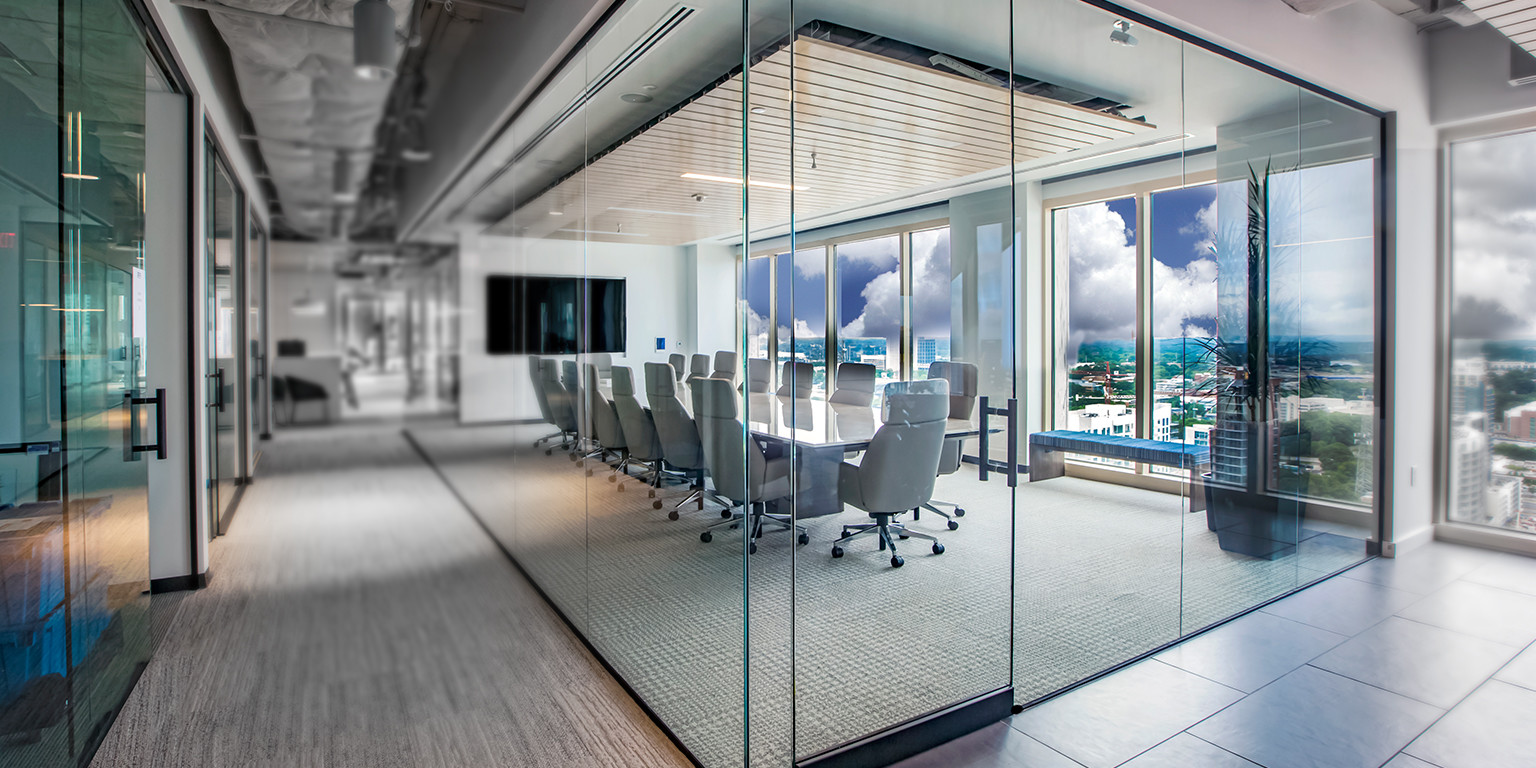
Class A Conference Room Glass
Conference rooms are among the most visible parts of a premium office buildout.
But Class A conference-room glass should not be evaluated solely by appearance.
The complete system can involve:
Glass + Framing + Door + Hardware + Acoustics + Privacy
This is where higher-end TI work separates itself from basic office glass.
Acoustic Glass Becomes More Important at the Top
Consider the difference between a casual collaboration room and an executive boardroom.
Both may have glass walls.
Their performance expectations can be completely different.
Acoustic performance can depend on:
- Glass thickness
- Laminated configurations
- Double-glazed systems
- Framing
- Perimeter seals
- Door seals
- Ceiling construction
- Adjacent partitions
Installing expensive glass while ignoring sound transmission through the rest of the assembly misses the objective.
Executive Office Glass
Executive offices introduce another challenge in balancing transparency against privacy.
Leadership may want an open architectural environment without making every meeting visible.
Solutions can include:
- Gradient film
- Frosted bands
- Decorative laminated glass
- Patterned glazing
- Switchable privacy glass
- Strategic partial-opacity treatments
The correct system depends on how the tenant uses the space.
Switchable Privacy Glass
Premium office buildouts are one environment where switchable privacy systems can make sense.
A conference room might remain transparent under normal conditions and become private during meetings.
Applications can include:
Boardrooms → Executive Offices → Legal → HR → Healthcare Administration
The technology is not necessary for every opening.
But Class A tenant improvements create environments where the additional functionality may justify the cost.
Glass Doors Become Part of the Architecture
A lower-cost office renovation may treat the door as simply an opening.
Class A projects increasingly treat it as part of the glazing system.
Options may include:
- Frameless glass doors
- Aluminum-framed glass doors
- Pivot doors
- Sliding glass doors
- Full-height systems
- Integrated hardware
- Access-controlled entrances
Door selection affects appearance, acoustics, accessibility, security, and maintenance.
Dallas Boardroom & Executive Glazing
Dallas’ large corporate tenant base creates particular opportunities for executive glazing.
The progression might be:
Reception → Executive Corridor → Boardroom → Executive Offices
Those spaces may require:
- Larger panels
- Higher acoustic performance
- Premium hardware
- Custom privacy
- Decorative glass
- Integrated technology
The glazing contractor needs to understand the architectural objective rather than treating every partition identically.
Salt Lake City Technology Office Glass
Salt Lake City’s corporate and technology corridors can produce a different premium-office aesthetic.
The emphasis may lean toward:
Daylight + Transparency + Collaboration + Flexibility
Glass can define conference rooms and offices without visually fragmenting the workplace.
That becomes particularly useful in larger floor plates where natural light needs to move beyond perimeter offices.
Daylight Is a Glass Strategy
Consider a conventional office:
Exterior Glass → Executive Office → Drywall → Interior Employees
The executives get daylight.
Everyone else gets artificial lighting.
Replacing the opaque office fronts with glass changes the sequence:
Exterior Glass → Executive Office → Interior Glass → Workspace
The exterior façade hasn’t changed.
But the tenant receives greater benefit from the daylight already entering the building.
That makes interior glazing part of workplace planning rather than simply decoration.
Existing Class A Glass Shouldn’t Automatically Be Demolished
This is particularly important as office tenants continue relocating between existing buildings.
Before demolition, inventory:
- ✓ Conference-room panels
- ✓ Office fronts
- ✓ Glass doors
- ✓ Sidelites
- ✓ Reception glazing
- ✓ Decorative glass
- ✓ Interior storefront
- ✓ Mirrors
High-end previous tenants may leave behind extremely expensive glazing systems.
Those systems deserve evaluation before demolition.
Reusing Premium Office Glass
Tempered glass generally cannot simply be field-cut into different dimensions.
But that doesn’t mean it can’t be reused.
The better sequence is:
Survey → Measure → Catalog → Compare With New Plan → Preserve Compatible Openings → Fabricate What’s Missing
Imagine a previous tenant leaves 30 glass office fronts.
The new layout can naturally reuse eight.
That’s eight openings that may not require entirely new glazing.
Across a large portfolio, those savings can compound.
Dallas Spec-Suite Glass
Dallas creates enormous potential for standardized spec-suite glazing.
A landlord might develop several suites using consistent:
- Office-front systems
- Conference-room glass
- Doors
- Hardware
- Privacy film
That creates repeatability.
Instead of designing every opening from scratch:
Standard Detail → Standard Hardware → Standard Glass → Repeat
This can simplify estimating, fabrication, replacement, and future maintenance.
Salt Lake City Spec-Suite Glass
Salt Lake City’s lack of new office construction makes spec suites particularly interesting.
If tenants are increasingly limited to renewing in place or absorbing existing vacant space, as CBRE notes, landlords have a reason to make that existing inventory easier to occupy.
A finished speculative suite can offer:
Immediate Visualization + Reduced TI Timeline + Modern Appearance
Glass plays a large role in making that space feel finished.
Class A Lobby Glazing
The lobby is another critical distinction.
A property owner may spend millions upgrading common areas because the leasing decision begins long before a tenant reaches the suite.
Glazing applications can include:
- Glass vestibules
- Entrance systems
- Decorative partitions
- Security glazing
- Reception glass
- Elevator lobby glass
- Interior feature walls
The lobby glazing package can become part of the building’s repositioning strategy.

Premium Commercial Entrances
Class A entrances require coordination beyond glass.
A complete entrance may involve:
Glass → Framing → Door → Hardware → Automatic Operator → Access Control → Security
These systems are used thousands of times.
Door performance therefore matters as much as appearance.
Access Control & Class A Glass Doors
Modern corporate offices increasingly integrate electronic security.
The opening may require:
- Card readers
- Electric strikes
- Magnetic locks
- Door-position sensors
- Request-to-exit devices
- Automatic operators
That creates a coordination chain:
Glazing Contractor → General Contractor → Hardware → Electrical → Security Integrator
Those requirements should be resolved before fabrication.
Dallas TI Allowances Create Another Glass Opportunity
Dallas landlords are still using meaningful concessions to compete for tenants.
Cushman & Wakefield reported that a typical new lease in Q2 2026 included roughly one month of free rent plus $5–$10 per square foot of improvement allowance for each year of lease term, depending on building quality, location, and occupancy.
That makes glazing part of a larger capital-allocation decision.
The tenant and landlord are effectively deciding where the TI dollars should go.
Glass has to compete against:
Flooring + Ceilings + Lighting + Millwork + Furniture + Technology + Amenities
The glazing contractor benefits when the project team understands what the glass is actually accomplishing.
Where Class A Glass Creates Value
Not every wall needs to be glass.
Prioritize locations where glazing materially changes the tenant experience.
Reception
Glass establishes the architectural language immediately.
Conference Rooms
High visibility and frequent use make them strong candidates.
Perimeter Offices
Glass can transfer daylight deeper into the workplace.
Executive Areas
Premium glazing can combine presentation, privacy, and acoustics.
Collaboration Spaces
Transparency can create visual connection between teams.
This is better value engineering than simply specifying cheaper glass everywhere.
Dallas Glass Value Engineering
Dallas lends itself to:
Standardize → Repeat → Scale
Large corporate buildouts benefit from limiting unnecessary variation.
Standardize:
- Office-front dimensions
- Glass thickness
- Door sizes
- Framing
- Hardware
- Privacy patterns
If 75 offices can use three standard configurations instead of 25, procurement becomes much easier.
Salt Lake City Glass Value Engineering
Salt Lake City lends itself to:
Survey → Reuse → Upgrade → Standardize
With essentially no new office construction currently underway, existing buildings become particularly important.
Before replacing systems, determine what the building already owns.
Then concentrate capital on the areas that most improve tenant perception and performance.
Dallas Class A Is Getting More Competitive
The Dallas market’s current numbers make the quality story especially clear.
Class A captured a disproportionate share of recent leasing, and top-tier buildings are tightening faster than lower-quality alternatives. Newmark reported that Class A accounted for 61.5% of Q1 2026 leasing activity, with the average Class A lease substantially larger than the market-wide average.
That creates a potential ripple effect:
Trophy Tightens → Tier I Tightens → Tenants Evaluate Alternatives → Owners Upgrade the Next Tier
Commercial glazing can participate at each level.
Salt Lake City’s Existing Buildings Face Their Own Competition
Salt Lake City has the opposite supply problem.
The market isn’t delivering enough new office product to give tenants endless new choices.
Vacancy has been declining while existing inventory has actually been removed through conversions and demolitions.
That gives well-positioned existing properties an opportunity to modernize now and capture demand while new supply remains limited.
For commercial glazing contractors, that is a strong renovation thesis.
Class A Glass & TI Scheduling
Premium glazing can also have longer coordination and fabrication requirements.
A simplified sequence is:
Design → Shop Drawings → Approval → Framing → Field Verification → Fabrication → Installation → Hardware → Punch
If the GC thinks about glass only when the walls are finished, the project can already be behind.
The critical milestone isn’t simply the installation date. It is the glass release date.
Full-Height Glass & Ceiling Coordination
Premium office projects increasingly use full-height glazing.
That creates coordination with:
- Ceiling systems
- Structure
- Deflection
- Lighting
- Sprinklers
- Mechanical systems
- Acoustic assemblies
The more architectural the glass becomes, the earlier the glazing contractor needs to participate.
Dallas vs Salt Lake City Portfolio Opportunities
Dallas has the clear advantage for massive multi-property programs.
A corporate or ownership portfolio can span:
Dallas → Plano → Frisco → Las Colinas → Fort Worth → Austin → Houston
Salt Lake City creates a smaller but highly coherent regional opportunity:
Salt Lake City → Murray → Sandy → Draper → Lehi → Provo
Both can support standardized office-glass programs.
The scale is simply different.
Which Market Is Better for Class A Office Glass?
Dallas offers more buildings, larger tenants, bigger buildouts, more submarkets, and more corporate users.
Class A demand is strengthening, top-tier vacancy is tightening, and Class A rents reached a record level in Q2 2026.
For a glazing contractor capable of handling major interior packages, Dallas is an enormous market.
Salt Lake City Wins on Existing-Building Scarcity
Salt Lake City’s opportunity comes from a different place.
Occupancy has improved for seven consecutive quarters, vacancy is at its lowest level in more than three years, and there were no office projects under construction in Q2 2026.
That places unusual importance on the quality of the existing inventory.
And improving existing inventory means tenant improvements.
Salt Lake City vs Dallas — Two Class A Glazing Engines
The strongest distinction is ultimately:
Salt Lake City
Limited New Supply → Existing Class A Inventory → Leasing → Modernization → Tenant Improvement Glass
Dallas
Corporate Demand → Flight to Quality → Class A Leasing → Large Buildouts → Premium Architectural Glass
Salt Lake City rewards contractors who can help existing buildings remain modern and competitive.
Dallas rewards contractors capable of delivering large, repeatable, sophisticated glazing packages across multiple Class A submarkets.
For property owners, developers, architects, general contractors, facility managers, and office tenant improvement contractors, the strongest strategy in either city is therefore:
Evaluate Existing Glass → Establish the Architectural Standard → Prioritize High-Value Glazing → Coordinate Acoustics, Privacy, Doors & Access Control Early → Standardize Repeating Openings → Release Fabrication Before It Threatens Occupancy
The markets are dramatically different in size, but they’re moving toward the same conclusion. As companies become more selective about where employees work, Class A office glass is no longer just about transparency. It’s part of how buildings compete for tenants.