
Denver, Colorado Springs & Fort Collins — Colorado Tenant Improvement Glazing Contractors
Denver, Colorado Springs & Fort Collins — Colorado Tenant Improvement Glazing Contractors, Commercial Glass & Office Buildout Specialists
Colorado’s commercial tenant improvement glazing market is not really three isolated city markets.
It is one connected Front Range commercial construction corridor.
Fort Collins → Loveland → Denver → Denver Tech Center → Castle Rock → Colorado Springs
Within that corridor, commercial glass contractors encounter almost every major form of tenant improvement: Class A office renovations, medical suites, research facilities, industrial offices, restaurants, retail storefronts, corporate campuses, warehouses, defense-related facilities, and commercial building repositioning.
The three markets, however, create demand differently.
Denver = Scale + Office Repositioning + Class A TI + Industrial
Colorado Springs = Defense + Aerospace + Healthcare + Specialized TI
Fort Collins = Research + Technology + Manufacturing + Office/Industrial Integration
For Colorado tenant improvement contractors, general contractors, developers, property managers, architects, and facility teams, commercial glazing connects all three.
Storefront → Entrances → Interior Office Glass → Conference Rooms → Specialty Glazing → Security → Building Modernization
Colorado Tenant Improvement Glazing Across the Front Range
| Commercial Glass Opportunity | Denver | Colorado Springs | Fort Collins |
|---|---|---|---|
| Office tenant improvements | Exceptional | Very strong | Strong |
| Interior office glass | Exceptional | Very strong | Very strong |
| Class A office glazing | Exceptional | Strong | Moderate |
| Commercial building repositioning | Exceptional | Strong | Strong |
| Medical office TI | Exceptional | Exceptional | Very strong |
| Defense / aerospace glazing | Strong | Exceptional | Moderate |
| Research / technology facilities | Very strong | Very strong | Exceptional |
| Industrial TI glazing | Exceptional | Very strong | Exceptional |
| Warehouse office glass | Exceptional | Very strong | Very strong |
| Retail storefront renovations | Exceptional | Very strong | Strong |
| Security glazing | Very strong | Exceptional | Strong |
| Multi-property TI programs | Exceptional | Strong | Very strong |
The opportunity isn’t choosing one city.
It is understanding how the same commercial glazing capabilities can serve different types of construction throughout Colorado.
Denver vs Colorado Springs Commercial Glazing
Albuquerque vs SLC Commercial Glass & TI
Dallas vs OKC Commercial TI & Buildout Markets
Colorado Springs vs Fort Collins TI & Office Glass
Denver vs SLC Commercial Glass & TI Glazing
Denver vs Dallas TI Glazing & Commercial Glass
Dallas TI Glass & Commercial Glazing
Albuquerque Commercial Glass & TI Contractors
OKC TI Glazing & Storefront Contractors
Salt Lake City Commercial TI & Office Glass
Fort Collins TI Glass & Commercial Glazing
Colorado Springs Commercial Glass & TI Glazing
Denver Tenant Improvement Glazing Contractors
Denver Tenant Improvement Glazing: The Front Range Anchor
Denver is the obvious scale market.
Its enormous inventory of office, industrial, medical, retail, hospitality, and mixed-use properties creates continuous opportunities for tenant turnover and building modernization.
Denver’s office market also showed improving activity in Q2 2026, recording 179,000 square feet of positive net absorption and 1.7 million square feet of quarterly leasing. Vacancy remained elevated at 28.7%, which keeps significant pressure on existing buildings to compete for tenants.
That combination is important for commercial glass.
Large Existing Inventory + Leasing Competition + Tenant Movement = TI Glazing
Denver Office Repositioning & Commercial Glass
High vacancy does not necessarily mean fewer opportunities for tenant improvement contractors.
It can change the type of opportunity.
An older office building competing against newer Class A properties may need:
- Lobby glazing
- Entrance modernization
- Spec-suite construction
- Glass office fronts
- Conference rooms
- Amenity glazing
- Failed insulated-glass replacement
- Exterior storefront upgrades
Denver’s 2026 outlook continues to show tenants favoring higher-quality office properties, while Class B and C assets face greater competitive pressure.
For commercial glazing contractors, that creates a powerful repositioning cycle:
Vacancy → Competition → Capital Improvements → Spec Suites → Tenant Buildouts → Commercial Glass
Colorado Springs Tenant Improvement Glazing: Specialized Commercial Construction
Colorado Springs operates differently.
Its office market is much smaller, but defense, aerospace, healthcare, technology, professional services, hospitality, and industrial users can create more specialized TI requirements.
The city’s office market ended H2 2025 with 9.2% direct vacancy, while Class A vacancy stood at 12.2%. Importantly, no new office projects had broken ground since the market’s last delivery in the first half of 2023.
That increases the importance of existing buildings.
Instead of waiting for new inventory, tenants often need to make existing commercial space work.
Regional TI Glazing Contractors Overview
Denver to Dallas Commercial Glass & TI Markets
Dallas, OKC & Denver Storefront & TI Glazing
Colorado Springs, Fort Collins & SLC
Regional TI Glazing Contractors Overview TI Glass
Denver, SLC & Dallas Office Glass & TI Glazing
Dallas, OKC & Albuquerque Commercial Glass & TI
Colorado Regional TI Glazing Contractors
SLC vs Dallas: Class A Office Glass & TI
Colorado Springs vs Albuquerque Storefront & TI
Dallas vs Denver: Office Buildout & TI Glass
OKC vs Albuquerque Commercial Glass & TI
Fort Collins vs SLC Office Glass & TI Markets
Colorado Springs Commercial Glass Can Become More Technical
A conventional office tenant might need:
Reception + Conference Rooms + Office Fronts
A specialized Colorado Springs tenant could require:
Controlled Entrance + Reception + Office Glass + Secure Areas + Technical Space + Access Control
That changes how the glazing contractor approaches the project.
The discussion may need to include:
- Laminated glass
- Privacy
- Access-controlled doors
- Specialized framing
- Acoustic separation
- Security glazing
- Interior observation systems
Not every defense or aerospace tenant requires specialized glazing.
But when those requirements exist, they need to be identified before fabrication.
Fort Collins Tenant Improvement Glazing: Office Meets Research & Industry
Fort Collins provides another variation.
Its commercial environment connects office space with:
- Research
- Technology
- Advanced manufacturing
- Healthcare
- Education
- Industrial
- Food production
- Flex facilities
Commercial contractors headquartered in Fort Collins describe tenant improvements, office redevelopment, adaptive reuse, industrial construction, healthcare, retail, and office work as part of the broader Front Range construction environment.
That creates an especially interesting glazing category in office-to-operations glass.
Fort Collins Office-to-Industrial Glazing
Consider a facility containing:
Reception → Offices → Conference Rooms → Engineering → Research → Production → Warehouse
Glass can help connect these spaces without eliminating functional separation.
Potential applications include:
- Interior office fronts
- Observation glazing
- Conference rooms
- Training rooms
- Controlled doors
- Safety glazing
- Reception systems
- Employee entrances
This makes Fort Collins particularly interesting for glazing contractors that want to work beyond conventional office partitions.
Colorado Existing Glass Is a TI Asset
Across all three markets, one of the biggest overlooked tenant improvement opportunities is already inside the building.
A previous tenant may leave:
- ✓ Glass office fronts
- ✓ Conference rooms
- ✓ Glass doors
- ✓ Sidelites
- ✓ Reception glazing
- ✓ Interior storefront
- ✓ Mirrors
- ✓ Exterior storefront systems
The lease may have ended.
The useful life of the glass did not.
Survey Glass Before Demolition
A better tenant improvement sequence is:
Existing Conditions Survey → Glass Inventory → New Floor Plan → Reuse Analysis → Selective Demolition → New Fabrication
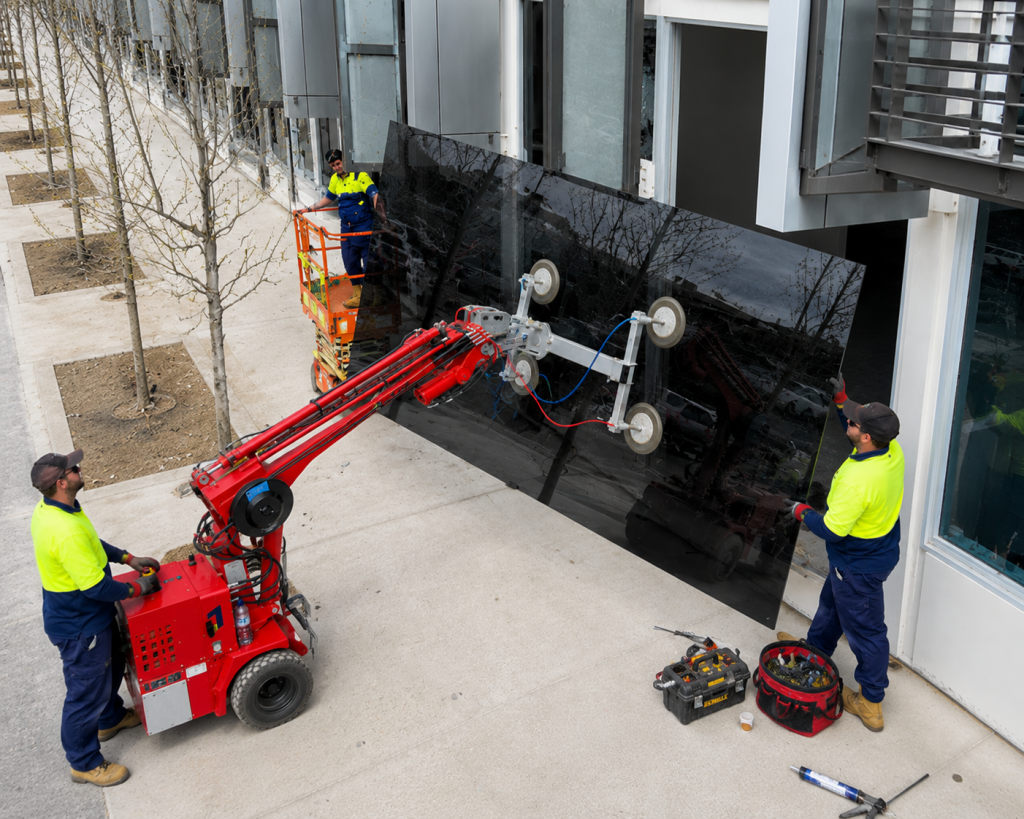
This is especially valuable with interior tempered glass.
Tempered architectural panels generally cannot simply be field-cut to entirely different dimensions after fabrication.
Reuse therefore needs to be designed into the project.
If an incoming tenant can naturally reuse six conference-room panels and eight office fronts, those materials should not disappear into a demolition dumpster before anyone notices them.
Denver Existing-Glass Reuse
Denver may have Colorado’s largest opportunity simply because of the amount of second-generation office inventory.
Large landlords may renovate suite after suite.
That creates the possibility of developing a repeatable process:
Survey → Catalog → Reuse → Supplement
That is far better than treating every vacant suite as a completely new glazing package.
Colorado Springs Existing-Glass Reuse
Colorado Springs can benefit from the same strategy, particularly in professional, medical, technical, and office properties.
A tenant may inherit a perfectly usable conference room but require more privacy.
The solution might be:
Keep Glass → Modify Door → Add Privacy Film → Improve Hardware
That approach is often better than replacing the entire enclosure.
Fort Collins Existing-Glass Reuse
Fort Collins adds industrial and technical spaces to the equation.
Existing glazing might include:
- Office partitions
- Observation windows
- Interior storefront
- Doors
- Reception glass
Some components may remain useful even when the operational layout changes.
The contractor should determine that before demolition.
Colorado Office Glass & Conference Room Systems
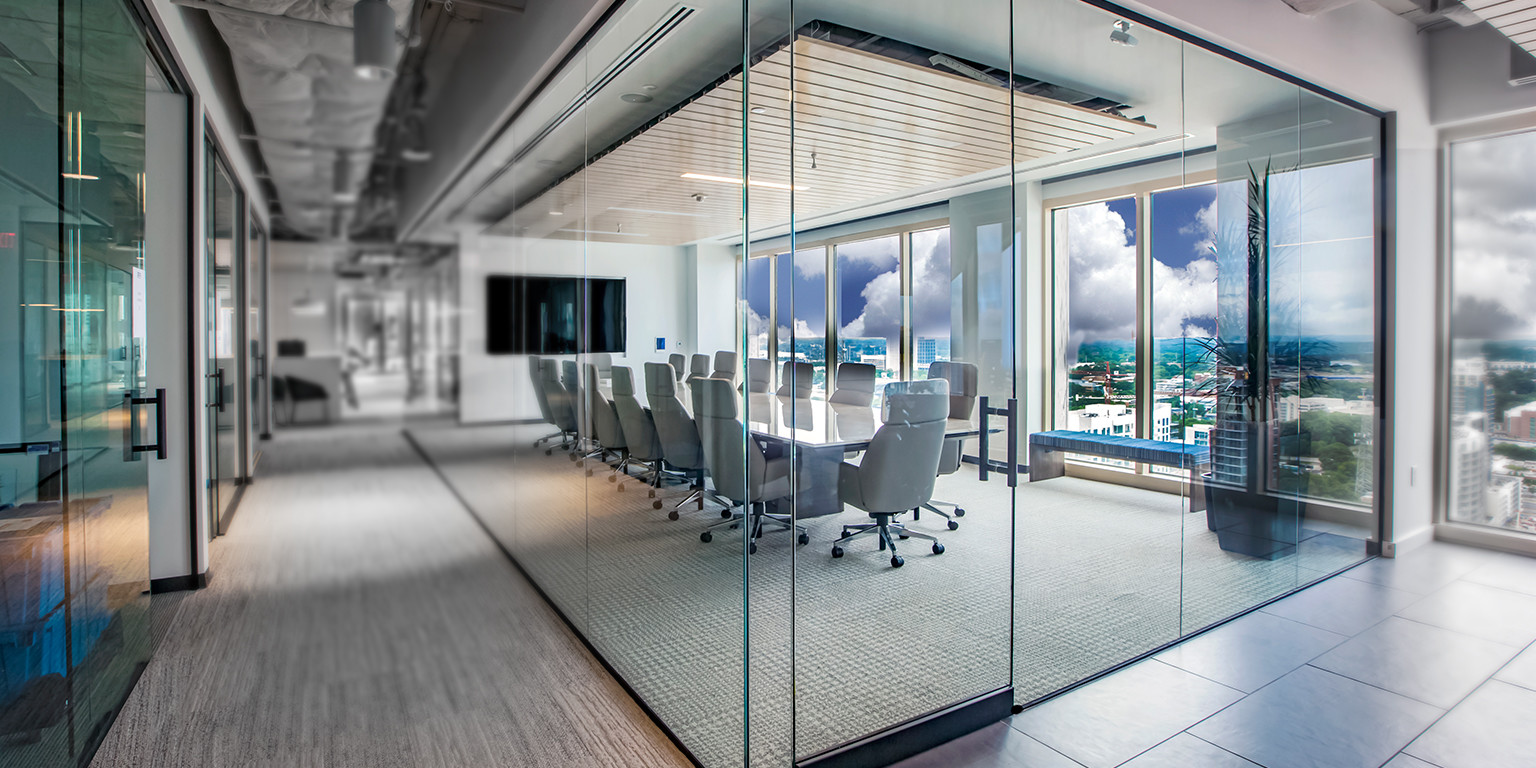
Office glass is one of the most repeatable TI glazing categories across Denver, Colorado Springs, and Fort Collins.
Typical applications include:
- Executive offices
- Private offices
- Conference rooms
- Boardrooms
- Huddle rooms
- Training areas
- Reception spaces
- Collaboration rooms
But not every glass wall needs to perform the same way.
Conference Room Glass
A complete conference-room system may include:
Glass + Framing + Door + Hardware + Privacy + Acoustics
That final component is frequently underestimated.
A conference room can look spectacular while functioning poorly if conversations easily travel through the doors, perimeter joints, ceilings, or adjacent construction.
The required level of privacy should be determined during design.
Acoustic Office Glass
Acoustic performance may matter particularly for:
- Executive offices
- HR
- Finance
- Legal
- Medical consultation
- Defense contractors
- Research teams
- Confidential meetings
Performance can depend on the entire assembly.
Glass alone doesn’t determine acoustics.
Framing, doors, seals, ceilings, and adjacent walls matter too.
Interior Glass & Colorado Office Daylighting
Glass can also help existing Colorado office buildings use their exterior windows more effectively.
An older layout might create:
Exterior Window → Private Office → Drywall → Interior Workspace
Replacing selected opaque office fronts with glass creates:
Exterior Window → Private Office → Glass → Interior Workspace
The building hasn’t gained another exterior window.
But daylight can penetrate deeper into the floor plate.
For Denver repositioning projects, that can help older office buildings feel substantially more contemporary.
For Fort Collins technology and research environments, it can help connect different teams visually.
For Colorado Springs professional and technical offices, it can create modern interiors without rebuilding the exterior envelope.
Denver Class A Office Glass
Denver has Colorado’s strongest premium office-glass opportunity.
The city’s strengthening 2026 leasing environment is increasingly highlighting the difference between prime Class A properties and commodity office space. CBRE notes that minimal new supply outside Cherry Creek is making the shortage of new prime Class A space increasingly relevant.
That creates opportunities for:
Premium Lobby Glass → Executive Offices → Boardrooms → Full-Height Glass → High-End Entrances → Amenity Glazing
Buildings one tier below the newest product also have a reason to upgrade.
That expands the opportunity beyond new construction.
Colorado Springs Security & Controlled-Access Glazing
Colorado Springs has arguably the strongest specialized security-glazing position of the three cities.
But security glass needs to be approached correctly.
A secure opening depends on more than the glass:
Glass + Framing + Anchoring + Door + Hardware + Adjacent Construction
Installing an upgraded glass product into an inadequate surrounding system does not necessarily provide the intended protection.
The performance objective should therefore be established during TI design.
Fort Collins Research & Technical Glass
Fort Collins can produce another kind of specialized requirement.
Research, engineering, manufacturing, healthcare, and technology environments may want visual connection while maintaining controlled separation.
Glass may divide:
- Office ↔ Laboratory
- Engineering ↔ Manufacturing
- Administration ↔ Operations
- Visitors ↔ Controlled Areas
That can require more thoughtful glazing than a standard office partition.
Colorado Industrial Tenant Improvement Glazing
Industrial TI is becoming increasingly important across the Front Range.
Denver’s industrial market recorded 1.07 million square feet of net absorption in Q1 2026, while leasing reached 4.46 million square feet—the highest quarterly total since Q3 2021.
But industrial glass can be a misleading term.
Much of the opportunity is actually an industrial building with a commercial office buildout inside it.
Warehouse Office Glass
A modern industrial facility may contain:
Employee Entrance → Reception → Administrative Offices → Conference Rooms → Training → Operations → Warehouse
Potential glazing includes:
- Exterior storefront
- Employee entrances
- Reception glass
- Office fronts
- Conference rooms
- Training-room glazing
- Observation windows
- Safety glass
The warehouse may contain relatively little architectural glass.
The administrative portion can contain a lot.
Denver Industrial TI Glass
Denver wins on scale.
The metro’s industrial market supports:
- Distribution
- Logistics
- Manufacturing
- Flex
- Warehouse
- Corporate industrial campuses
Large available industrial spaces can also generate TI allowances and subdivision work as landlords compete for tenants, creating opportunities for new office components, entrances, and interior improvements.
Fort Collins Industrial TI Glass
Fort Collins and Northern Colorado create a smaller but highly specialized industrial opportunity.
The regional corridor extends through:
Fort Collins → Loveland → Windsor → Greeley
Manufacturing, research, food production, technology, distribution, and flex users can all require commercial office and operational glazing.
Colorado Springs Industrial TI Glass
Colorado Springs adds defense, aerospace, manufacturing, logistics, and regional industrial users.
The result is another variation of the same basic requirement:
Industrial Shell → Tenant Requirements → Office Buildout → Commercial Glazing
Colorado Commercial Storefront Tenant Improvements
Storefront is where commercial glazing and tenant improvement construction intersect most visibly.
Throughout Denver, Colorado Springs, and Fort Collins, second-generation:
- Retail
- Restaurants
- Medical offices
- Banks
- Fitness centers
- Professional offices
- Ground-floor commercial spaces
continually change tenants.
Each transition creates a decision about whether to repair the existing storefront or replace it.
Storefront Repair vs Replacement
The glazing contractor should evaluate:
Framing → Glass → Doors → Hardware → Seals → Perimeter Conditions → Accessibility → Security
A new tenant does not automatically need a new storefront.
If the aluminum framing remains serviceable, the TI may only require:
- Glass replacement
- Failed IGU replacement
- Door adjustment
- New closers
- Hardware upgrades
- Weather seals
- Perimeter resealing
- Privacy or branding film
That preserves TI capital.
When Complete Storefront Replacement Makes Sense
Complete replacement becomes more appropriate when there is:
- Significant framing deterioration
- Chronic water intrusion
- Widespread glass failure
- Major entrance relocation
- Accessibility deficiencies
- Security requirements
- Major architectural redesign
The important distinction is that component failure is not the same as system failure.
A failed closer doesn’t mean the storefront has failed.
But repeated failures throughout the assembly may indicate a larger problem.
Colorado Medical Office Tenant Improvement Glass
Healthcare creates strong glazing opportunities in all three cities.
The emphasis varies.
Denver
Large healthcare systems, medical offices, administrative space, and specialized facilities.
Colorado Springs
Healthcare is one of the strongest specialized TI categories.
Fort Collins
Medical offices and healthcare environments complement the area’s research and technical economy.
Potential glazing applications include:
Reception → Administrative Offices → Conference Rooms → Staff Areas → Interior Entrances → Privacy Glass
The design needs to balance:
- Daylight + Privacy + Safety + Accessibility + Cleaning
- Retail & Restaurant Tenant Improvement Glazing
Retail and restaurants create another statewide category.
Retail glass connects:
Traffic → Visibility → Storefront → Merchandise → Entrance
Restaurant glass connects:
Traffic → Visibility → Activity → Atmosphere → Entrance
Potential restaurant scopes include:
- Exterior storefront
- Vestibules
- Glass entrances
- Private dining rooms
- Wine rooms
- Bar mirrors
- Patio glazing
- Operable glass
Denver provides the largest volume.
Colorado Springs provides substantial retail and hospitality demand.
Fort Collins adds its own restaurant, brewery, hospitality, and mixed-use character.
Commercial Entrance Systems
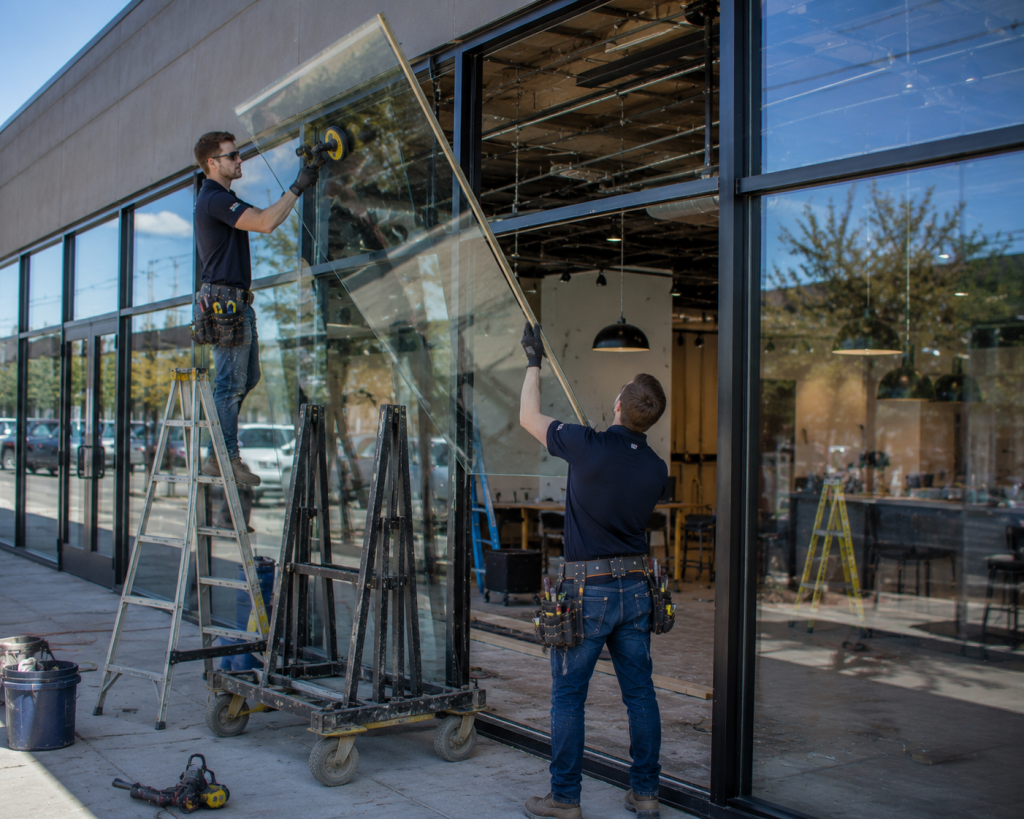
Entrances deserve to be treated separately from storefront.
A commercial entrance can involve:
- Aluminum doors
- All-glass doors
- Sidelites
- Transoms
- Closers
- Pivots
- Continuous hinges
- Panic hardware
- Automatic operators
- Electrified hardware
The entrance isn’t simply a piece of glass.
It is a building system that may operate thousands of times each week.
Access Control & Colorado TI Glass Doors
Electronic access adds another coordination layer.
A commercial glass entrance may need:
Card Reader → Electric Strike → Magnetic Lock → Door Sensor → Request-to-Exit → Automatic Operator
That creates a construction relationship:
Glazing Contractor → General Contractor → Hardware → Electrical → Security Integrator
The requirements need to be resolved before fabrication.
A late card-reader decision can become a glazing problem very quickly.
Spec Suite Glazing Across Colorado
Speculative suites can create particularly repeatable commercial glass work.
A landlord may build:
- ✓ Reception glazing
- ✓ Conference rooms
- ✓ Office fronts
- ✓ Glass doors
- ✓ Privacy film
That work can be completed before the final tenant signs.
Denver has the largest opportunity because of its extensive office inventory.
Colorado Springs can use spec suites to make existing buildings more competitive when new office construction is limited.
Fort Collins can apply similar strategies to professional, technology, medical, and flex environments.
Commercial Glass Value Engineering
The best glazing value engineering does not start by asking how to buy cheaper glass.
It starts by asking where glass creates the most value.
For many tenant improvements, that means prioritizing:
Reception
The tenant’s first architectural impression.
Conference Rooms
Highly visible and heavily used.
Perimeter Offices
Opportunity to transfer daylight.
Executive Areas
Privacy, acoustics, and presentation.
Entrances
Appearance, accessibility, security, and daily operation.
Then evaluate secondary areas more aggressively for cost.
Denver Glazing Value Engineering
Denver lends itself to:
Survey → Reuse → Reposition → Standardize
Its enormous existing office inventory makes glass reuse and building modernization particularly interesting.
Colorado Springs Glazing Value Engineering
Colorado Springs lends itself to:
Reuse → Specialize → Secure → Modernize
The contractor should identify whether a project actually requires specialized security or technical glazing before treating every opening the same.
Fort Collins Glazing Value Engineering
Fort Collins lends itself to:
Reuse → Integrate → Standardize → Adapt
The opportunity is often connecting conventional office architecture with research, manufacturing, industrial, or technical operations.
Colorado TI Glass Scheduling
One of the biggest glazing problems is deceptively simple.
Glass is installed late but must be planned early.
A simplified construction sequence is:
Design → Framing → Drywall → Finished Openings → Field Measure → Fabrication → Installation → Hardware → Punch
If the finished opening is late, measurement is late.
If measurement is late, fabrication is late.
Then glass becomes one of the last obstacles between the general contractor and occupancy.
The GC should therefore track the glass release date, not simply the glass installation date.
Flooring, Ceiling & Glass Coordination
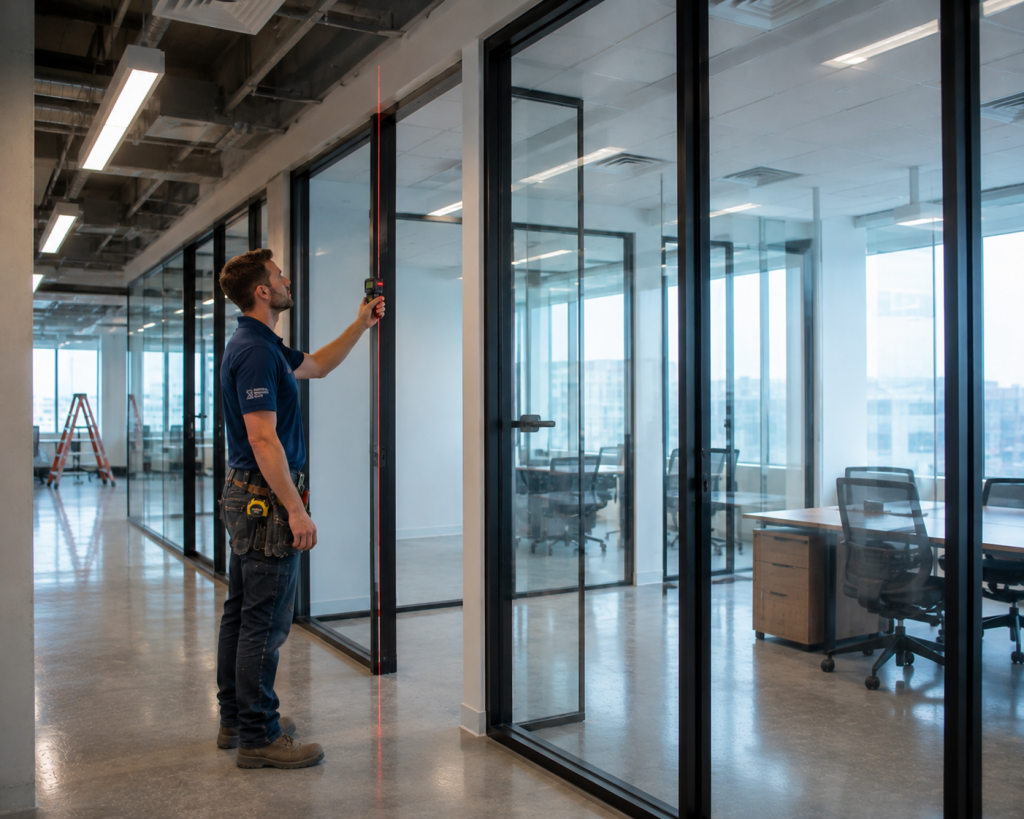
Interior glass can depend on:
- Finished-floor elevations
- Flooring thickness
- Thresholds
- Bottom channels
- Floor closers
- Ceiling grids
- Structural headers
- Deflection
- Lighting
- Sprinklers
Full-height glass makes early coordination even more important.
Glass may be installed near the end of a TI project. It should never be designed near the end.
Occupied Tenant Improvement Glazing
Many Colorado commercial renovations happen while neighboring tenants remain operational.
Glazing work may therefore require:
- ✓ Night installation
- ✓ Weekend work
- ✓ Temporary entrances
- ✓ Phased storefront replacement
- ✓ Temporary board-up
- ✓ Protected circulation
This becomes especially important for medical, retail, office, hospitality, and multi-tenant commercial properties.
One Colorado Commercial Glazing Corridor
The larger opportunity is seeing Denver, Colorado Springs, and Fort Collins as a connected market.
Northern Colorado connects:
Fort Collins → Loveland → Windsor → Greeley
The Denver metro connects:
Boulder → Denver → Aurora → Lakewood → Denver Tech Center
The Southern Front Range connects:
Castle Rock → Monument → Colorado Springs
Colorado’s commercial construction industry already operates across these boundaries; statewide firms describe tenant improvement work spanning office, industrial, retail and other commercial sectors throughout the Front Range.
For a commercial glazing contractor, that means the addressable market is much larger than one city.
Denver vs Colorado Springs vs Fort Collins — Where Is the Best TI Glass Opportunity?
Denver provides the deepest opportunity for:
Class A Office + Building Repositioning + Spec Suites + Industrial TI + Retail + Multi-Property Programs
Its office market remains highly competitive, while recent leasing and absorption improvements indicate more tenant movement through the existing inventory.
Colorado Springs — Best for Specialized Commercial TI
Colorado Springs provides a compelling mix of:
Defense + Aerospace + Healthcare + Office + Retail + Industrial
Limited recent office construction also increases the importance of improving existing commercial properties.
Fort Collins — Best for Office and Technical Integration
Fort Collins and Northern Colorado offer an unusually interesting mix of:
Technology + Research + Manufacturing + Healthcare + Office + Industrial
That creates glazing opportunities where glass is not merely decorative—it helps connect administrative, technical, research, and operational environments.
Colorado Tenant Improvement Glazing — Three Markets, One Strategy
The strongest way to think about Colorado commercial glass is:
- Fort Collins = Innovation & Industrial Integration
- Denver = Scale & Repositioning
- Colorado Springs = Specialized & Security-Sensitive TI
Together, they form a Front Range market where commercial glazing contractors can move between office buildouts, storefront renovations, industrial tenant improvements, medical facilities, conference rooms, glass office fronts, entrances, research environments, security glazing, restaurants, retail, and commercial property modernization.
For general contractors, developers, architects, property owners, facility managers, and tenant improvement contractors, the strongest process remains consistent across all three markets:
Survey Existing Glass → Preserve What Has Value → Coordinate Storefront & Entrances → Design Interior Glass Around the Tenant → Resolve Privacy, Acoustics & Security Early → Standardize Repeatable Openings → Release Fabrication Before It Threatens Occupancy
That is what turns commercial glass from a late-stage finish into an integral part of the Colorado tenant improvement construction strategy.