
Denver, Colorado Springs, Fort Collins, Salt Lake City, Oklahoma City, Albuquerque & Dallas — Tenant Improvement Glazing Contractors
Denver to Dallas Tenant Improvement Glass Contractors
Denver, Colorado Springs, Fort Collins, Salt Lake City, Oklahoma City, Albuquerque, and Dallas create something much larger than seven individual commercial glass markets.
Together, they form a Mountain West-to-North Texas tenant improvement glazing network connecting some of the country’s most important office, industrial, healthcare, technology, defense, aerospace, logistics, retail, and advanced-manufacturing markets.
From a commercial glass perspective, the opportunity is not simply geographic.
Each market represents a different type of tenant improvement demand:
- Denver = Office Repositioning + Class A Modernization
- Colorado Springs = Defense + Aerospace + Healthcare
- Fort Collins = Research + Technology + Manufacturing
- Salt Lake City = Wasatch Front Growth + Corporate + Industrial
- Oklahoma City = Healthcare + Energy + Regional Commercial TI
- Albuquerque = Aerospace + Defense + Advanced Manufacturing
Dallas = Corporate Scale + Industrial Expansion + Multi-Floor TI
Together, they create opportunities across:
Commercial Storefront → Office Glass → Conference Rooms → Entrances → Industrial Office Buildouts → Security Glazing → Specialty Glass → Building Modernization
Seven Commercial TI Glazing Markets
| Market | Strongest TI Glass Position | Major Opportunity |
|---|---|---|
| Denver | Office repositioning | Existing-building modernization |
| Colorado Springs | Specialized commercial TI | Defense, aerospace & healthcare |
| Fort Collins | Office / operations integration | Research & advanced manufacturing |
| Salt Lake City | Regional TI programs | Wasatch Front corporate & industrial |
| Oklahoma City | Existing-space renovation | Healthcare, energy & regional business |
| Albuquerque | Technical glazing | Aerospace, defense & manufacturing |
| Dallas | Large-scale TI | Corporate, industrial & portfolio work |
This diversity is what makes the larger footprint compelling.
A glazing contractor network does not have to depend on one type of construction cycle.
Denver Tenant Improvement Glazing Contractors
Denver is the largest commercial market in the Mountain West portion of this group and one of the strongest opportunities for office renovation, spec suites, commercial building repositioning, industrial TI, and Class A office glass.
A Denver project may involve:
- Interior office fronts
- Conference rooms
- Executive offices
- Lobby glass
- Commercial entrances
- Storefront renovation
- Spec-suite glazing
- Industrial office glass
- Failed IGU replacement
Denver’s distinguishing opportunity is its enormous amount of existing commercial space.
That changes the contractor’s starting question from what glass is being installed to what glass is already there that still has value.
Regional TI Glazing Contractors Overview
Denver to Dallas Commercial Glass & TI Markets
Dallas, OKC & Denver Storefront & TI Glazing
Colorado Springs, Fort Collins & SLC TI Glass
Denver, SLC & Dallas Office Glass & TI Glazing
Dallas, OKC & Albuquerque Commercial Glass & TI
Colorado Regional TI Glazing Contractors
SLC vs Dallas: Class A Office Glass & TI
Colorado Springs vs Albuquerque Storefront & TI
Dallas vs Denver: Office Buildout & TI Glass
OKC vs Albuquerque Commercial Glass & TI
Fort Collins vs SLC Office Glass & TI Markets
Denver Office Repositioning Glass
A commercial property may already have good structure, parking, exterior glazing, and floor plates but still feel dated to prospective tenants.
The repositioning sequence can become:
Entrance → Lobby → Amenities → Spec Suites → Interior Glass → Tenant Buildout
Commercial glazing can participate at nearly every stage.
That makes glass part of the leasing strategy rather than merely a late-stage construction finish.
Colorado Springs Tenant Improvement Glazing Contractors
Colorado Springs creates a more specialized commercial TI environment.
Its combination of:
Defense + Aerospace + Healthcare + Technology + Professional Office + Industrial
can create glazing requirements that extend beyond conventional office partitions.
Projects may involve:
- Controlled entrances
- Secure reception areas
- Interior office glass
- Conference rooms
- Privacy systems
- Laminated glazing
- Access-controlled doors
- Specialty framing
Not every defense or aerospace tenant requires specialty glass.
But when performance requirements exist, they need to be established early.
Colorado Springs Security Glazing
Security glazing should always be considered as an assembly:
Glass + Framing + Anchoring + Door + Hardware + Adjacent Construction
Simply installing stronger glass does not necessarily create a stronger opening.
For tenant improvement contractors, this makes early coordination between the architect, GC, glazing contractor, security consultant, and hardware trades particularly important.
Denver vs Colorado Springs Commercial Glazing
Albuquerque vs SLC Commercial Glass & TI
Dallas vs OKC Commercial TI & Buildout Markets
Colorado Springs vs Fort Collins TI & Office Glass
Denver vs SLC Commercial Glass & TI Glazing
Denver vs Dallas TI Glazing & Commercial Glass
Dallas TI Glass & Commercial Glazing
Albuquerque Commercial Glass & TI Contractors
OKC TI Glazing & Storefront Contractors
Salt Lake City Commercial TI & Office Glass
Fort Collins TI Glass & Commercial Glazing
Colorado Springs Commercial Glass & TI Glazing
Denver Tenant Improvement Glazing Contractors
Fort Collins Tenant Improvement Glass Contractors
Fort Collins introduces another commercial-glass niche in office-to-operations integration.
Northern Colorado supports a strong mixture of:
- Research
- Technology
- Manufacturing
- Healthcare
- Education
- Food production
- Industrial
- Professional office
That means a single facility might contain:
Reception → Offices → Conference Rooms → Engineering → Research → Production → Warehouse
Glass can help connect these environments visually while maintaining physical separation.
Fort Collins Technical & Industrial Glazing
Potential applications include:
- ✓ Office fronts
- ✓ Conference rooms
- ✓ Observation windows
- ✓ Interior storefront
- ✓ Safety glazing
- ✓ Controlled doors
- ✓ Employee entrances
- ✓ Reception glass
The facility may technically be classified as industrial.
But the glazing package can look much more like a sophisticated commercial office buildout.
Salt Lake City Tenant Improvement Glazing Contractors
Salt Lake City should be considered as the center of a broader Wasatch Front commercial market:
Salt Lake City → Murray → Sandy → Draper → Lehi → Provo
That corridor creates substantial tenant improvement demand involving:
- Corporate offices
- Technology
- Healthcare
- Financial services
- Professional offices
- Industrial
- Logistics
- Retail
- Restaurants
For glazing contractors, Salt Lake City’s advantage is the opportunity to develop repeatable regional TI programs.
Salt Lake City Standardized Office Glass
A landlord or corporate tenant can establish common standards for:
Office Front → Conference Room → Door → Hardware → Privacy
Those standards can then be repeated across multiple suites or properties.
That simplifies:
- Estimating
- Procurement
- Fabrication
- Installation
- Future repairs
Standardization also creates better opportunities for future reuse.
Oklahoma City Tenant Improvement Glazing Contractors
Oklahoma City provides a strong regional commercial TI market centered around:
Healthcare + Energy + Financial Services + Office + Industrial + Retail + Hospitality
The projects may not always have Dallas-scale glazing packages.
But they can create something equally valuable in repeat commercial relationships.
A property manager, developer, healthcare organization, or GC may generate a steady stream of:
- Office renovations
- Medical TI
- Storefront modifications
- Restaurant buildouts
- Commercial entrance work
- Industrial office renovations
For glazing contractors, consistency can matter more than individual project size.
Oklahoma City Existing-Space Glazing
A second-generation office might already contain:
Reception Glass + Conference Rooms + Office Fronts + Glass Doors
Instead of automatically demolishing those systems, the TI contractor can evaluate:
Keep → Modify → Refinish → Supplement
That can preserve substantial previous investment.
Albuquerque Tenant Improvement Glazing Contractors
Albuquerque is arguably the most technically specialized market in the group.
Its commercial environment combines:
Aerospace + Defense + Advanced Manufacturing + Research + Healthcare + Office + Industrial
That can create projects where conventional office glazing sits alongside much more specialized requirements.
A facility may contain:
Administration → Engineering → Research → Manufacturing → Operations
Commercial glass can help create controlled visual connections between those environments.
Albuquerque Technical Glazing
Potential requirements can include:
- Observation glazing
- Controlled entrances
- Security glass
- Interior office systems
- Specialty partitions
- Laminated glazing
- Access-controlled doors
- Safety glazing
The strongest contractors are not necessarily those who specify the most expensive product.
They’re the ones who understand what each opening actually needs to accomplish.
Dallas Tenant Improvement Glazing Contractors
Dallas is the scale engine.
A large DFW office buildout can contain:
- Dozens of conference rooms
- Hundreds of office-front panels
- Executive boardrooms
- Reception glazing
- Training centers
- Glass corridors
- Controlled entrances
- Specialty privacy systems
The project may span multiple floors.
At that point, the commercial glazing contractor is managing a significant construction package.
Dallas rewards:
- Capacity + Standardization + Coordination + Repeatability
- Dallas Multi-Floor Office Glass
Large projects benefit from limiting unnecessary variation.
Instead of 30 unique office-front configurations, a project can define a small set of repeating details:
- Standard Office A
- Standard Office B
- Standard Conference Room
- Standard Door
Those details can be repeated throughout the project.
That simplifies fabrication and reduces coordination complexity.
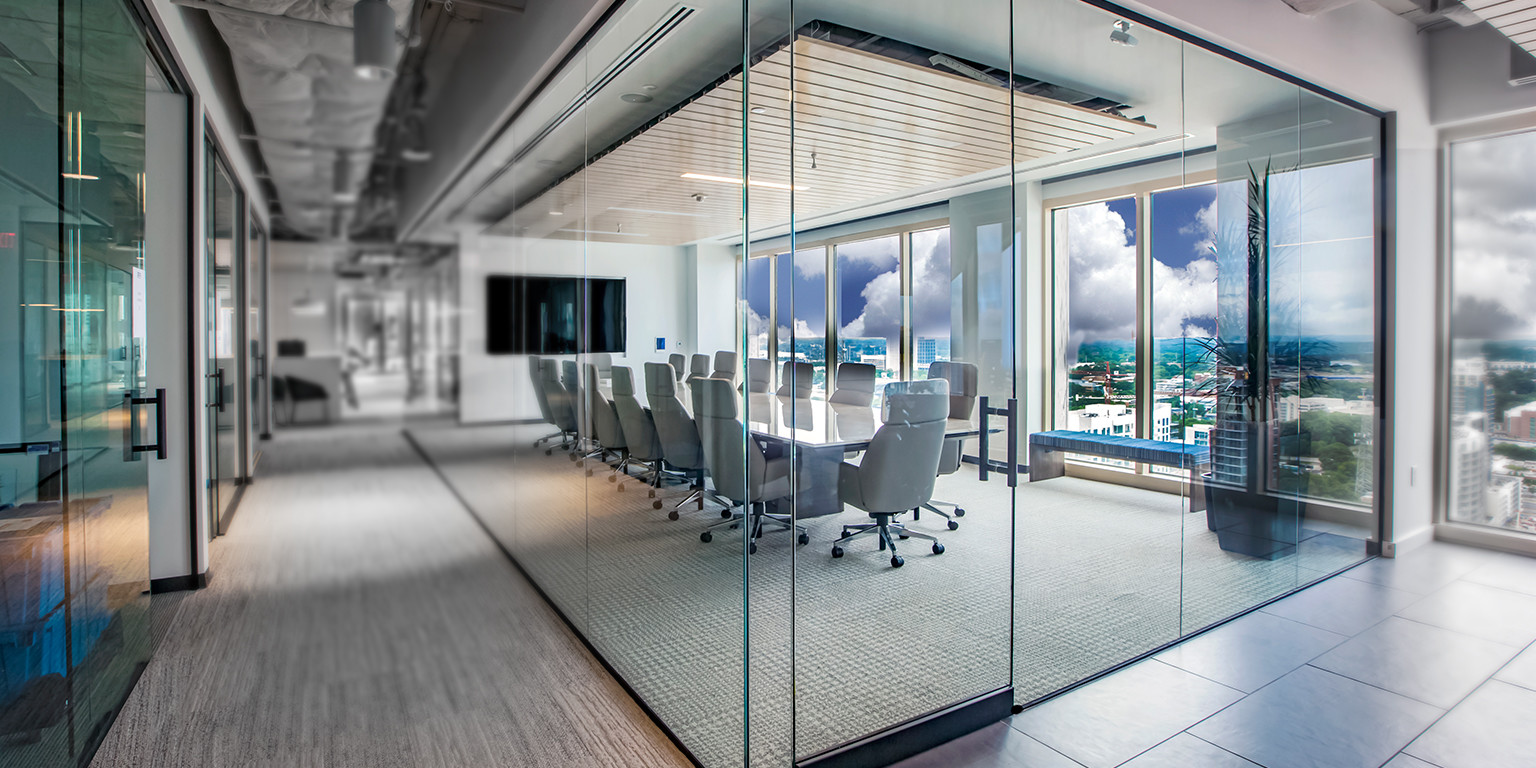
One Tenant Improvement Glass Strategy Across Seven Markets
Although these cities are different, the core TI glazing process remains remarkably similar.
The strongest sequence is:
Existing Conditions → Glazing Survey → New Floor Plan → Reuse Analysis → Design → Coordination → Fabrication → Installation → Hardware → Punch
That sequence matters because glass has a peculiar construction problem.
It is installed late but needs to be planned early.
Survey Existing Glass Before Demolition
This should become standard practice for second-generation commercial tenant improvements.
Inventory:
- Conference-room panels
- Glass office fronts
- Glass doors
- Sidelites
- Reception glazing
- Interior storefront
- Mirrors
- Exterior storefront
The previous tenant may have invested $100,000 or more into architectural glazing.
Demolition can erase that investment in a few hours.
Existing Glass Is a Building Asset
The better question is whether any of that glazing can become part of the next tenant improvement.
Sometimes the answer is no.
Sometimes it is substantial.
The important part is asking before demolition.
Reusing Tempered Glass
Tempered architectural glass generally cannot simply be field-cut to a completely different size.
That makes reuse a design problem.
A better process is:
Measure Existing Panels → Compare With New Openings → Identify Matches → Preserve Selected Glass → Fabricate What’s Missing
Perhaps only 20% can be reused.
That can still matter.
Across dozens of suites and multiple buildings, even modest reuse percentages can compound.
Seven Markets, Seven Reuse Opportunities
Denver
Large second-generation office inventory.
Colorado Springs
Professional, medical, technical, and defense-related interiors.
Fort Collins
Office, research, and industrial environments.
Salt Lake City
Repeatable Wasatch Front tenant layouts.
Oklahoma City
Existing professional and healthcare space.
Albuquerque
Office, research, industrial, and technical facilities.
Dallas
Massive office and portfolio inventory.
Glass reuse does not need to be an environmental slogan.
It can simply be good commercial construction economics.
Commercial Storefront Tenant Improvements
Storefront is another universal opportunity across all seven markets.
Retailers, restaurants, medical offices, banks, fitness centers, and ground-floor commercial tenants continually inherit existing aluminum storefront systems.
Every new tenant creates a question:
Repair → Modify → Modernize → Replace?
The answer should follow an inspection.
Storefront Glass Assessment
Evaluate:
- ✓ Aluminum framing
- ✓ Glass
- ✓ Insulated glass units
- ✓ Entrance doors
- ✓ Closers
- ✓ Hinges and pivots
- ✓ Thresholds
- ✓ Weather seals
- ✓ Perimeter sealants
- ✓ Accessibility
- ✓ Security
A $2 million interior renovation does not automatically require complete storefront replacement.
Component Failure vs System Failure
This distinction can protect TI budgets.
A broken lite is a component failure.
A failed closer is a component failure.
A fogged IGU may be a component failure.
But other conditions may indicate a system-level problem:
- Widespread framing deterioration
- Chronic water intrusion
- Extensive glass failure
- Major entrance relocation
- Serious security deficiencies
The glazing contractor should help the project team distinguish between the two.
Commercial Entrance Systems
Entrances deserve their own evaluation.
A commercial entrance can include:
- Aluminum doors
- All-glass doors
- Sidelites
- Transoms
- Closers
- Pivots
- Continuous hinges
- Panic hardware
- Automatic operators
- Electrified hardware
The entrance is not simply part of the storefront.
It is an operating building system.
Access Control & Glass Doors
Modern tenant improvements increasingly integrate electronic access.
That creates a coordination chain:
Glazing Contractor → General Contractor → Hardware → Electrical → Security Integrator
The opening may require:
- Card readers
- Electric strikes
- Magnetic locks
- Door-position switches
- Request-to-exit devices
- Automatic operators
These requirements should be established before fabrication.
Office Tenant Improvement Glass
Interior office glazing is the most transferable service across all seven markets.
Applications include:
- Executive offices
- Private offices
- Conference rooms
- Boardrooms
- Huddle rooms
- Training rooms
- Reception
- Collaboration spaces
- Glass corridors
The size of the project changes.
The underlying glazing principles do not.
Interior Glass & Daylighting
Consider an older office layout:
Exterior Window → Private Office → Drywall → Interior Workspace
The perimeter offices capture the daylight.
Replacing the opaque office fronts with glass changes the sequence:
Exterior Window → Private Office → Glass → Interior Workspace
The exterior façade has not changed.
But natural light can travel deeper into the tenant space.
That makes interior glass part of the office modernization strategy.
Conference Room Glass
Conference rooms require more than transparent partitions.
Think:
Glass + Framing + Door + Hardware + Privacy + Acoustics
A beautiful glass room can still be unsuccessful if confidential conversations can be heard throughout the office.
Acoustic performance can depend on:
- Glass configuration
- Laminated glass
- Framing
- Door seals
- Perimeter seals
- Ceiling construction
- Adjacent partitions
This becomes especially important in corporate, medical, financial, legal, defense, and research environments.
Privacy Glass & Film
Transparency is not appropriate everywhere.
Privacy may be needed around:
- Executive offices
- HR
- Finance
- Legal
- Medical consultations
- Technical meetings
- Boardrooms
Options include:
Frosted Film → Gradient Film → Decorative Glass → Laminated Glass → Switchable Privacy
Film can be especially valuable when existing clear glass is otherwise worth preserving.

Industrial Tenant Improvement Glazing
Industrial TI may be one of the largest cross-market opportunities.
Dallas, Denver, Salt Lake City, Fort Collins, Oklahoma City, Albuquerque, and Colorado Springs all have meaningful industrial economies.
A warehouse or manufacturing building can contain:
Employee Entrance → Reception → Offices → Conference Rooms → Training → Operations → Production / Warehouse
That can generate substantial architectural glazing.
Warehouse Office Buildout Glass
Potential scopes include:
- Exterior storefront
- Employee entrances
- Office fronts
- Conference rooms
- Training-room glass
- Observation windows
- Safety glazing
- Interior storefront
A 300,000-square-foot warehouse may contain only 20,000 square feet of office.
Those 20,000 square feet can contain most of the project’s architectural glass.
Medical Office Tenant Improvement Glass
Healthcare is another category that exists throughout the network.
Medical TI glass can include:
- Automatic entrances
- Reception glazing
- Administrative offices
- Conference rooms
- Staff areas
- Interior doors
- Privacy glass
Healthcare requires a balance of:
Visibility + Privacy + Accessibility + Safety + Cleaning
That makes medical-office glazing a specialized subset of commercial TI.
Retail Storefront Glazing
Retail glass connects:
Traffic → Storefront → Merchandise → Entrance → Sales
A new retailer may want:
- Greater transparency
- Larger displays
- New doors
- Security upgrades
- New film
- Modified storefront framing
The storefront should be coordinated with the tenant’s merchandising strategy.
Restaurant Tenant Improvement Glass
Restaurants use glazing differently.
The sequence becomes:
Traffic → Storefront → Activity → Atmosphere → Entrance
Potential scopes include:
- Exterior storefront
- Vestibules
- Entrance systems
- Private dining rooms
- Wine-room glass
- Mirrors
- Patio glazing
- Operable systems
Dallas and Denver provide the greatest scale, but restaurant TI exists throughout all seven markets.
Spec Suite Glazing
Speculative suites create another repeatable opportunity.
Ownership may build:
- ✓ Reception glazing
- ✓ Conference rooms
- ✓ Glass office fronts
- ✓ Doors
- ✓ Privacy systems
That work can be completed before the final tenant signs.
The advantage is simple:
Empty Suite → Finished Workplace
That can shorten the tenant’s decision-making and construction timeline.
Building Repositioning & Commercial Glass
Denver provides the clearest example, but repositioning applies throughout the network.
An older property can be upgraded through:
Entrance → Lobby → Storefront → Amenities → Spec Suites → Interior Glass
This allows ownership to improve the tenant experience without replacing the entire building.
Commercial glazing becomes part of the capital improvement strategy.
Tenant Improvement Glass Value Engineering
The strongest value engineering question isn’t where glass can be eliminated.
It is where glass creates enough value to justify the investment.
Entrance
Accessibility, security, appearance, operation.
Reception
First impression.
Conference Rooms
Visibility and frequent use.
Perimeter Offices
Daylight transfer.
Executive Areas
Privacy and presentation.
Technical Areas
Visibility, separation, safety, or security.
Storefront
Visibility and exterior performance.
Then secondary spaces can be evaluated more aggressively.
Seven Markets Require Different TI Glazing Strategies
Denver
Survey → Reuse → Retrofit → Reposition
Colorado Springs
Assess → Secure → Specialize → Modernize
Fort Collins
Integrate → Observe → Separate → Adapt
Salt Lake City
Standardize → Repeat → Expand → Scale
Oklahoma City
Repair → Modernize → Build Relationships → Repeat
Albuquerque
Retrofit → Specialize → Protect → Integrate
Dallas
Standardize → Fabricate → Scale → Repeat
These aren’t different glazing businesses.
They’re different applications of the same commercial glazing capabilities.
Glass Fabrication & TI Scheduling
Every market shares one fundamental problem.
Glass is installed late but must be coordinated early.
The typical sequence is:
Design → Framing → Drywall → Finished Opening → Field Measure → Fabrication → Installation → Hardware → Punch
If framing is late, measurement is late.
If measurement is late, fabrication is late.
Then glass becomes one of the final obstacles between the GC and occupancy.
The critical milestone is therefore the glass release date, not simply the glass installation date.
Exterior Storefront vs Interior Glass Scheduling
One tenant improvement may actually contain several glazing schedules:
Storefront Framing → Exterior Glass → Entrance Systems → Interior Office Glass → Glass Doors → Hardware → Punch
Treating everything as one late-stage glass scope can create unnecessary delays.
From Local Glass Contractors to a Regional TI Glazing Network
The seven markets become particularly powerful when connected.
Front Range
Fort Collins → Denver → Colorado Springs
Wasatch Front
Salt Lake City → Sandy → Draper → Lehi → Provo
Southern Plains
Oklahoma City → Dallas-Fort Worth
Southwest
Albuquerque → Santa Fe → Regional Technical & Industrial Markets
That creates a broader footprint capable of serving multi-location:
- Corporate tenants
- Retailers
- Restaurant groups
- Healthcare organizations
- Industrial portfolios
- Property owners
- Developers
- General contractors
A regional client may not want seven different glazing strategies.
They may want one standard executed in seven markets.
Regional Commercial Glass Standardization
That opens a larger opportunity.
A portfolio can standardize:
- Storefront Systems
- Office Fronts
- Conference Rooms
- Doors
- Hardware
- Privacy
- Entrance Systems
Then local contractors execute the same design intent in each market.
That can improve:
- Estimating
- Procurement
- Brand consistency
- Maintenance
- Replacement
- Future tenant turnover
The commercial glazing relationship moves beyond one project.
It becomes a multi-market tenant improvement program.
Seven Cities, Seven Commercial Glazing Engines
The overall network can be summarized:
- Denver — Reposition
- Colorado Springs — Specialize
- Fort Collins — Integrate
- Salt Lake City — Standardize
- Oklahoma City — Repeat
- Albuquerque — Technicalize
- Dallas — Scale
Together, these markets cover an unusually broad spectrum of tenant improvement demand—from Class A corporate offices and medical suites to aerospace facilities, advanced manufacturing, warehouses, restaurants, retail storefronts, research environments, and security-sensitive commercial properties.
For commercial glazing contractors, tenant improvement contractors, general contractors, developers, property owners, architects, and facility managers, the strongest regional process remains:
Survey Existing Glass → Preserve What Has Value → Determine Repair vs Replacement → Coordinate Storefront & Entrances Early → Design Interior Glass Around the Tenant → Resolve Privacy, Acoustics, Security & Access Control → Standardize Repeatable Systems → Release Fabrication Before Occupancy Is Threatened
The real opportunity is not simply finding a tenant improvement glazing contractor in seven cities.
It is creating a commercial glass strategy capable of following the same client from Denver to Colorado Springs, Fort Collins to Salt Lake City, Albuquerque to Oklahoma City, and ultimately Dallas-Fort Worth—while adapting the glazing package to the very different commercial forces driving each market.