
Colorado Springs, Fort Collins & Salt Lake City — Tenant Improvement Glass Contractors
Colorado Springs, Fort Collins & Salt Lake City — Tenant Improvement Glass Contractors, Commercial Glazing & Office Buildout Glass
Colorado Springs, Fort Collins, and Salt Lake City form an interesting commercial glazing triangle across the Mountain West.
None has the sheer commercial scale of Dallas or Denver, but that is precisely what makes the comparison useful. These markets contain strong concentrations of technology, defense, aerospace, healthcare, research, advanced manufacturing, industrial facilities, professional offices, retail, and second-generation commercial space.
For tenant improvement glass contractors, commercial glazing companies, general contractors, developers, property managers, architects, and facility teams, each market presents a different opportunity:
Colorado Springs = Defense + Aerospace + Healthcare + Specialized TI
Fort Collins = Research + Technology + Manufacturing + Office/Industrial Integration
Salt Lake City = Corporate Growth + Wasatch Front Scale + Industrial & Repeatable TI
Across all three, commercial glass connects the tenant improvement process:
Storefront → Entrances → Office Glass → Conference Rooms → Interior Partitions → Privacy → Security → Specialty Glazing
Colorado Springs vs Fort Collins vs Salt Lake City TI Glazing
| Commercial Glass Opportunity | Colorado Springs | Fort Collins | Salt Lake City |
|---|---|---|---|
| Office tenant improvements | Very strong | Strong | Very strong |
| Interior office glass | Very strong | Very strong | Exceptional |
| Conference-room glazing | Very strong | Very strong | Exceptional |
| Defense / aerospace TI | Exceptional | Moderate | Strong |
| Research / technology glazing | Very strong | Exceptional | Very strong |
| Advanced manufacturing TI | Strong | Exceptional | Very strong |
| Industrial office glass | Very strong | Exceptional | Exceptional |
| Medical office TI | Exceptional | Very strong | Very strong |
| Commercial storefront renovation | Very strong | Strong | Exceptional |
| Security glazing | Exceptional | Strong | Very strong |
| Existing-glass reuse | Major opportunity | Major opportunity | Major opportunity |
| Multi-location TI programs | Strong | Strong | Exceptional |
The glass systems overlap.
The tenants creating demand for them are different.
Regional TI Glazing Contractors Overview
Denver to Dallas Commercial Glass & TI Markets
Dallas, OKC & Denver Storefront & TI Glazing
Colorado Springs, Fort Collins & SLC
Regional TI Glazing Contractors Overview TI Glass
Denver, SLC & Dallas Office Glass & TI Glazing
Dallas, OKC & Albuquerque Commercial Glass & TI
Colorado Regional TI Glazing Contractors
SLC vs Dallas: Class A Office Glass & TI
Colorado Springs vs Albuquerque Storefront & TI
Dallas vs Denver: Office Buildout & TI Glass
OKC vs Albuquerque Commercial Glass & TI
Fort Collins vs SLC Office Glass & TI Markets
Colorado Springs Tenant Improvement Glass Contractors
Colorado Springs has one of the most specialized commercial tenant mixes of the three markets.
Commercial glazing opportunities can emerge from:
- Defense contractors
- Aerospace companies
- Healthcare
- Medical offices
- Technology companies
- Professional services
- Hospitality
- Retail
- Industrial users
A conventional tenant improvement might require:
Reception → Conference Rooms → Glass Offices
A more specialized project could require:
Controlled Entrance → Secure Reception → Office Glass → Technical Areas → Access-Controlled Openings
That difference matters.
Colorado Springs Office Glass
Professional office buildouts can require:
- Glass office fronts
- Conference rooms
- Executive offices
- Huddle rooms
- Reception glazing
- Interior doors
- Privacy film
- Access-controlled entrances
Interior glass can also help modernize older office configurations.
Instead of:
Exterior Window → Private Office → Drywall → Interior Workspace
a renovated suite can create:
Exterior Window → Glass Office → Interior Workspace
The building hasn’t gained additional windows.
The tenant simply gets more value from the daylight already entering the building.
Colorado Springs Security & Specialty Glazing
Defense, aerospace, medical, institutional, and other controlled environments can introduce security considerations.
But a critical distinction needs to be made between a security glass product and a secure opening.
The performance of an opening can depend on:
Glass + Framing + Anchoring + Door + Hardware + Adjacent Construction
A high-performance glass product installed into an inappropriate surrounding system may not achieve the intended result.
Security requirements therefore belong in the TI design process—not as a last-minute glass substitution.
Fort Collins Tenant Improvement Glass Contractors
Fort Collins creates a different kind of commercial glazing market.
Northern Colorado combines:
- Research
- Technology
- Advanced manufacturing
- Healthcare
- Education
- Food production
- Professional offices
- Industrial facilities
- Flex buildings
That creates one of the more interesting commercial-glass niches in office-to-operations glazing.
Fort Collins Office & Industrial Glass
Consider a commercial facility arranged as:
Entrance → Reception → Offices → Conference Rooms → Engineering → Production → Warehouse
Commercial glass may be used throughout the transitions.
Potential applications include:
- Exterior storefront
- Employee entrances
- Interior office fronts
- Conference rooms
- Observation windows
- Safety glazing
- Controlled doors
- Reception glass
The glazing isn’t necessarily there just to make the office look modern.
It may help connect administrative, engineering, manufacturing, and operational teams visually.
Denver vs Colorado Springs Commercial Glazing
Albuquerque vs SLC Commercial Glass & TI
Dallas vs OKC Commercial TI & Buildout Markets
Colorado Springs vs Fort Collins TI & Office Glass
Denver vs SLC Commercial Glass & TI Glazing
Denver vs Dallas TI Glazing & Commercial Glass
Dallas TI Glass & Commercial Glazing
Albuquerque Commercial Glass & TI Contractors
OKC TI Glazing & Storefront Contractors
Salt Lake City Commercial TI & Office Glass
Fort Collins TI Glass & Commercial Glazing
Colorado Springs Commercial Glass & TI Glazing
Denver Tenant Improvement Glazing Contractors
Fort Collins Research & Technical Glazing
Research and technical facilities create another opportunity.
Glass may divide:
- Office ↔ Research
- Engineering ↔ Production
- Visitors ↔ Controlled Operations
- Administration ↔ Technical Space
Depending on the project, those openings may need to address:
- Safety
- Acoustics
- Privacy
- Access control
- Visibility
- Specialized operational requirements
That makes early glazing coordination more important.
Salt Lake City Tenant Improvement Glass Contractors
Salt Lake City has the largest regional commercial footprint of these three markets.
The key is not viewing Salt Lake City only as downtown.
The broader commercial corridor extends through:
Salt Lake City → Murray → Sandy → Draper → Lehi → Provo
That creates opportunities involving:
- Corporate offices
- Technology
- Healthcare
- Financial services
- Professional offices
- Industrial facilities
- Warehouses
- Retail
- Restaurants
- Mixed-use properties
For a glazing contractor, the real opportunity is the Wasatch Front tenant improvement market.
Salt Lake City Office Buildout Glass
Office TI glazing can include:
- Private office fronts
- Executive offices
- Conference rooms
- Boardrooms
- Reception glazing
- Collaboration spaces
- Training rooms
- Glass doors
- Privacy treatments
Salt Lake City’s advantage is repeatability.
A property owner or corporate tenant operating across several Wasatch Front locations can potentially establish a consistent glazing standard.
That creates:
Standard Office Front → Standard Conference Room → Standard Door → Standard Hardware → Repeat
For contractors, repeatability can be as valuable as project size.
Salt Lake City Industrial TI Glass
Salt Lake City also has a strong industrial and logistics component.
A warehouse or distribution facility may contain:
Employee Entrance → Reception → Offices → Conference Rooms → Training → Operations → Warehouse
Commercial glass can appear throughout the administrative portion.
Typical scopes can include:
- ✓ Exterior storefront
- ✓ Employee entrances
- ✓ Interior office glass
- ✓ Conference rooms
- ✓ Training-room glazing
- ✓ Operations windows
The building may be primarily industrial.
The glass package may still look surprisingly similar to a commercial office TI.
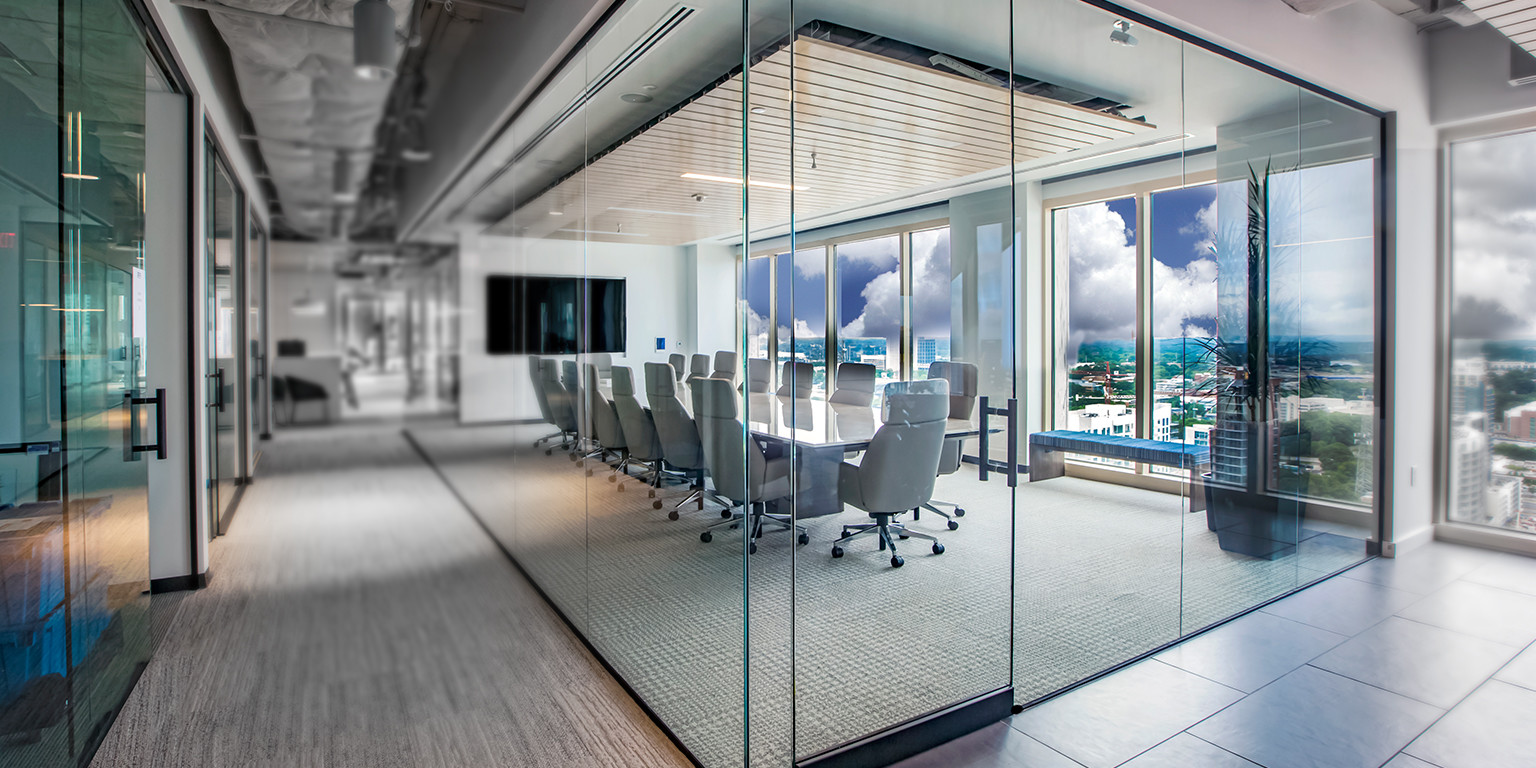
Existing Glass Before Tenant Improvement Demolition
All three markets have substantial second-generation commercial inventory.
Before demolition, identify:
- Conference-room glass
- Office fronts
- Glass doors
- Sidelites
- Reception glazing
- Interior storefront
- Mirrors
- Exterior storefront
The previous tenant may have spent significant money installing those systems.
A new lease doesn’t automatically eliminate their remaining value.
Why Glass Reuse Requires Early Planning
Tempered architectural glass generally cannot simply be field-cut to an entirely different dimension after fabrication.
That means reuse needs to be evaluated before demolition.
A stronger process is:
Survey → Measure → Catalog → Compare With New Floor Plan → Preserve Compatible Glass → Fabricate What’s Missing
Not everything will work.
It doesn’t need to.
If 20% of an existing glazing package can naturally be incorporated into the new design, that can still reduce unnecessary demolition, disposal, fabrication, and installation.
Colorado Springs Existing-Glass Reuse
A Colorado Springs professional or technical tenant might inherit an existing conference room.
Instead of:
Demolish → Reframe → Reorder Glass
the TI might allow:
Keep Glass → Modify Privacy → Replace Door → Upgrade Hardware
The value is in determining that before demolition begins.
Fort Collins Existing-Glass Reuse
Fort Collins may offer additional reuse opportunities inside office-industrial facilities.
Several existing components may remain compatible even when surrounding operational areas are reconfigured:
- Observation windows
- Office partitions
- Interior storefront
- Doors
- Reception glass
- Salt Lake City Existing-Glass Reuse
Salt Lake City’s repeatable TI environment can take reuse a step further.
Owners can begin thinking about common dimensions.
If multiple suites use standardized:
Doors + Office Fronts + Conference Rooms
future glass reuse becomes easier.
The glass starts behaving more like a building asset and less like a disposable tenant finish.
Conference Room Glass Across All Three Markets
Conference rooms are among the most common TI glazing applications.
But the glass panel is only part of the system.
Think:
Glass + Framing + Door + Hardware + Privacy + Acoustics
The room may look impressive and still perform badly if conversations travel easily through doors, perimeter joints, ceilings, or surrounding walls.
Acoustic requirements should be established early.
Acoustic Office Glass
Acoustic performance can be especially important around:
- Executive offices
- HR
- Finance
- Medical consultations
- Defense-related meetings
- Research discussions
- Client conference rooms
Performance may depend on:
- Glass thickness
- Laminated configurations
- Framing
- Door seals
- Perimeter seals
- Ceiling construction
- Adjacent walls
Simply specifying thicker glass does not necessarily solve every acoustic problem.
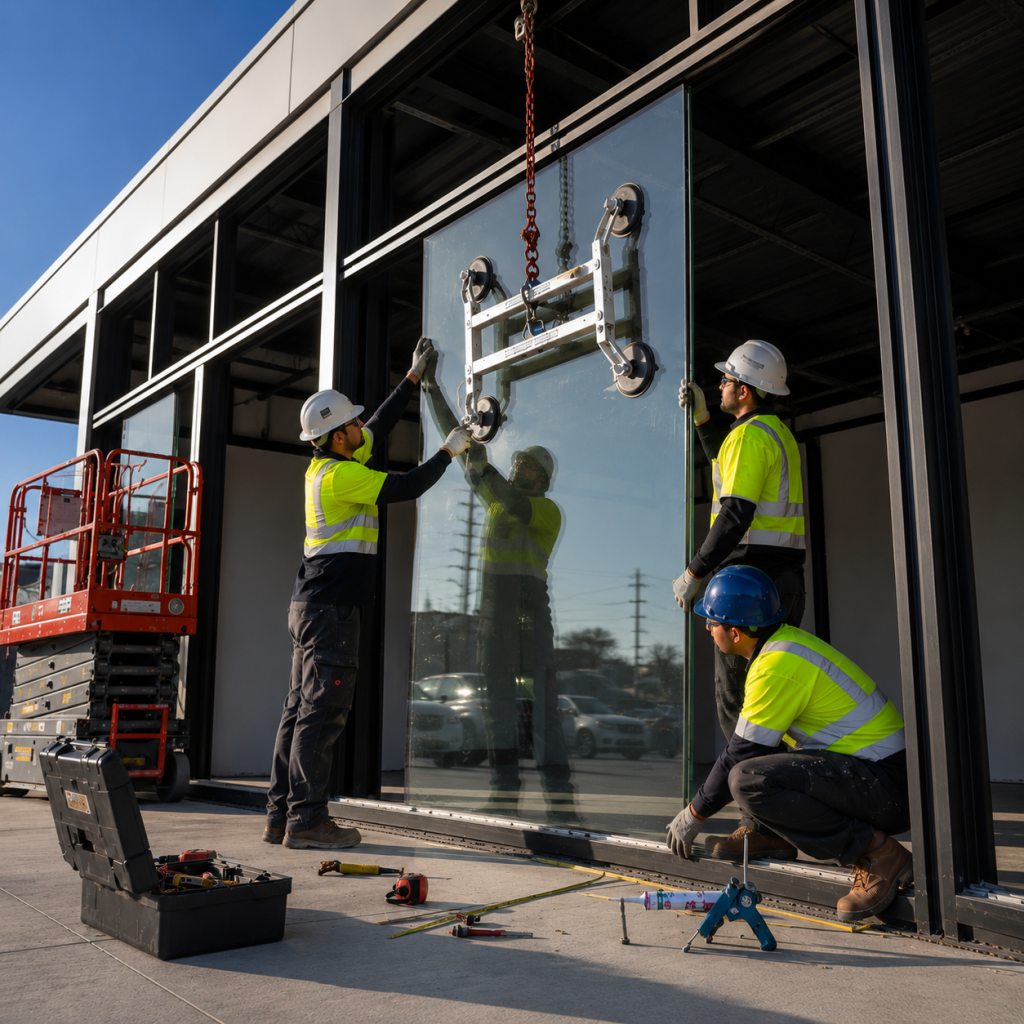
Privacy Glass & Film
Transparency isn’t appropriate everywhere.
Tenant improvements may require privacy around:
Executive → HR → Finance → Medical → Technical → Conference
Options can include:
- Frosted film
- Gradient film
- Decorative patterns
- Laminated decorative glass
- Patterned glazing
- Switchable privacy systems
Film can be particularly useful when existing clear glass is otherwise worth preserving.
Commercial Storefront Tenant Improvements
Commercial storefront creates another large opportunity across Colorado Springs, Fort Collins, and Salt Lake City.
Second-generation properties often inherit aluminum storefront from previous occupants:
- Retail spaces
- Restaurants
- Medical offices
- Banks
- Fitness centers
- Professional offices
A new tenant creates a question about whether to repair, modify, or replace.
Evaluate the Existing Storefront First
Inspect:
Framing → Glass → Doors → Hardware → Thresholds → Weather Seals → Perimeter Sealants → Accessibility → Security
A major interior renovation does not automatically require complete storefront replacement.
Sometimes the storefront is one of the most reusable components of the property.
Component Failure vs Storefront System Failure
This distinction matters.
A broken glass lite is a component problem.
A failed closer is a component problem.
A fogged IGU may be a component problem.
But widespread problems may indicate a system-level issue:
- Framing deterioration
- Water intrusion
- Glass failure
- Entrance problems
- Security deficiencies
The glazing contractor can help the TI team determine which condition actually exists.
Failed Insulated Glass
Fogged or cloudy insulated glass can undermine an otherwise successful commercial renovation.
A tenant may receive:
New Flooring + New Lighting + New Furniture + New Interior Glass
while the exterior still contains visibly failed IGUs.
If the surrounding framing remains serviceable, selective glass replacement can improve the property’s appearance without complete storefront replacement.
Medical Office Tenant Improvement Glass
Healthcare is an important overlap among all three markets.
Medical glazing may be used around:
- Reception
- Administrative offices
- Conference rooms
- Staff areas
- Interior entrances
- Consultation spaces
Medical TI introduces a different balance:
Daylight + Privacy + Safety + Accessibility + Cleaning
The appropriate glass solution may change from one portion of the facility to another.
Retail & Restaurant TI Glass
Retail storefronts connect:
Traffic → Visibility → Merchandise → Entrance
Restaurants connect:
Traffic → Visibility → Activity → Atmosphere
Potential restaurant glazing can include:
- Exterior storefront
- Commercial entrances
- Vestibules
- Private dining glass
- Wine rooms
- Mirrors
- Patio glazing
- Operable systems
Salt Lake City offers the largest regional volume of the three.
Colorado Springs offers a strong retail, hospitality, and restaurant environment.
Fort Collins adds a distinctive restaurant, brewery, hospitality, and mixed-use market.

Commercial Entrance Systems
Entrances deserve to be considered separately from storefront.
A commercial entrance can include:
- Aluminum doors
- All-glass doors
- Sidelites
- Transoms
- Closers
- Continuous hinges
- Pivots
- Panic hardware
- Automatic operators
- Electrified hardware
An entrance isn’t simply a glazed opening.
It is a continuously operating building system.
Access Control & TI Glass Doors
Modern offices, technical facilities, healthcare environments, and industrial properties increasingly require electronic access.
That creates a coordination chain:
Glazing Contractor → General Contractor → Hardware → Electrical → Security Integrator
An opening may require:
- Card readers
- Electric strikes
- Magnetic locks
- Door-position switches
- Request-to-exit devices
- Automatic operators
These requirements should be established before door and framing fabrication.
Spec Suite Glazing
Speculative office suites can create repeatable glazing work in all three markets.
Ownership may install:
- ✓ Conference rooms
- ✓ Office fronts
- ✓ Reception glazing
- ✓ Glass doors
- ✓ Privacy film
That work can be completed before the final tenant signs.
It transforms an empty suite into a workplace a prospective tenant can immediately understand.
Salt Lake City’s larger office corridor gives it the greatest regional scale.
Colorado Springs can use spec suites to reposition existing professional office inventory.
Fort Collins can apply the same approach to office, technology, medical, and flex environments.
Warehouse Office Glass Is a TI Market of Its Own
Industrial buildings deserve particular attention.
A 200,000-square-foot warehouse might contain only 15,000 square feet of administrative space.
But those 15,000 square feet can require:
Storefront + Entrance + Reception + Offices + Conference Rooms + Training + Operations Glass
For the commercial glazing contractor, the smallest portion of the building may contain most of the architectural glass.
This is especially relevant in Fort Collins and Salt Lake City’s industrial corridors, while Colorado Springs adds aerospace, defense, and manufacturing applications.
Tenant Improvement Glass Value Engineering
The strongest value engineering question isn’t how to make the glass cheaper.
It is where glass creates the most value for this tenant.
Prioritize high-impact areas.
Reception
Strong architectural visibility.
Conference Rooms
Frequent use and high tenant value.
Perimeter Offices
Daylight transfer.
Entrances
Appearance, security, accessibility, and operation.
Specialized Spaces
Privacy, acoustics, observation, or security.
Then evaluate secondary areas more aggressively.
Colorado Springs TI Glazing Strategy
Colorado Springs rewards:
Assess → Reuse → Specialize → Secure
The contractor should understand when a conventional office-glass solution is appropriate and when the tenant requires something more specialized.
Fort Collins TI Glazing Strategy
Fort Collins rewards:
Integrate → Adapt → Observe → Connect
Commercial glass can bridge the architectural gap between offices, research, manufacturing, and operations.
Salt Lake City TI Glazing Strategy
Salt Lake City rewards:
Standardize → Repeat → Expand → Scale
The Wasatch Front provides a strong environment for contractors capable of delivering consistent glazing packages across multiple commercial submarkets.
Commercial Glass Fabrication & TI Scheduling
All three markets share the same construction problem.
Glass is installed late but needs to be planned early.
A simplified sequence is:
Design → Framing → Drywall → Finished Opening → Field Measure → Fabrication → Installation → Hardware → Punch
If the finished opening is late, field measurement is late.
If field measurement is late, fabrication is late.
Then glass becomes one of the final obstacles to tenant occupancy.
General contractors should therefore track the glass release date, not simply the glass installation date.
Flooring, Ceiling & Full-Height Glass Coordination
Interior glass can interact with:
- Flooring thickness
- Finished-floor elevations
- Thresholds
- Bottom channels
- Floor closers
- Ceiling grids
- Structural headers
- Deflection
- Lighting
- Sprinklers
- Mechanical systems
The more architectural the glazing system becomes, the earlier coordination needs to occur.
Glass may be installed late. It should never be designed late.
Multi-Market Tenant Improvement Glass Programs
The three markets become more interesting when they are viewed as regional anchors rather than isolated cities.
Colorado Springs anchors:
Colorado Springs → Monument → Castle Rock → Denver
Fort Collins anchors:
Fort Collins → Loveland → Windsor → Greeley → Denver
Salt Lake City anchors:
Salt Lake City → Murray → Sandy → Draper → Lehi → Provo
That creates the foundation for a much larger commercial glazing footprint:
Northern Colorado → Denver → Colorado Springs → Salt Lake City / Wasatch Front
A property owner, general contractor, retailer, healthcare organization, industrial company, or corporate tenant operating across these markets can potentially establish common standards for:
- Storefront
- Office fronts
- Conference rooms
- Doors
- Hardware
- Privacy
- Commercial entrances
That turns individual glass projects into a regional tenant improvement glazing program.
Colorado Springs vs Fort Collins vs Salt Lake City — Which TI Glass Market Is Best?
Colorado Springs is the strongest market for specialized TI.
Its combination of:
Defense + Aerospace + Healthcare + Technology + Commercial Office
creates opportunities where privacy, security, access control, and specialized performance can become particularly important.
Fort Collins — Best for Office and Technical Integration
Its combination of:
Research + Technology + Manufacturing + Healthcare + Industrial
creates unusual opportunities where architectural glass connects office and operational environments.
Salt Lake City — Best for Regional Scale
The Wasatch Front provides the largest connected commercial market of the three.
Its combination of:
Corporate + Technology + Healthcare + Industrial + Logistics + Retail
creates strong opportunities for repeatable tenant improvement glazing programs.
Three Markets, Three Tenant Improvement Glass Strategies
The clearest distinction is:
Colorado Springs
Specialized Tenant → Specialized Buildout → Security / Privacy / Performance Glass
Fort Collins
Research & Industry → Office / Operations Integration → Technical Commercial Glass
Salt Lake City
Regional Growth → Leasing & Expansion → Repeatable Tenant Improvements → Standardized Commercial Glass
For commercial glass contractors, office buildout contractors, general contractors, property owners, developers, architects, and facility managers, the strongest strategy across all three markets remains remarkably consistent:
Survey Existing Glass → Preserve What Has Value → Coordinate Storefront & Entrances → Design Interior Glass Around the Tenant → Resolve Privacy, Acoustics, Security & Access Control Early → Standardize Repeatable Openings → Release Fabrication Before It Threatens Occupancy
Together, Colorado Springs, Fort Collins, and Salt Lake City create a compelling Mountain West tenant improvement glass corridor where commercial glazing moves far beyond basic storefront installation into office modernization, industrial buildouts, healthcare TI, research facilities, security-sensitive environments, corporate interiors, and long-term commercial property improvement.