
Denver to Dallas — Commercial Glass & Tenant Improvement Glazing Markets
Denver to Dallas — Commercial Glass, Tenant Improvement Glazing & Office Buildout Markets
Denver to Dallas is more than a city-to-city comparison. It is a commercial construction corridor connecting the Mountain West, Southern Plains, and North Texas through a series of growing office, industrial, retail, healthcare, hospitality, and logistics markets.
For commercial glass contractors, tenant improvement contractors, general contractors, developers, property managers, architects, and facility teams, the opportunity stretches well beyond Denver and Dallas themselves.
The corridor can be viewed as:
Denver → Colorado Springs → Pueblo → Amarillo → Lubbock → Fort Worth → Dallas
And depending on the contractor network, it can also connect laterally into:
Oklahoma City → Albuquerque → Salt Lake City
That makes the Denver-to-Dallas route particularly valuable for a commercial glazing strategy built around:
Storefront → Commercial Entrances → Office Glass → Conference Rooms → Industrial Office Buildouts → Building Repositioning → Specialty Glazing
Regional TI Glazing Contractors Overview
Denver to Dallas Commercial Glass & TI Markets
Dallas, OKC & Denver Storefront & TI Glazing
Colorado Springs, Fort Collins & SLC
Regional TI Glazing Contractors Overview TI Glass
Denver, SLC & Dallas Office Glass & TI Glazing
Dallas, OKC & Albuquerque Commercial Glass & TI
Colorado Regional TI Glazing Contractors
SLC vs Dallas: Class A Office Glass & TI
Colorado Springs vs Albuquerque Storefront & TI
Dallas vs Denver: Office Buildout & TI Glass
OKC vs Albuquerque Commercial Glass & TI
Fort Collins vs SLC Office Glass & TI Markets
Denver vs Dallas Commercial TI Glazing
Denver and Dallas sit at opposite ends of the corridor, but they create demand differently.
Denver = Reposition + Modernize + Reuse
Dallas = Build + Expand + Standardize
Denver has a larger emphasis on existing-building competition, second-generation office renovation, Class A repositioning, spec suites, adaptive reuse, and selective commercial modernization.
Dallas has the stronger scale story—corporate relocations, headquarters projects, industrial expansion, multi-floor office buildouts, retail, healthcare, and repeatable portfolio construction.
The corridor in between creates another category:
Regional Commercial Expansion + Industrial TI + Storefront Renovation
| Commercial Glass Opportunity | Denver / Front Range | Central Corridor | Dallas-Fort Worth |
|---|---|---|---|
| Office tenant improvements | Exceptional | Strong | Exceptional |
| Interior office glass | Exceptional | Strong | Exceptional |
| Class A office glazing | Exceptional | Limited | Exceptional |
| Commercial building repositioning | Exceptional | Strong | Very strong |
| Commercial storefront TI | Exceptional | Very strong | Exceptional |
| Retail storefront renovation | Exceptional | Very strong | Exceptional |
| Restaurant buildout glass | Exceptional | Strong | Exceptional |
| Medical office TI | Very strong | Very strong | Exceptional |
| Industrial office buildouts | Very strong | Very strong | Exceptional |
| Warehouse office glass | Very strong | Very strong | Exceptional |
| Security glazing | Strong | Very strong | Very strong |
| Spec-suite glazing | Exceptional | Strong | Exceptional |
| Existing glass reuse | Exceptional | Major opportunity | Major opportunity |
| Multi-market TI programs | Very strong | Strong | Exceptional |
Denver Commercial Glass & Tenant Improvement Contractors
Denver remains one of the strongest markets for existing-office renovation and commercial property repositioning.
A tenant or building owner may be working with:
- Older Class A office
- Second-generation corporate space
- Vacant spec suites
- Retail storefronts
- Medical offices
- Restaurants
- Industrial buildings
- Mixed-use properties
The commercial glass package can therefore include both renovation and new construction.
A typical sequence may be:
Existing Glass Survey → Selective Demolition → Interior Office Glass → Entrance Modernization → Storefront Repair → Tenant Occupancy
Denver rewards glazing contractors that know how to work intelligently with what is already there.
Dallas Commercial Glass & Tenant Improvement Contractors
Dallas rewards a different capability in sheer scale.
A DFW tenant improvement can include:
- Hundreds of glass office fronts
- Multiple boardrooms
- Conference centers
- Reception glazing
- Commercial storefronts
- Automatic entrances
- Access-controlled doors
- Interior architectural glass
The contractor may need to execute the same glazing details repeatedly across several floors or buildings.
That makes standardization extremely important.
Think:
Standard Detail → Standard Door → Standard Hardware → Repeat Across Project
Dallas offers more opportunities where glazing becomes a major subcontractor package rather than a collection of isolated glass openings.
The Markets Between Denver and Dallas Matter
The corridor is not empty between the two anchor metros.
Commercial projects can occur throughout:
- Colorado Springs
- Pueblo
- Amarillo
- Lubbock
- Fort Worth
- North Texas industrial corridors
Each market creates different types of TI work.
A regional contractor might encounter a medical-office renovation in Colorado Springs, a warehouse-office buildout in Amarillo, a retail storefront renovation in Lubbock, and a corporate TI in Dallas.
The glass systems overlap enough that a contractor network can create repeatable standards across markets.
Denver vs Colorado Springs Commercial Glazing
Albuquerque vs SLC Commercial Glass & TI
Dallas vs OKC Commercial TI & Buildout Markets
Colorado Springs vs Fort Collins TI & Office Glass
Denver vs SLC Commercial Glass & TI Glazing
Denver vs Dallas TI Glazing & Commercial Glass
Dallas TI Glass & Commercial Glazing
Albuquerque Commercial Glass & TI Contractors
OKC TI Glazing & Storefront Contractors
Salt Lake City Commercial TI & Office Glass
Fort Collins TI Glass & Commercial Glazing
Colorado Springs Commercial Glass & TI Glazing
Denver Tenant Improvement Glazing Contractors
Colorado Springs as the Southern Colorado TI Hub
Colorado Springs introduces:
Defense + Aerospace + Healthcare + Professional Office + Industrial
That can create glazing requirements involving:
- Interior office fronts
- Conference rooms
- Controlled entrances
- Security glazing
- Medical office glass
- Storefront systems
- Industrial office buildouts
This is where the Denver-to-Dallas corridor begins shifting from large metropolitan office renovation toward more specialized tenant improvement work.
Pueblo and Secondary-Market Glazing
Smaller commercial markets should not automatically be dismissed.
Pueblo and similar secondary cities can produce recurring:
- Medical office renovations
- Retail storefront replacement
- Restaurant buildouts
- Government-related work
- Industrial office TI
- Professional-office renovations
These projects may be smaller individually but can be attractive because competition among specialized commercial glazing contractors may also be lower.
For a regional network, secondary cities can fill the gaps between major metros.
Amarillo Commercial Glass & TI Opportunity
Amarillo can serve as another regional node.
Commercial demand may come from:
- Healthcare
- Logistics
- Industrial
- Distribution
- Retail
- Hospitality
- Professional offices
This creates strong applications for:
Storefront + Commercial Doors + Warehouse Offices + Medical TI Glass
For glazing contractors, industrial-office buildouts can be especially valuable because large warehouse and distribution facilities still require architecturally finished administrative areas.
Lubbock Commercial Glass & Tenant Buildouts
Lubbock adds:
- Healthcare
- Education
- Professional services
- Retail
- Restaurants
- Industrial
- Regional corporate users
Commercial glazing opportunities can include:
- Storefront renovation
- Office partitions
- Conference rooms
- Medical entrances
- Interior glass
- Retail doors
- Hospitality glazing
The market may not generate Dallas-sized projects, but it can support steady repeat commercial work.
Fort Worth Is Not Just an Extension of Dallas
Fort Worth deserves to be treated as its own commercial TI market.
The western side of DFW can generate:
- Corporate offices
- Industrial campuses
- Warehouses
- Manufacturing facilities
- Healthcare
- Retail
- Hospitality
- Mixed-use development
For commercial glass contractors, the Dallas-to-Fort Worth region creates a massive combined addressable market.
The sequence can become:
Fort Worth → Arlington → Irving → Las Colinas → Dallas → Plano → Frisco
That is a commercial glazing ecosystem by itself.
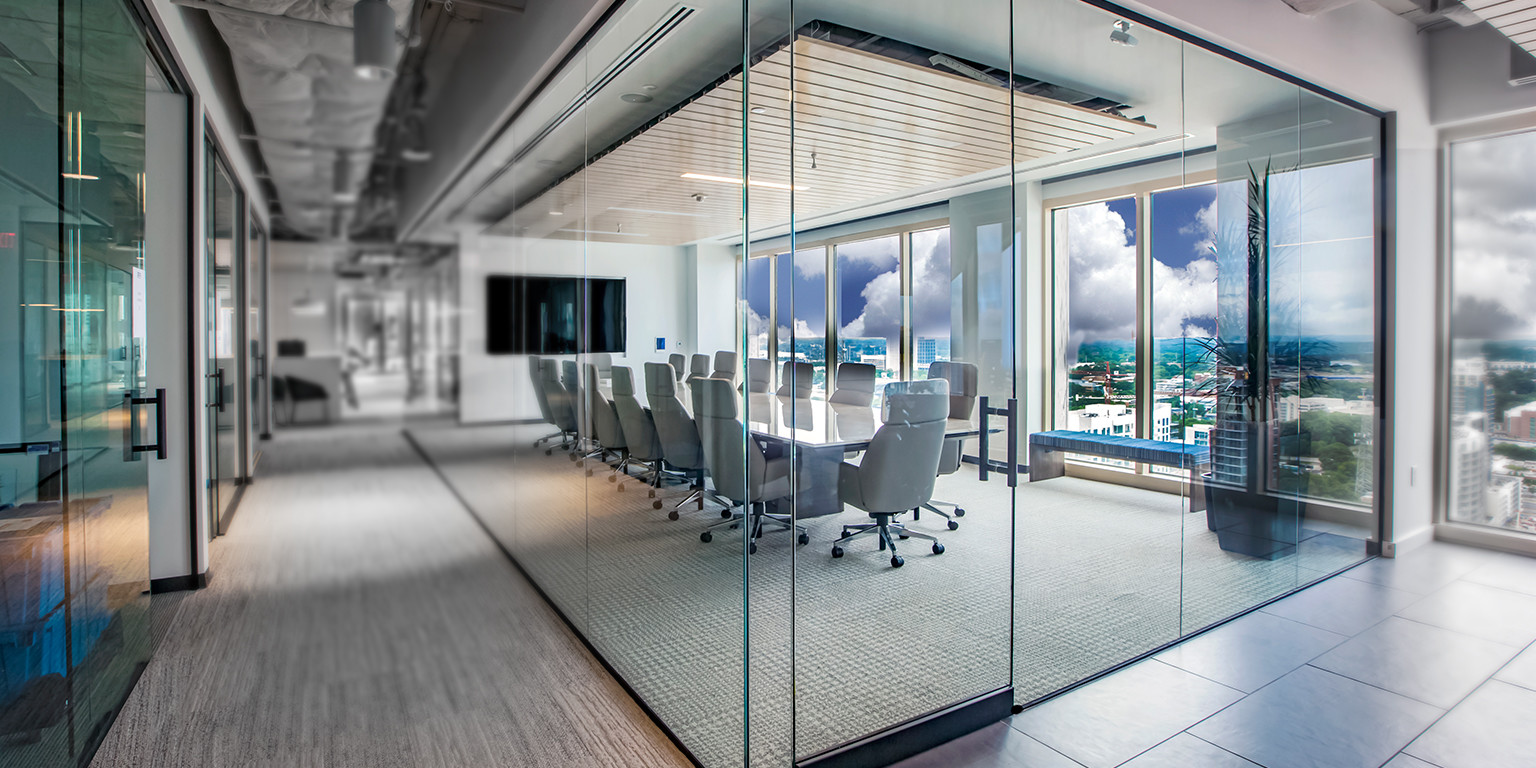
Office Glass Across the Denver-to-Dallas Corridor
Interior office glazing remains one of the most transferable TI categories across every market.
Applications include:
- Private office fronts
- Executive offices
- Conference rooms
- Boardrooms
- Huddle rooms
- Reception glazing
- Collaboration spaces
- Training rooms
The architecture may differ, but the planning issues remain consistent.
The glass contractor still needs to coordinate:
- Dimensions + Framing + Door + Hardware + Privacy + Acoustics
- Conference Room Glass
Conference rooms often become one of the most visible parts of a commercial tenant improvement.
The full system may involve:
Fixed Glass → Framing → Door → Hardware → Privacy → Acoustic Strategy
A visually impressive room can still fail if conversations are easily heard outside.
That means the glazing contractor should understand whether the space is intended for:
- Casual collaboration
- Executive meetings
- HR
- Legal
- Financial discussions
- Medical consultation
- Confidential technical work
The required glass system can change accordingly.
Existing Glass Before Demolition
This is one of the most important opportunities throughout the corridor.
Second-generation office spaces frequently contain:
- ✓ Conference rooms
- ✓ Office fronts
- ✓ Glass doors
- ✓ Sidelites
- ✓ Reception glazing
- ✓ Mirrors
- ✓ Interior storefront
- ✓ Exterior storefront
Before demolition, those components should be evaluated.
The previous tenant may be gone.
The glass may still be perfectly usable.
Reusing Tempered Glass
Tempered architectural glass generally cannot simply be cut to a new dimension after fabrication.
That makes reuse a planning exercise.
The better sequence is:
Survey → Measure → Compare With New Floor Plan → Preserve Compatible Glass → Fabricate the Rest
Not every panel will fit.
But partial reuse can still reduce demolition, disposal, fabrication, and installation.
For landlords managing repeat tenant turnover, this can become a real portfolio strategy.
Denver Reuse vs Dallas Standardization
The two anchor markets suggest different strategies.
Denver
Think:
Survey → Preserve → Retrofit → Reposition
Dallas
Think:
Standardize → Fabricate → Repeat → Scale
Denver often rewards intelligent adaptation of existing systems.
Dallas often rewards consistency across larger quantities.
A regional contractor needs to be comfortable doing both.
Commercial Storefront Along the Corridor
Storefront TI is another highly repeatable category.
Retail, restaurant, medical, financial, fitness, and office tenants continually inherit existing storefront systems.
The first question should be whether the storefront needs replacement or simply modernization.
Evaluate:
- Aluminum framing
- Glass
- IGUs
- Entrance doors
- Closers
- Hardware
- Thresholds
- Weather seals
- Perimeter sealants
- Accessibility
- Security
- Component Failure vs System Failure
A single failed component should not automatically trigger full replacement.
Examples of component problems:
- Broken glass
- Failed closer
- Fogged IGU
- Damaged sweep
- Worn weather seal
System-level problems may include:
- Broad framing deterioration
- Chronic leakage
- Widespread IGU failure
- Major entrance reconfiguration
- Structural or anchorage issues
- Security deficiencies
This distinction matters whether the project is in Denver, Amarillo, Fort Worth, or Dallas.
Retail Storefront TI
Retail glazing follows a simple commercial sequence:
Traffic → Storefront → Merchandise → Entrance → Sales Floor
The storefront becomes part of the tenant’s marketing environment.
A new retailer may want to:
- Increase transparency
- Relocate doors
- Remove old graphics
- Upgrade security
- Add larger display areas
- Replace damaged glass
The glass contractor should therefore be involved before the merchandising plan is finalized.
Restaurant Buildout Glass
Restaurants use storefront differently.
The sequence becomes:
Traffic → Storefront → Activity → Atmosphere → Entrance
The glass shows the restaurant itself.
Potential scopes include:
- Exterior storefront
- Vestibules
- Commercial doors
- Private dining glass
- Wine-room glass
- Bar mirrors
- Patio glazing
- Operable systems
Dallas and Denver provide the largest restaurant volume, but the same scope can appear in Colorado Springs, Amarillo, Lubbock, and Fort Worth.
Medical Office TI Glass
Healthcare is one of the most consistent commercial construction categories along the route.
Medical glazing can include:
- Automatic entrances
- Reception glass
- Administrative offices
- Conference rooms
- Interior doors
- Staff spaces
- Privacy glass
The design needs to balance:
Daylight + Privacy + Accessibility + Safety + Cleaning
This makes medical TI more specialized than standard office glass.
Industrial Tenant Improvement Glazing
Industrial construction may be the biggest hidden opportunity across the entire Denver-to-Dallas corridor.
A warehouse can look like a low-glass building from the outside.
Inside, the office portion can include:
Employee Entrance → Reception → Offices → Conference Rooms → Training → Operations → Warehouse
Potential glazing includes:
- Exterior storefront
- Employee entrances
- Glass office fronts
- Conference rooms
- Observation windows
- Safety glazing
The corridor contains an enormous amount of industrial, manufacturing, distribution, and logistics space.
That means industrial TI glass should be treated as a major category rather than a secondary one.
Dallas Industrial Scale
Dallas has the strongest industrial volume.
Large logistics and distribution portfolios can create repeat packages across multiple buildings:
Warehouse Office + Storefront + Entrances + Interior Glass
That is ideal for standardized glazing programs.
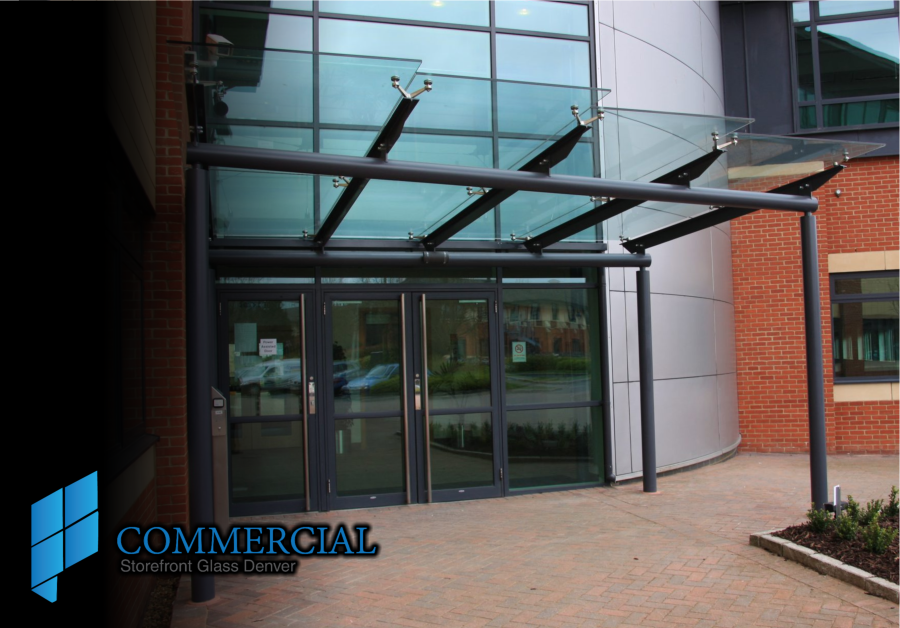
Denver Industrial TI
Denver also offers substantial warehouse, manufacturing, distribution, and flex-space opportunities.
Its advantage is that many projects involve both new industrial TI and existing industrial reconfiguration.
The glazing contractor may need to work with existing storefront and office systems rather than starting from a shell.
Secondary-Market Industrial Glass
Markets between the two anchors can be especially interesting for:
- Warehouse office buildouts
- Employee entrances
- Safety glazing
- Operations windows
- Interior storefront
A contractor network does not need a 50-story office tower to create valuable TI glazing work.
A 250,000-square-foot distribution facility with a 20,000-square-foot office component can provide a substantial commercial-glass package.
Commercial Entrance Systems
Entrance work is another corridor-wide opportunity.
A commercial entrance may include:
- Aluminum doors
- All-glass doors
- Sidelites
- Transoms
- Closers
- Continuous hinges
- Pivots
- Panic hardware
- Automatic operators
- Electrified hardware
Entrances should be treated as operating systems.
They affect the building long after the buildout is complete:
Accessibility + Security + Weather Protection + Traffic + Maintenance
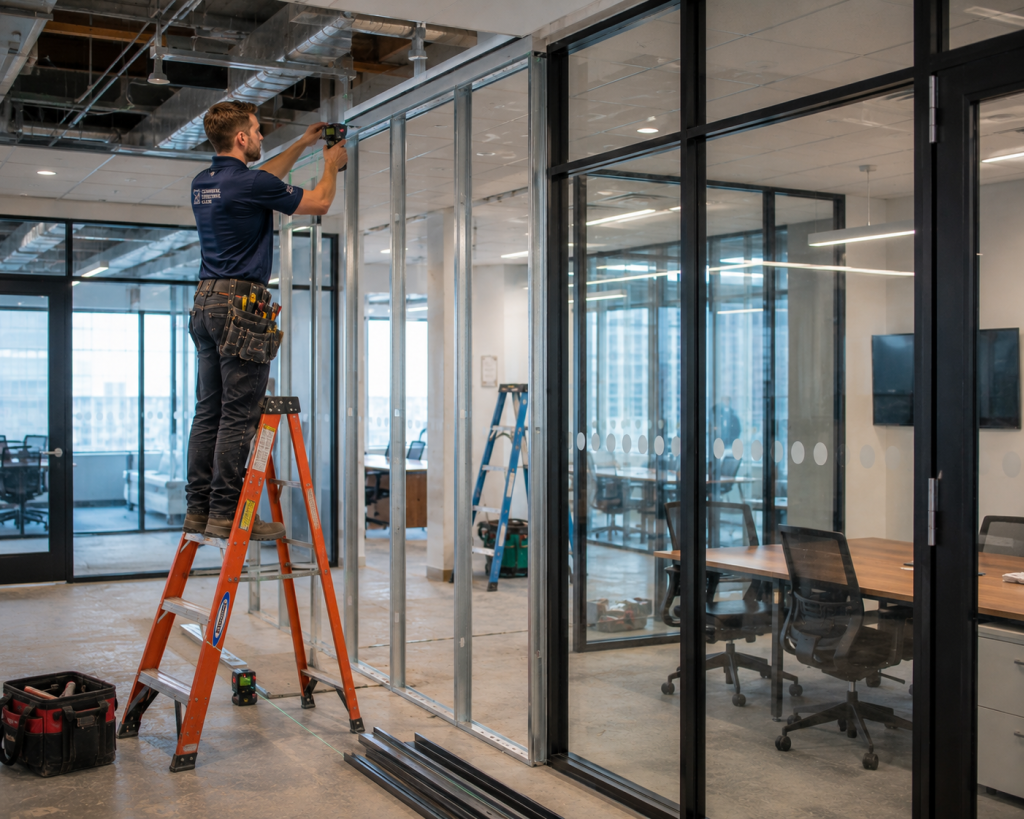
Access Control & Glass Doors
Modern offices, medical properties, industrial facilities, and corporate campuses increasingly require electronic access.
That creates a trade coordination sequence:
Glazing Contractor → General Contractor → Hardware → Electrical → Security Integrator
The opening may require:
- Electric strikes
- Card readers
- Magnetic locks
- Door-position sensors
- Automatic operators
- Request-to-exit devices
These requirements need to be resolved before fabrication.
Security Glazing Across the Corridor
Some projects may require enhanced security at:
- Corporate facilities
- Financial offices
- Healthcare
- Defense-related tenants
- Industrial operations
- High-value retail
The key principle remains that a security glass product is not the same thing as a security system.
The performance of an opening may depend on:
Glass + Framing + Anchorage + Door + Hardware + Adjacent Construction
The required objective should be established before specifying products.
Commercial Building Repositioning
Denver has the strongest repositioning story, but the strategy can work in every market.
An older commercial property may be modernized through:
Entrance → Lobby → Storefront → Spec Suite → Interior Glass
Instead of rebuilding the complete structure, ownership upgrades the spaces tenants interact with most.
This can apply to:
- Office buildings
- Medical properties
- Retail centers
- Mixed-use assets
- Professional buildings
- Spec Suite Glazing
Spec suites can create highly repeatable commercial glass work.
Ownership may install:
- ✓ Conference rooms
- ✓ Glass office fronts
- ✓ Reception glazing
- ✓ Glass doors
- ✓ Privacy film
That work can be completed before a tenant signs.
Denver and Dallas offer the greatest volume.
Smaller markets can still benefit because move-in-ready space may help landlords differentiate older commercial inventory.
Commercial Glass Value Engineering
Value engineering should not start by asking how to reduce the glass.
It should start by asking where glass creates the most value.
Storefront
Visibility and building performance.
Entrance
Accessibility, security, and daily operation.
Reception
High architectural impact.
Conference Rooms
Frequent use and visibility.
Perimeter Offices
Daylight transfer.
Specialized Spaces
Privacy, acoustics, observation, or security.
Then secondary glazing can be challenged more aggressively.
Denver-to-Dallas TI Glass Scheduling
The scheduling rule is the same across the entire corridor.
Glass is installed late but needs to be planned early.
A typical process may be:
Design → Framing → Drywall → Finished Openings → Field Measure → Fabrication → Installation → Hardware → Punch
If finished openings are late, measurement becomes late.
If measurement is late, fabrication becomes late.
Then glass becomes one of the final obstacles to tenant occupancy.
General contractors should track the glass release date, not simply the glass installation date.
Exterior Storefront and Interior Glass May Need Different Schedules
One project can actually contain multiple glazing timelines.
For example:
Storefront Framing → Exterior Glass → Commercial Entrance → Interior Office Glass → Glass Doors → Hardware → Punch
Treating all glazing as one late-stage subcontractor scope can create avoidable scheduling problems.
Denver-to-Dallas Multi-Market Contractor Programs
The larger strategic opportunity is creating repeatable glazing standards across markets.
A property owner, healthcare operator, retailer, restaurant group, industrial portfolio, or corporate tenant may operate in:
Denver + Colorado Springs + Amarillo + Fort Worth + Dallas
Instead of redesigning every glazing package independently, the organization can standardize:
- Storefront systems
- Interior office fronts
- Conference-room details
- Doors
- Hardware
- Privacy
- Entrance systems
This makes multi-market contractor relationships much more valuable.
Denver to Dallas — Different Markets, One Commercial Glass Network
The corridor can be divided into three construction environments.
Denver and the Front Range
Repositioning + Existing-Space Renovation + Office TI + Industrial
The Central Corridor
Regional Healthcare + Retail + Industrial + Warehouse Office TI
Dallas-Fort Worth
Corporate Scale + Industrial Expansion + Class A Office + Portfolio Buildouts
Each requires a slightly different contractor strategy.
But the glazing fundamentals remain remarkably consistent.
The Commercial Glass Opportunity From Denver to Dallas
For commercial glazing contractors, office buildout contractors, tenant improvement contractors, developers, property managers, architects, and facility managers, the Denver-to-Dallas market is not simply about connecting two large cities.
It is about building a repeatable commercial-glass system across a broad regional construction corridor.
The strongest approach is:
Survey Existing Glass → Determine Repair vs Replacement → Preserve What Has Value → Coordinate Storefront & Entrances Early → Design Office Glass Around the Tenant → Resolve Privacy, Acoustics & Security → Standardize Repeating Systems → Release Fabrication Before Occupancy Is at Risk
Denver provides the repositioning and retrofit engine.
Dallas provides the scale and expansion engine.
The cities and industrial corridors in between provide the regional connective tissue.
Together, they create a commercial glazing market that can support everything from storefront repair and small office renovations to multi-floor corporate interiors, warehouse office buildouts, medical tenant improvements, security glazing, commercial entrances, and portfolio-wide TI programs.